 BirthstoneMeaning
 Aries Birthstone
 Taurus Birthstone
 Gemini Birthstone
 Cancer Birthstone
 Leo Birthstone
 Virgo Birthstone
 Libra Birthstone
 Scorpio Birthstone
 Sagittarius Birthstone
 Capricorn Birthstone
 Aquarius Birthstone
 Pisces Birthstone
 Peridot Meaning
 Garnet Meaning
 Amethyst Meaning
 Aquamarine Meaning
 Diamond Meaning
 Emerald Meaning
 Pearl Meaning
 Ruby Meaning
 Blue Sapphire Meaning
 Opal Meaning
 Topaz Meaning
 Turquoise Meaning
 Moonstone Meaning
 Tourmaline Meaning
 Citrine Meaning
 Tanzanite Meaning
 Alexandrite Meaning
 Spinel Meaning
 Sardonyx Meaning
 Zircon Meaning
 Lapis Lazuli Meaning
 Rose Quartz Meaning
 Onyx Meaning
 Labradorite Meaning
 Malachite Meaning
 Jade Meaning
 Agate Meaning
 Carnelian Meaning
 Clear Quartz Meaning
 Black Tourmaline Meaning
 Smoky Quartz Meaning
 Sodalite Meaning
 Obsidian Meaning
 Fluorite Meaning
 Selenite Meaning
 Hematite Meaning
 Howlite Meaning
 September Birthstone
Hematite Meaning and Healing Properties Explained
The hematite meaning centers on extreme physical grounding and protective energy. Modern practitioners use this dense iron oxide to anchor scattered thoughts and foster intense mental focus. Crystal healers frequently apply the dark metallic stone to the Root chakra to promote emotional stability during chaotic life events.
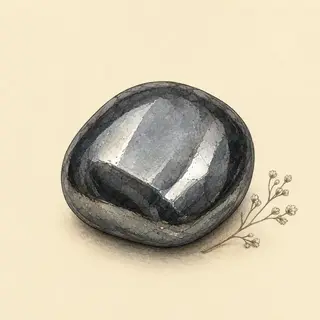
| Chakra | Root (Muladhara) |
| Element | Earth |
| Zodiac | Aries |
| Color | Metallic gray, Black, Reddish-brown, Silver |
What Is the Traditional Spiritual Hematite Meaning?
George Frederick Kunz documented rich cultural beliefs surrounding this iron ore in his 1913 book. He noted that the famous 1st-century Roman naturalist Pliny the Elder cited an even older gem-treatise writer named Azchalias (Kunz, p. 80). Azchalias taught that holding the stone as a talisman procured a favorable hearing from kings and ensured fortunate outcomes in lawsuits. Traditional beliefs closely linked the mineral to Mars, the Roman god of war. Ancient soldiers considered it an invaluable aid on the battlefield, rubbing their bodies with the red-streaking stone in an attempt to confer physical invulnerability (Kunz, p. 81). In ancient Egypt, practitioners placed high value on the stone's perceived protective qualities. The Ebers Papyrus, a famous medical text dated to roughly 1550 BC, recommended using astringent substances like lapis lazuli for eye salves, while deploying hematite to check hemorrhages and reduce inflammation (Kunz, p. 367). By the 17th century, court physician Anselmus de Boot similarly claimed the mineral could stop bleeding when applied directly to the body, though he cautioned that many virtues ascribed to gems were completely false (Kunz, p. 6). Today, historians view these ancient medical applications as early folklore.
In modern crystal healing practice, practitioners value this metallic mineral as an intense anchor for the emotional body. Crystal workers traditionally believe the heavy iron content pulls scattered, anxious energy downward into the earth. Energy healers commonly rest the stone low near the tailbone during sessions aimed at building that same profound emotional stability. Many people carry a tumbled piece in their pocket when facing stressful work environments or difficult personal conflicts. Practitioners claim this provides a stable, unshakeable energetic foundation. The stone is traditionally believed to absorb chaotic vibrations from your surroundings and neutralize them before they affect your mood. Crystal texts suggest it helps you maintain clear boundaries with demanding people. Energy workers also use the mineral to address feelings of spatial disorientation or day-dreaming. Traditional crystal practice positions it as a practical tool for keeping your mind focused on present physical reality. Healers recommend holding a heavy piece of the stone in your palm when you need to make purely logical decisions devoid of emotional interference.
Zodiac Connection
Astrological tradition strongly pairs this mineral with the zodiac sign Aries. This connection comes from a direct historical link to the Roman god of war, Mars. Aries is the astrological sign ruled by Mars. As George Frederick Kunz documented, ancient warriors rubbed the red-streaking iron ore on their bodies to gain battlefield invulnerability. Modern practitioners use this aggressive, Mars-ruled energy to support Aries individuals, traditionally believing it helps ground their impulsive nature while supporting their natural leadership drive.
Traditional crystal practice claims regarding hematite's ability to ground energy lack scientific validation, and the 19th-century reports of the stone causing physical paralysis represent purely historical pseudoscience unverified by modern medicine.
How Do Practitioners Use Hematite in Healing Traditions?
Physical Healing
Physical healing claims regarding this stone require careful historical context. In 1913, George Frederick Kunz documented early 1800s mesmeric and clairvoyant experiments (Kunz, p. 10). During these tests, observers claimed that holding the iron oxide induced a sensation of inner chill and physical paralysis in the clairvoyant subject. You must recognize this claim as 19th-century pseudo-science and historical folklore, completely separate from validated modern medicine. Today, modern crystal healing practitioners traditionally associate the mineral with blood health and circulation, drawing upon its high iron content and red streak. Alternative healers often suggest wearing the stone to theoretically support physical recovery and general bodily strength. When purchasing these items for physical wear, you will frequently encounter "magnetic hematite" bracelets marketed for joint pain. True natural hematite possesses only very weak magnetism. The heavily magnetized products sold in modern jewelry stores consist of a synthetic, man-made ceramic material called hematine. While some people report feeling relief using magnetic hematine jewelry, you are handling a manufactured composite containing added magnets, entirely distinct from the natural Earth-mined mineral.
Emotional & Spiritual Healing
The emotional-healing side of the hematite meaning treats this dense stone as a powerful tool for boundary-setting. In traditional energy practice, the mineral creates a perceived protective shield around the user's personal emotional field. Practitioners recommend keeping a piece nearby if you work as a counselor, teacher, or active caregiver. The tradition holds that the heavy iron frequency prevents you from absorbing the emotional trauma or daily stress of the people around you. Many people incorporate the stone into their daily routines to combat feelings of intense timidity or persistent self-doubt. Crystal healing lore suggests the mineral bolsters self-esteem by deeply grounding your physical presence in any room. Practitioners believe it helps you assert your needs clearly during difficult conversations with authority figures. Energy workers frequently prescribe the dark metallic stone for individuals experiencing severe grief or sudden, unexpected life changes. According to traditional crystal belief, the dense weight of the mineral provides a highly comforting, stabilizing anchor. Healers claim it pulls nervous, fluttering energy out of the upper chest and directs it safely down into the ground.
Chakra Association
In the traditional chakra system, practitioners almost exclusively link this heavy mineral to the Root chakra, also called Muladhara. This energy center sits low at the tailbone and, in tradition, governs your fundamental sense of physical survival, safety, and worldly stability. Crystal healers believe a blocked Root chakra causes severe anxiety, lethargy, and a feeling of disconnect from your physical body. Energy workers traditionally place the dark stone directly over the pelvic floor area during balancing sessions. They believe the mineral's intense Earth element properties pull stagnant energy out of the lower body, re-establishing a firm connection to the physical plane. Practitioners also maintain a strong secondary association between this stone and the Solar Plexus chakra. Situated just above the navel, the Solar Plexus controls personal willpower and raw confidence. While yellow stones typically dominate Solar Plexus work, healers incorporate this iron oxide when a person needs aggressive, warrior-like energy to overcome major obstacles. The tradition asserts that pairing Root chakra grounding with Solar Plexus activation creates a highly focused, determined mindset capable of handling immense stress.
This is tradition and practice, not medical, financial, or life advice.
How Do You Use Hematite Day to Day?
Wearing Hematite
The hematite meaning, worn as daily jewelry, provides a practical way to keep its heavy, grounding energy close to your body. Its Mohs hardness runs 5 to 6.5, so the stone holds up reasonably well for most daily wear. Rings and bracelets remain extremely popular choices among modern crystal practitioners. You must take basic care to avoid striking the stone against hard surfaces, as the polished finish will show wear and fine scratches over years of consistent use. Taking off your jewelry before heavy physical labor preserves the mirror-like metallic luster.
Hematite in Your Home
The home-use side of the hematite meaning places the mineral near the front entrance, aligning with traditional protective crystal practices. Energy workers believe the heavy iron acts as a dense energetic filter, stripping negative or chaotic vibrations off guests as they walk through your door. Many practitioners also set a raw cluster near their desktop computer or home office workspace. Traditional lore suggests the grounding properties help maintain sharp mental focus during complex, detail-oriented work. Placing a polished sphere on your nightstand is often recommended to calm an overactive mind before sleep.
Meditation with Hematite
To utilize the stone during meditation, sit quietly and hold a heavy tumbled piece in each palm. Crystal healers traditionally recommend this bilateral placement to quickly draw racing thoughts down into the physical body. Focus your attention on the dense, cold weight of the mineral resting against your skin. Practitioners believe this specific technique rapidly anchors your awareness in the present moment. Lying flat on the floor with a smooth piece resting near your tailbone is another way practitioners target the Root chakra directly.
Cleansing & Charging
Cleansing this specific mineral requires careful attention to its chemical makeup. Because it is an iron oxide, prolonged water soaking can damage raw or unsealed pieces and degrade the polished surface over time. You should always opt for a dry, soft microfiber cloth or a brief, careful wiping to remove physical dust. Avoid all harsh chemical cleaners entirely. For energetic clearing, modern practitioners recommend placing the stone on a bed of dry coarse sea salt overnight. Passing the mineral through the smoke of dried sage or cedar also provides a safe, moisture-free cleansing method.
Crystal Combinations
Hematite pairs well with these crystals for complementary energy in crystal healing practice:
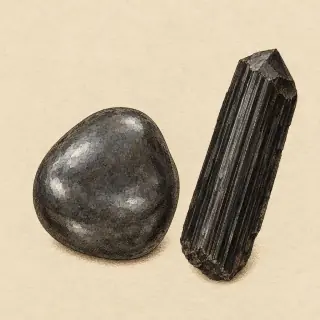
- Black Tourmaline for Crystal healers traditionally combine these two dense stones to create a highly fortified energetic shield against severe environmental stress and negativity.
- Carnelian for Practitioners pair the heavy grounding energy of the iron oxide with this bright orange stone to simultaneously stimulate physical vitality and determined willpower.
Caring for Hematite
Cleaning: Wipe with a soft, dry cloth; avoid water on polished specimens.
Avoid: Avoid water exposure, which causes rust; relatively soft and brittle, so protect from scratches and impacts.
Your crystal profile
Is Hematite Your Birthstone?
Month
Day
Hematite is linked to Aries. Enter your birthday above to see if it matches your sign.
Pairs well with
Hematite at a glance
- Also known as
- kidney ore, specular hematite, iron rose
- Tradition
- Grounding and endurance, per the hematite meaning in modern practice
- Chakra / element
- Root (Muladhara) / Earth
- In one line
- The hematite meaning centers on physical grounding and protective energy, traditionally used to anchor the mind and stabilize the body.
- Try this first
- Hold a polished piece in your non-dominant hand during stressful phone calls to anchor your physical awareness.
- Do not
- Prolonged soaking in water, since this iron-based mineral can degrade or lose its polish with repeated exposure.
Kunz, The Curious Lore of Precious Stones, 1913, p.81
Hematite in Modern Practice
Modern practitioners rely on this dense iron ore for moments demanding physical endurance and extreme mental stability.
Friday at 4:00 PM in a high-stakes legal negotiation.
You sit across the conference table as the opposing counsel pushes an aggressive settlement offer. Your thoughts start to race under the fluorescent lights. Modern crystal practitioners traditionally associate this dark stone with the Root chakra, turning to it for immediate physical grounding when the mind spirals. You keep a smooth piece in your suit pocket. As you press your thumb against its surprisingly dense surface, you focus entirely on the physical weight. In crystal healing practice, this simple tactile anchor helps you pause, stabilize your breathing, and respond with deliberate calm.
Tuesday morning at your cluttered home office desk.
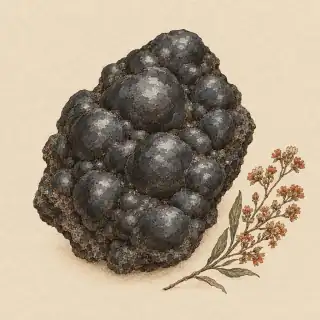
You log into your computer to face 47 unread emails and three conflicting project deadlines. Overwhelm threatens to derail your entire morning before you even type a response. Crystal enthusiasts often use hematite as a stabilizing force to cut through chaotic mental energy. You place a heavy, raw piece of botryoidal kidney ore right between your keyboard and monitor. Tradition suggests this iron-rich mineral draws scattered energy downward, anchoring your focus. You let the heavy metallic luster catch your eye between tasks, using it as a visual reminder to tackle one single email at a time.
Sunday evening packing for a turbulent cross-country flight.
You zip your suitcase in the bedroom, dreading the impending chaos of airport security and the physical discomfort of the long flight ahead. The hematite meaning, in traditional energetic practices, ties this stone to Aries and the martial energy of Mars, and believers lean on it to build personal endurance. You slip a polished tumbled stone into your carry-on bag. During the bumpy ascent over the Rockies, you hold the dense mineral in your palm. Practitioners use this specific physical ritual to draw on the stone's Earth element connection, seeking a deep sense of rooted safety while suspended miles in the air.
Historical Tensions in Hematite Lore
The hematite meaning carries sharp historical disagreements in Kunz's own pages about exactly what powers this iron oxide truly possessed.
The Skeptical Physician vs. The Roman Magician
In his 1913 text, George Frederick Kunz outlines a clear divide in how authorities viewed this mineral. Anselmus de Boot, the 17th-century court physician to Emperor Rudolf II, acknowledged the physical use of the stone for checking hemorrhage (p.6). In the exact same passage, de Boot issued a strict warning that individuals falsely ascribe many magical virtues to gems. Centuries earlier, the ancient writer Azchalias, cited by the 1st-century Roman naturalist Pliny the Elder, made massive supernatural promises. Azchalias taught that a talisman of this stone guaranteed a favorable hearing from kings and assured victory in lawsuits (p.80). A working European physician demanded strict boundaries on the mineral's physical applications. Meanwhile, ancient treatise writers promised limitless social and legal manipulation from the very same stone.
Protecting the Dead vs. Invulnerability for the Living
Kunz reveals another distinct tension regarding who exactly needed the protection of this mineral. In ancient Egypt, practitioners placed the stone with the dead as a solemn funerary object. Kunz notes that crafters typically made the "urs" or pillow amulet out of this dense material (p.227). Priests engraved Chapter 166 of the Book of the Dead on these amulets to command the deceased to rise from non-existence. Conversely, living soldiers treated the stone as an active battlefield shield. Because it is a red oxide of iron associated with Mars, warriors rubbed the mineral directly on their bodies before combat (p.81). They believed this act conferred physical invulnerability against enemy weapons. The stone simultaneously served as a quiet pillow for eternal rest and a bloody, active armor for chaotic warfare.
Frequently Asked Questions
Who should wear hematite?
The hematite meaning, in modern crystal practice, is frequently recommended for individuals struggling with extreme anxiety, spatial disorientation, or chronic overthinking. Because traditional healing frameworks link the mineral to the Root chakra, energy workers prescribe it for people who need intense grounding and emotional stability. If you work in a highly stressful environment or constantly absorb the chaotic moods of your coworkers, crystal lore suggests the dense iron energy will help anchor your personal boundaries. Practitioners believe it provides a strong energetic foundation for anyone navigating sudden, chaotic life transitions.
What zodiac sign is hematite for?
Astrological traditions strongly associate this mineral with the zodiac sign Aries. This specific pairing stems from a deep historical connection to Mars, the Roman god of war. Ancient warriors famously utilized the red-streaking iron ore in attempts to gain invulnerability on the battlefield. Because Mars acts as the ruling planet of Aries, modern practitioners align the aggressive, warrior-like history of the stone with the natural leadership drive of Aries individuals. Crystal healers traditionally believe it helps ground their notoriously impulsive tendencies.
Is hematite magnetic?
Natural hematite exhibits only extremely weak magnetism and will barely interact with a standard household magnet. The strongly magnetic jewelry sold in retail stores under this name is almost entirely a man-made product. Manufacturers create a synthetic ceramic material called hematine, adding powerful magnetic components to the mixture before shaping and polishing it. This creates massive confusion for buyers. If your metallic bracelet sticks firmly to a refrigerator, you are holding a manufactured synthetic composite, completely distinct from the natural Earth-mined iron oxide mineral.
Is hematite safe to wear every day?
Yes, it is reasonably safe for daily wear, provided you treat the jewelry with basic care. This mineral scores 5 to 6.5 on the Mohs scale, tougher than many people expect given its exceptionally smooth, metallic appearance. However, the mirror-like polished surface remains susceptible to fine scratches over time if constantly rubbed against harder objects like steel keys or quartz crystals. Taking off rings and bracelets before engaging in heavy physical labor or intense exercise will preserve the stone's original glossy finish for years.
How do you cleanse hematite?
You must keep this mineral away from prolonged water exposure. As an iron oxide, leaving raw or unsealed pieces submerged in water can severely damage the finish and potentially cause surface rust over time. To physically clean the stone, use a dry, soft cloth or perform a very brief, careful wiping before drying it immediately. Never use harsh chemical cleaners. For traditional energetic cleansing, practitioners recommend leaving the stone resting on top of dry sea salt or passing the piece through the smoke of burning cedar or sage bundles.
Crystal practice also pairs hematite with a card from the tarot deck. The Eight of Pentacles tarot guide covers that card's upright and reversed meaning, plus the zodiac sign tradition assigns to it.
What Kunz Actually Documented About Hematite
George Frederick Kunz recorded the historical material behind the hematite meaning across ancient medicine, Roman magic, and 19th-century pseudoscience.
- Warriors used the stone for invulnerability, and petitioners used it for legal victory.
Kunz 1913, pp.80-81
Kunz documents that the ancient writer Azchalias, as cited by the Roman naturalist Pliny, asserted this mineral acted as a powerful talisman. He taught that it brought a favorable hearing from kings and guaranteed success in complex lawsuits and judgments (p.80). Kunz then links the mineral's physical properties directly to warfare. He explains the name comes from the Greek word haima, meaning blood, because the abraded stone yields a distinct red streak. As an iron ore, ancient people closely associated it with Mars, the god of war. Warriors rubbed the substance on their bodies on the field of battle, trusting it would confer physical invulnerability against their enemies (p.81). - 19th-century mesmeric experiments claimed the stone induced physical paralysis.
Kunz 1913, p.10
Reporting on 19th-century clairvoyant experiments, Kunz details tests involving a mesmeric subject who held various minerals to gauge their physical effects. Kunz notes that hematite exerted the most powerful action of any tested substance in these trials. The researchers claimed the iron oxide in the stone induced a specific kind of physical paralysis in the subject, accompanied by a sensation of inner chill. According to this pseudo-scientific record, the paralysis yielded only upon applying a piece of witherite, a completely different barium mineral, to the subject. Kunz reports this purely as historical lore, documenting the strange extremes of 19th-century alternative medical beliefs. - Ancient Egyptian medical texts prescribed it to check hemorrhages and reduce inflammation.
Kunz 1913, p.367
Kunz opens his chapter on the therapeutic uses of gemstones by referencing the Ebers Papyrus, a famous ancient Egyptian medical text dating to roughly 1550 BC. He notes that Egyptian practitioners utilized certain astringent substances for direct physical interventions. According to the text, healers used hematite, specifically because it is an iron oxide, as an active ingredient for checking hemorrhages and for reducing inflammations in patients. The documentation demonstrates how ancient cultures attempted to use the dense mineral as a practical, topical treatment for acute physical trauma. This historical record aligns with the later 17th-century European physicians who continued to praise the stone's ability to stem blood flow.
References
“The safest cleaning methods are also the easiest.”