 BirthstoneMeaning
 Aries Birthstone
 Taurus Birthstone
 Gemini Birthstone
 Cancer Birthstone
 Leo Birthstone
 Virgo Birthstone
 Libra Birthstone
 Scorpio Birthstone
 Sagittarius Birthstone
 Capricorn Birthstone
 Aquarius Birthstone
 Pisces Birthstone
 Peridot Meaning
 Garnet Meaning
 Amethyst Meaning
 Aquamarine Meaning
 Diamond Meaning
 Emerald Meaning
 Ruby Meaning
 Blue Sapphire Meaning
 Opal Meaning
 Topaz Meaning
 Moonstone Meaning
 Tourmaline Meaning
 Citrine Meaning
 Tanzanite Meaning
 Alexandrite Meaning
 Spinel Meaning
 Sardonyx Meaning
 Zircon Meaning
 Lapis Lazuli Meaning
 Rose Quartz Meaning
 Onyx Meaning
 Labradorite Meaning
 Malachite Meaning
 Jade Meaning
 Agate Meaning
 Carnelian Meaning
 Clear Quartz Meaning
 Black Tourmaline Meaning
 Smoky Quartz Meaning
 Sodalite Meaning
 Obsidian Meaning
 Fluorite Meaning
 Selenite Meaning
 Hematite Meaning
 Howlite Meaning
 September Birthstone
What Turquoise Stone Means and How to Use It
Anselmus de Boot described beliefs about the turquoise stone in 1609. Court physician to Emperor Rudolf II, he discussed the belief that the talisman should be received as a gift. His own father had a stone that had gone pale, and passed it to his son. Inside a month in the son's hands, the blue had come back and kept deepening. A gifted piece can symbolize care between two people. It does not absorb a shock or keep its owner physically safe. Commercial guides claim this gem ruled December for millennia. That is modern sales fiction. Real lore tells a bolder story.
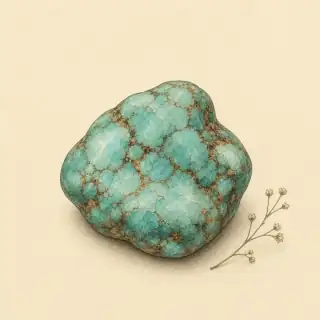
| Chakra | Throat (Vishuddha) |
| Element | Earth |
| Zodiac | Sagittarius, Capricorn |
| Color | Sky blue, Robin's egg blue, Green-blue, Blue with brown matrix |
What Ancient Secrets Does Turquoise Hold?
The oldest written record reveals a forgotten purpose. In the thirteenth century, Volmar wrote in his Steinbuch: "Whoever owns the true turquoise set in gold will not injure any of his limbs when he falls, whether he be riding or walking, so long as he has the stone with him." Kunz, writing in 1913, calls that line the earliest written notice of the belief he could find. Volmar gave a strict rule. You must set the piece in gold. In the fourteenth century, the Lapidaire attributed to Sir John Mandeville explained that the stone protected horses. Riders in Samarcand, Persia, and Ottoman lands fastened these blue pieces to bridles and frontlets of their mounts. Kunz showed that the amulet began as equestrian armor. People believed it kept horses sure-footed on mountain paths. The belief that it protected riders grew directly from keeping the animal upright. That is a belief about horse amulets; it does not establish protection for a rider or a modern vehicle. Centuries earlier, the people who wanted it would not climb for it. Pliny described the stone as callaina in Book 37 of his Natural History during the first century. He says it grows on frozen and unreachable rock, protruding like an eye, and that the locals were terrified of the climb. So they stood off and knocked it down with slings, moss and all. Their chief glory was recounting the pieces brought down from the heights since childhood. By 1609, de Boot recorded that European men viewed it as an essential status symbol. No gentleman considered his hand adorned without a fine blue ring. Women rarely wore it.
Turquoise's travel-charm stories can symbolize a wish for someone's safe return. A gifted piece may remind you who is thinking of you. That is a meaning people give the object. It does not absorb panic, establish an emotional perimeter, or tell you whether an instinct is right. Before a difficult conversation, use the keepsake as a cue to review what you want to say.
Zodiac Connection
This site pairs turquoise with Sagittarius and Capricorn in modern symbolism. Journey imagery suits Sagittarius; the idea of a keepsake carried through a long project suits Capricorn. These are optional readings, not promises of physical protection. Kunz found ruby in six of eight December lists and turquoise in two. The 1912 trade list standardized turquoise for December, consolidating an existing association.
The accounts below document turquoise folklore. A charm story does not demonstrate protection from injury.
How Can Turquoise Symbolize Care Between Friends?
Physical Healing
A turquoise stone can mark a new job, a journey, or a promise between friends. Write the meaning on a card if you are giving it to someone. The talisman does not break a financial deadlock, attract allies, or change your delivery in a meeting. You can carry a meaningful object while making decisions from the information and preparation available to you.
Emotional & Spiritual Healing
De Boot attributed two narrow escapes to his turquoise, according to Kunz: a stumble on horseback and an incident while lifting a heavy pole. In both accounts, he noticed damage to his ring and interpreted it as the stone taking harm for him. Those are his interpretations of anecdotes. They do not establish that turquoise absorbs an impact or protects its owner. The stories are worth reading as evidence of belief, without relying on a gem when your safety is at stake.
Chakra Association
Modern crystal practice pairs turquoise with the Throat Chakra, Vishuddha. This guide treats the pairing as a symbol of honest speech. A pendant can be a visible reminder of a sentence you have rehearsed. It does not silence self-doubt or act on the throat. Use the symbolism if you enjoy it, and let the actual conversation supply information.
This is tradition and practice, not medical, financial, or life advice.
How Do You Use Turquoise Day to Day?
Wearing Turquoise
Volmar's thirteenth-century charm instruction specified turquoise set in gold. Kunz records that belief; a gold frame does not create a protective current. Wear a turquoise stone in a setting you enjoy. Kunz's weekday table lists it on Saturday and as Wednesday's talisman, which you may use as a personal tradition. These days do not provide stamina, influence, or protection from falls.
Turquoise in Your Home
Keep a gifted turquoise in a secure place with a note about its giver. Near the door, it can be a reminder to check what you need before leaving. The horse-amulet story does not extend into real protection for a car or its occupants. Keep driving and travel decisions separate from the charm, and store the gem away from heat and accidental damage.
Meditation with Turquoise
Crowley's 1909 correspondence table places turquoise with The Empress through the path of Daleth. You can use the card's creative themes for a reflection on something you want to make or care for. Write one practical next step while holding the stone. The association does not open a channel to prosperity or supply an answer to a critical choice. It is one occult framework you may choose to explore.
Cleansing & Charging
Kunz records a Persian belief about viewing the new moon on a friend's face, a sacred text, or turquoise to seek good fortune. Read the account as a custom, not a proven way to avoid misfortune or gain wealth. For your own simple ritual, set the turquoise stone on a clean cloth one evening and recall the person who gave it to you. Do not place porous turquoise in salt or water for symbolic cleansing. Follow its physical care guidance separately.
Crystal Combinations
Turquoise pairs well with these crystals for complementary energy in crystal healing practice:
- Topaz for Symbolic pairing: combining honest communication with confident self-expression
- Garnet for Symbolic pairing: pairing throat-centered calm with Root Chakra grounding in crystal reflection tradition
Anselmus de Boot wrote in 1609 that a faded turquoise wakes only when it changes hands, a claim proven on his own father's stone, handed down to him faded and restored to color in his hands. That is the plainer half of a two-stone rule the love-stone lineup sets out in full, the other half belonging to a diamond Kunz wrote about three centuries later.
Caring for Turquoise
Cleaning: A damp soft cloth and nothing else. No soap, no cleaner, no machine, no soaking.
Avoid: Keep perfume, sunscreen, hand cream and sweat off it. Turquoise drinks whatever touches it and the blue turns green for good. Sunlight and heat finish the job.
Your crystal profile
Is Turquoise Your Birthstone?
Month
Day
Turquoise is linked to Sagittarius and Capricorn and the month of December. Enter your birthday above to see if it matches your sign.
Turquoise at a glance
- Also known as
- The gem a Renaissance physician suspected of working through borrowed spirit, not simple mineral luck.
- Tradition
- Kunz records fall-protection beliefs and a court jester's skeptical joke about them.
- Chakra / element
- Throat chakra, earth element.
- In one line
- A gifted keepsake with protective folklore, not a physical shock absorber.
- Try this first
- Keep it with a note about its giver; make travel preparations from actual conditions.
- Do not
- Don't let the stone replace preparation for a hard conversation or a real safety check; De Boot warned about exactly that substitution in 1609.
Kunz, The Curious Lore of Precious Stones, 1913, p. 6, 24.
When to actually reach for turquoise
Three real situations, not general advice.
You are packing at home the night before a trip and find a turquoise someone gave you.
Read the giver's note or recall the occasion. You can keep the gem as a memento in a safe place, then check the actual travel arrangements. The old fall-protection stories add history to the object, not another layer of physical protection. There is no reason to wear a pendant during climbing, skiing, or riding because of a charm story.
You have a confrontation coming, the kind where you need a steady voice more than a clever argument.
This is the stone people reach for when they need vocal authority under pressure, worn at the throat where its chakra association sits. Put it on, then do the preparation De Boot's own worry points you toward: write down the three sentences you actually need to say. Say them out loud once before you walk in. The reminder belongs to the rehearsal; the stone does not steady your hand or write the script.
You're three days into a new job and you need your voice to carry weight before anyone has a reason to trust it yet.
Earth element grounding is the traditional pairing here, steadiness before speed. Wear the stone somewhere visible at meetings, and let it remind you to slow your speech down half a beat before you commit to a claim in front of new colleagues. People believe confidence comes from clarity, not volume. Speak less, and make every sentence one you would repeat under questioning.
A jester's joke and a physician's concern
Kunz records two skeptical reactions to turquoise's reputation. Both ask what people are trusting when they carry a charm.
The turquoise survives; the joke says nothing about its wearer
Kunz records a reply attributed to Charles V's court jester on page 24. Asked about turquoise's virtue, he said that if someone fell from a tower wearing it, the turquoise would remain unbroken. The joke withholds any promise about the person. Kunz does not report that the jester jumped, survived a fall, or tested the stone. Turning his joke into a successful stunt reverses its point.
The stone meant to protect you might teach you not to protect yourself
Anselmus de Boot, physician to Emperor Rudolf II, wrote in 1609 that he suspected something darker behind turquoise's power to absorb harm. He worried that an evil spirit worked through the stone, training people to trust the gem and to stop trusting God. His concern wasn't about the mineral. It was about what leaning on it does to a person over time. Traditional practice still treats turquoise as an ally against sudden shock, and De Boot's four-hundred-year-old warning still asks the same question: are you carrying protection, or are you outsourcing your own vigilance to a rock?
Frequently Asked Questions
What is a turquoise stone actually for?
Turquoise stone meaning, as a protective talisman, has one of the most specific documented origin points among all the stones on this site. The thirteenth-century writer Volmar recorded in his Steinbuch that whoever owns the true turquoise set in gold will not injure any limbs when they fall, whether riding or walking, so long as they carry the stone with them. Kunz, writing in 1913, called this the earliest written notice of the belief he could find, and noted that Volmar's instructions were specific: the stone had to be set in gold, not simply carried loose. Ancient Egyptians had already been mining turquoise in the Sinai Peninsula since roughly 3200 BCE, and King Tutankhamun's burial mask features extensive turquoise inlay, but the specific fall-protection belief Volmar recorded is a distinct, later, and separately documented tradition.
Does turquoise have to be given as a gift?
No gift is required to own or enjoy turquoise. Kunz does record a belief that purchased turquoise lost its talismanic virtue, alongside other charm traditions such as Volmar's gold-setting rule. Those are different historical beliefs, not conditions that make jewelry work. A gift can carry personal meaning without making a stone protective or a self-purchased piece unlucky.
What is the historical origin of turquoise as a protective talisman?
Turquoise's protective reputation began, as far as the documented record shows, with horses not people. The fourteenth-century Lapidaire attributed to Sir John Mandeville describes riders in Samarcand, Persia, and Ottoman lands fastening turquoise to the bridles and frontlets of their mounts, believing it kept the animal sure-footed on mountain paths. George Frederick Kunz argued in his 1913 research that the belief in turquoise protecting riders grew directly out of this practice of protecting the horse first, the amulet started as equestrian armor, and the rider's safety followed as a secondary effect of keeping the animal upright. The thirteenth-century writer Volmar had separately recorded, in his Steinbuch, that a turquoise set in gold protected its human wearer from injury in a fall specifically, a related but distinct tradition.
Why is turquoise associated with December?
The turquoise stone's association with December is a swap from a single 1912 vote, not an old tradition, and the two stones involved essentially traded places. Kunz examined eight historical birthstone lists in his 1913 research and found ruby claimed December in six of them; turquoise appeared for December only twice. At the Kansas City meeting in August 1912, the jewelers' association voted the two stones into each other's traditional months, moving ruby to July and turquoise to December, reasoning that a warm-colored stone suited a warm month and a cool-colored one suited winter. Kunz answered directly in his 1913 book that this logic was backward, reasoning that cold months call for warmth and hot ones call for relief from it, so the swap, in his view, matched each stone to the wrong season not the right one.
Which tarot cards connect to turquoise?
Crowley's 777 places emerald and turquoise at row 14 of Column XL, the path of Daleth associated with The Empress. This guide uses that correspondence as a creative reflection theme. It does not show that turquoise produces prosperity or provides an answer about the future.
Which day is turquoise's day?
Volmar's thirteenth-century charm instruction specified turquoise set in gold. Kunz records that belief; a gold frame does not create a protective current. Wear a turquoise stone in a setting you enjoy. Kunz's weekday table lists it on Saturday and as Wednesday's talisman, which you may use as a personal tradition. These days do not provide stamina, influence, or protection from falls.
How was turquoise gathered in ancient times?
Pliny described the turquoise stone, which he called callaina, in Book 37 of his first-century Natural History as growing on frozen and unreachable rock, protruding like an eye, in terrain so dangerous that local people were reportedly terrified of the climb needed to reach it. They did not climb for it directly; they stood off at a distance and knocked pieces down using slings, bringing down moss and rock along with the stone itself. Pliny recorded that their chief source of pride was in recounting, over the years, how many pieces they had brought down from the heights since childhood, treating the recovery of turquoise as a lifelong tally of accomplishment not a single event. This account predates the gold-setting and horse-bridle traditions recorded centuries later by Volmar and the Mandeville Lapidaire.
How do you cleanse a turquoise stone?
Kunz records a Persian belief about viewing the new moon on a friend's face, a sacred text, or turquoise to seek good fortune. Read the account as a custom, not a proven way to avoid misfortune or gain wealth. For your own simple ritual, set the turquoise stone on a clean cloth one evening and recall the person who gave it to you. Do not place porous turquoise in salt or water for symbolic cleansing. Follow its physical care guidance separately.
The jester and the physician in Kunz's account
The jester's line and De Boot's warning, cited to the pages where the turquoise stone record holds them.
- Charles V's court jester joked that a turquoise would survive a tower fall.
Kunz 1913, p. 24
Kunz reports a hypothetical joke about the stone remaining unbroken, not a stunt or the survival of its wearer. - De Boot suspected an evil spirit worked through turquoise, teaching people to trust the stone over God.
Kunz 1913, p. 6
De Boot framed the stone's apparent power as a spiritual risk, not a mineral fact.
References
- Turquoise, Gemological Institute of America (GIA)
- Turquoise, International Gem Society
- perseus.tufts.edu/hopper/text?doc=Perseus:text:1999.02.0137:book=37:chapter=33
- gutenberg.org/files/57978/57978-h/57978-h.htm
“The safest cleaning methods are also the easiest.”

 ?
?