 BirthstoneMeaning
 Aries Birthstone
 Taurus Birthstone
 Gemini Birthstone
 Cancer Birthstone
 Leo Birthstone
 Virgo Birthstone
 Libra Birthstone
 Scorpio Birthstone
 Sagittarius Birthstone
 Capricorn Birthstone
 Aquarius Birthstone
 Pisces Birthstone
 Peridot Meaning
 Garnet Meaning
 Amethyst Meaning
 Aquamarine Meaning
 Diamond Meaning
 Emerald Meaning
 Pearl Meaning
 Ruby Meaning
 Blue Sapphire Meaning
 Opal Meaning
 Topaz Meaning
 Turquoise Meaning
 Moonstone Meaning
 Tourmaline Meaning
 Citrine Meaning
 Tanzanite Meaning
 Alexandrite Meaning
 Spinel Meaning
 Sardonyx Meaning
 Zircon Meaning
 Lapis Lazuli Meaning
 Rose Quartz Meaning
 Onyx Meaning
 Labradorite Meaning
 Malachite Meaning
 Jade Meaning
 Agate Meaning
 Carnelian Meaning
 Clear Quartz Meaning
 Black Tourmaline Meaning
 Smoky Quartz Meaning
 Sodalite Meaning
 Obsidian Meaning
 Fluorite Meaning
 Selenite Meaning
 Hematite Meaning
 Howlite Meaning
 September Birthstone
Malachite Meaning and Healing Properties Explained
Malachite meaning centers on protection, transformation, and heart-centered emotional work. Ancient Egyptians mined this banded green mineral near Suez and Sinai for ornament and trade. European folklore later treated it as a guardian stone for children and travelers, a tradition gemologist George Frederick Kunz recorded in his 1913 survey of precious-stone lore.
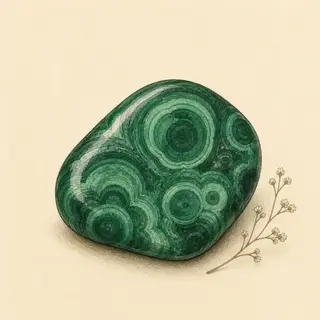
| Chakra | Heart (Anahata) |
| Element | Earth |
| Zodiac | Capricorn |
| Color | Green, Dark green, Banded green |
What Is the Traditional Spiritual Malachite Meaning?
The cultural malachite meaning has two separate roots, and George Frederick Kunz recorded both on a single page of his 1913 book, The Curious Lore of Precious Stones. On page 97, Kunz first states plain economic history: the ancient Egyptians worked malachite mines between Suez and Sinai, extracting the banded green stone for ornament and trade many centuries before the modern era. He then turns, on the very same page, to nursery folklore: malachite "was considered to be a talisman peculiarly appropriate for children." Parents attached a piece of the stone to an infant's cradle, and tradition held that evil spirits stayed away and the child slept soundly and peacefully through the night. Kunz also recorded a second, regionally distinct malachite meaning from Germany. There, malachite shared a reputation with turquoise for protecting the wearer from falls, and it carried an additional, more dramatic belief: the stone was said to warn its owner of approaching disaster by breaking into several pieces. A German household in this tradition treated a cracked piece of malachite as a genuine early warning, not decorative damage. A third regional malachite meaning appears on page 137 of the same book, where Kunz describes an Italian custom. Because natural malachite often shows banded, eye-shaped markings, some Italians wore the stone as a ward against the Evil Eye, joining a wider Mediterranean practice of using eye-marked amulets for daily protection.
You can read the layered malachite meaning as a story about how people once tried to control uncertainty. A German family cracking their protective stone open and treating it as a warning is not so different from checking a smoke detector today. The emotional logic holds up: a physical object that visibly changes state gives you something concrete to respond to. A vague, formless worry gives you nothing to act on. Crystal practitioners today extend that same logic inward. They treat the stone as a mirror for buried feelings, something that surfaces what you have been avoiding. A hidden feeling stays hidden without a prompt like that. You might hold a piece of malachite during a difficult week and use it to name what is actually bothering you, the way a cracked stone once named a coming danger. The cradle folklore adds a gentler layer to this emotional malachite meaning. Sleep, safety, and being watched over are simple, universal needs. Modern practitioners who keep a piece near their bed are drawing on the same impulse that put malachite on an infant's cradle: a physical object standing in for reassurance during vulnerable hours.
Zodiac Connection
Capricorn pairs naturally with a stone whose own folklore is about vigilance and early warning, qualities this earth sign already values in practical, day-to-day life.
All claims about malachite's protective and emotional properties reflect traditional folklore and modern crystal practice, not verified scientific findings. Raw malachite dust is a genuine handling hazard, separate from any traditional or symbolic belief about the stone.
How Do Practitioners Use Malachite in Healing Traditions?
Physical Healing
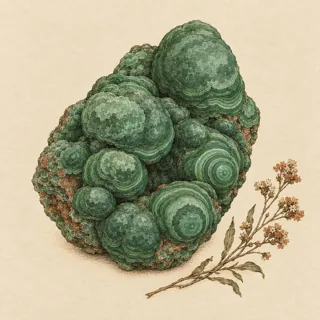
The physical malachite meaning in crystal practice grows directly out of its folkloric role as a household guardian. Practitioners who follow this tradition place a piece near an entryway or a child's room, echoing the cradle-talisman custom Kunz recorded on page 97. This is a symbolic, folklore-based practice, and it carries one separate, real safety note: raw or unsealed malachite is a copper mineral, and its dust is genuinely irritating if inhaled or ingested, so handling raw specimens calls for washing your hands afterward and never using the stone to flavor drinking water. Traditional users also treat the stone as a stand-in for physical vigilance during ordinary tasks. You might keep a tumbled piece in a bag or on a desk during a physically demanding week, using it the way the German tradition used a cracked stone: as a prompt to notice your own body's warning signs, like fatigue or tension, before pushing through them anyway. Because natural malachite has a Mohs hardness of only about 3.5 to 4, practitioners who wear it daily also treat basic physical care as part of the tradition itself. A soft, banded stone that needs gentle handling becomes, in this framing, a small daily reminder to slow down.
Emotional & Spiritual Healing
The emotional malachite meaning in modern practice leans heavily on the stone's association with the heart and with buried feelings coming to the surface. Practitioners describe malachite as a stone that will not let you avoid a feeling indefinitely, the way its banded surface will not let you avoid noticing its pattern. You might use it during a stretch of low-grade anxiety about a decision you keep putting off, treating the stone as encouragement to actually name the decision out loud. Some practitioners connect this directly to the German breaking-stone belief: if malachite once cracked to announce danger from the outside, it can also be understood, in modern practice, as a symbol for feelings that need to break open before they can be addressed. This is folklore extended into a metaphor. It makes no scientific claim about the mineral itself. Others lean on the Italian eye-marking tradition instead, treating the stone's natural pattern as a watchful presence more than a warning sign. You decide which reading fits your own week: a stone that watches over you, or a stone that eventually tells you the truth.
Chakra Association
Crystal healers assign malachite to the Heart chakra, called Anahata, located at the center of the chest. Practitioners place a flat piece directly on the sternum during meditation, treating the stone's deep green color as a visual match for this chakra's traditional association with growth and renewal. The tradition holds that a blocked Heart chakra shows up as guardedness, the emotional opposite of the open, protective role malachite plays in its own folklore. Practitioners use the stone to work against that guardedness directly, holding it while consciously naming something they have been protecting themselves from feeling. Some practitioners also link the chakra practice back to the cradle-talisman custom on page 97 of Kunz's book: a stone once used to protect a sleeping child is now used to protect an adult's capacity to feel safe enough to be emotionally open. The through-line is the same idea of protection, applied to a different kind of vulnerability.
This is tradition and practice, not medical, financial, or life advice.
How Do You Use Malachite Day to Day?
Wearing Malachite
Jewelers typically set malachite as cabochons in pendants and earrings; rings see too much daily contact for a stone with a Mohs hardness of only 3.5 to 4, which leaves it vulnerable to scratches and chips. Remove malachite jewelry before washing dishes, applying lotion, or using perfume, since the stone is a carbonate and reacts to acids and household chemicals. Wearing it close to the chest, near the Heart chakra, is the traditional placement practitioners favor.
Malachite in Your Home
Traditional practice places malachite near an entryway or a child's bedroom, drawing on the cradle-talisman custom Kunz recorded in 1913. A raw, unpolished chunk works well for this purpose, since the point is display, not handling. Wash your hands after touching raw or unsealed pieces anyway, since malachite dust is a genuine copper-mineral irritant, separate from any folklore concern.
Meditation with Malachite
Hold a smooth, palm-sized piece against your chest while seated, over the Heart chakra. Focus on the stone's banded pattern and let your attention settle on one feeling you have been avoiding. Some practitioners breathe slowly for several minutes before naming that feeling out loud, treating the exhale as the moment the stone symbolically cracks open, the way the German tradition's warning stone once did.
Cleansing & Charging
Never soak malachite in water or use an ultrasonic cleaner, since both can dissolve or fracture this soft carbonate mineral over time. Wipe the surface with a dry or barely damp soft cloth instead. Store it away from acidic substances like perfume, hairspray, and lotion, and keep it separate from harder gemstones that could scratch its surface in a jewelry box.
Crystal Combinations
Malachite pairs well with these crystals for complementary energy in crystal healing practice:
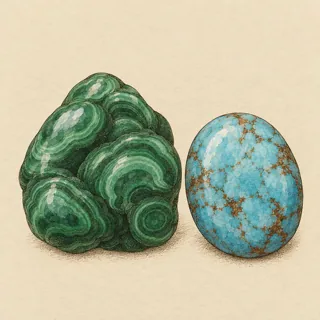
- Turquoise for Kunz himself paired these two stones in the same German protective tradition, and practitioners still combine them for a shared sense of guarded safety.
- Rose Quartz for Practitioners pair malachite with rose quartz to balance its more intense, surfacing energy with a gentler, steadier Heart chakra presence.
Malachite is filed under the Heart chakra in crystal practice, a warmer, more grounded assignment than the Crown-chakra clarity work clear quartz is known for. The clear quartz guide sets out that Crown chakra work and clear quartz's Aquarius association.
Caring for Malachite
Cleaning: Wipe with a dry or barely damp soft cloth only.
Avoid: Sensitive to acids, ammonia, heat, and water. Never wear it while cleaning or showering. Contains copper; wash hands after handling raw pieces.
Your crystal profile
Is Malachite Your Birthstone?
Month
Day
Malachite is linked to Capricorn. Enter your birthday above to see if it matches your sign.
Pairs well with
Malachite at a glance
- Also known as
- No widely used alias; sold under its own mineral name, malachite
- Tradition
- A guardian stone for children, travelers, and the home
- Chakra / element
- Heart (Anahata) / Earth
- In one line
- A banded green copper mineral tied to a European guardian-stone tradition and, in modern practice, to the Heart chakra malachite meaning.
- Try this first
- Hold a smooth piece against your chest and name one feeling you have been avoiding.
- Do not
- Water soaking, ultrasonic cleaners, perfume, and ingesting or inhaling raw dust.
Kunz, The Curious Lore of Precious Stones, 1913, p.97
When People Actually Reach for Malachite
Crystal practitioners describe using malachite at specific, recognizable moments, not as a constant, background presence.
Sunday night before a Monday you are dreading
You sit on the edge of your bed and hold a smooth piece of malachite against your chest. You have been avoiding one specific conversation all weekend, and you finally say out loud, to an empty room, what you have been putting off. This is the emotional malachite meaning practitioners describe most often: a physical object that pushes a buried feeling into the open before you can talk yourself out of it again.
The first night your child sleeps in a new bedroom
You place a raw piece of malachite on a shelf near the door, consciously borrowing the cradle-talisman custom Kunz recorded in 1913. You know the stone will not actually prevent anything. You use it anyway, the same way a nightlight does not prevent anything either, as a small object that makes an unfamiliar room feel less unfamiliar to both of you.
The moment you notice a decision you have delayed for weeks
You are standing in your kitchen, and a tumbled piece of malachite happens to be sitting on the counter where you left it. You pick it up and turn it over, tracing the banded pattern with your thumb. You use that small pause to finally admit which decision you have been avoiding, treating the stone the way German tradition once treated a cracking one: as a signal that waiting any longer is no longer the safer option.
Two Protective Malachite Traditions That Never Agreed
Kunz's own pages show two different countries answering the same question about malachite in two different ways.
A Warning Stone or a Watching Stone
On page 97 of his 1913 book, Kunz records a German belief that malachite warns its owner of approaching disaster by breaking into several pieces, a reactive kind of protection that only announces danger after the fact. On page 137, describing an Italian custom, he records a different mechanism entirely: malachite's natural eye-shaped markings let it work as a ward against the Evil Eye, a preventive kind of protection meant to stop harm before it starts. Kunz records both beliefs without reconciling them or ranking one above the other. Nothing in the text suggests either tradition borrowed from the other, and Kunz gives no indication that the two regions were even aware of each other's version of the belief. The stone's protective reputation developed twice, independently, around two incompatible ideas of how protection actually works.
A Nursery Talisman Beside a Mining Ledger
Page 97 also holds a second, quieter tension. In the same passage where Kunz records the cradle-talisman custom protecting sleeping infants, he also states, as plain historical fact, that Egyptian miners worked malachite deposits between Suez and Sinai for their economic value. Kunz makes no effort to connect the nursery folklore to the mining history, and nothing in the text suggests the ancient miners who dug the stone from the ground shared the later superstition about its power over children. The same page holds a fragile, sentimental belief beside a hard, practical fact, with no bridge between them beyond the fact that both concern the same mineral.
Frequently Asked Questions
What is the traditional malachite meaning in crystal practice?
The traditional malachite meaning is protection, specifically protection for children, travelers, and the home. George Frederick Kunz documented this in 1913, recording a German custom of attaching malachite to an infant's cradle to ward off evil spirits and help the child sleep. He also recorded a related belief that the stone warned its owner of danger by breaking apart, and a separate Italian tradition that used its eye-shaped markings against the Evil Eye. Modern crystal practitioners extend these folkloric roles into emotional territory, treating malachite as a stone that surfaces buried feelings more than one that wards off physical harm.
Is malachite safe to wear every day?
Malachite is safe to wear as finished jewelry, but it needs more care than harder stones. Its Mohs hardness of only 3.5 to 4 makes it prone to scratching and chipping, so jewelers typically set it in pendants and earrings, since rings take too much daily contact for a stone this soft. Raw or unsealed malachite is a copper mineral, and its dust is genuinely irritating if inhaled or ingested, so wash your hands after handling rough or tumbled pieces. Polished, sealed jewelry does not pose this risk during normal wear.
Why is malachite associated with the Heart chakra?
Crystal healers assign malachite to the Heart chakra, called Anahata, largely because of its deep green color, which matches this chakra's traditional association in modern energy-healing systems. Practitioners place a flat piece on the chest during meditation and treat it as a tool for working through guardedness, using the stone's own folkloric role as a guardian object as a template for guarding your own emotional openness, the opposite of shutting it down. This pairing is a modern practitioner convention. Kunz himself never connected malachite to the Heart chakra in 1913.
How do you clean and care for malachite?
Wipe malachite with a dry or barely damp soft cloth only. Never soak it in water or use an ultrasonic cleaner, since both can dissolve or fracture this soft carbonate mineral over time. Keep it away from perfume, lotion, and household cleaning chemicals, which can react with the stone's surface. Store malachite separately from harder gemstones in a jewelry box, since even routine contact with a harder stone can leave visible scratches.
Who should wear malachite?
Traditionally believed to be a guardian mineral, this banded green copper stone appeals to travelers and parents alike. Modern crystal practice associates it strongly with the heart chakra. Folklore holds that keeping a piece close helps protect the home and encourage honest feelings. Those wanting a steady earth element companion frequently choose it.
What zodiac sign is malachite for?
Astrological tradition strongly connects this protective guardian stone to Capricorn. People born under this sign value stability, family, and home life. Practitioners associate the deep earth element qualities of the green mineral with their naturally grounded personality. Folklore suggests its heart chakra alignment brings emotional balance to their often serious disposition.
Crystal practice also pairs malachite with a card from the tarot deck. The Judgement tarot guide covers that card's upright and reversed meaning, plus the zodiac sign tradition assigns to it.
What Kunz Actually Documented About Malachite
Two pages of Kunz's 1913 book anchor almost everything modern practitioners say about this stone's traditional meaning.
- European folklore treated malachite as a protective talisman for children and a danger-warning stone for adults.
Kunz 1913, p.97
Kunz records that a piece of malachite attached to an infant's cradle was believed to keep evil spirits away and help the child sleep soundly. On the same page, he records a separate German belief that malachite shared turquoise's reputation for protecting against falls and warned its owner of coming disaster by breaking apart. He also records the Suez-Sinai mining history as plain fact, separate from the folklore above. - Italian tradition used malachite's natural eye-shaped markings as a ward against the Evil Eye.
Kunz 1913, p.137
Kunz describes a wider tradition of eye-marked amulets used against the Evil Eye across the Mediterranean, then states that malachite was worn in parts of Italy for exactly this reason, because its banded pattern sometimes resembles an eye. This is a distinct protective mechanism from the German breaking-stone belief he records elsewhere in the same book.
References
“The safest cleaning methods are also the easiest.”