 BirthstoneMeaning
 Aries Birthstone
 Taurus Birthstone
 Gemini Birthstone
 Cancer Birthstone
 Leo Birthstone
 Virgo Birthstone
 Libra Birthstone
 Scorpio Birthstone
 Sagittarius Birthstone
 Capricorn Birthstone
 Aquarius Birthstone
 Pisces Birthstone
 Peridot Meaning
 Garnet Meaning
 Amethyst Meaning
 Aquamarine Meaning
 Diamond Meaning
 Emerald Meaning
 Pearl Meaning
 Ruby Meaning
 Blue Sapphire Meaning
 Opal Meaning
 Topaz Meaning
 Turquoise Meaning
 Moonstone Meaning
 Tourmaline Meaning
 Citrine Meaning
 Tanzanite Meaning
 Alexandrite Meaning
 Spinel Meaning
 Sardonyx Meaning
 Zircon Meaning
 Lapis Lazuli Meaning
 Rose Quartz Meaning
 Onyx Meaning
 Labradorite Meaning
 Malachite Meaning
 Jade Meaning
 Agate Meaning
 Carnelian Meaning
 Clear Quartz Meaning
 Black Tourmaline Meaning
 Smoky Quartz Meaning
 Sodalite Meaning
 Obsidian Meaning
 Fluorite Meaning
 Selenite Meaning
 Hematite Meaning
 Howlite Meaning
 September Birthstone
Obsidian Meaning and Healing Properties Explained
The core obsidian meaning centers on grounding, truth, and psychological protection in modern crystal practice. Practitioners view this dark volcanic glass as a surface for confronting what usually stays hidden. Beyond its spiritual associations, obsidian possesses a rich physical history as a prehistoric blade and an ancient divination tool.
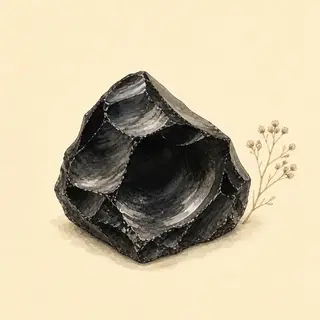
| Chakra | Root (Muladhara) |
| Element | Earth |
| Zodiac | Scorpio |
| Color | Black, Mahogany, Rainbow, Snowflake, Gold sheen |
What Is the Traditional Spiritual Obsidian Meaning?
The Curious Lore of Precious Stones, George Frederick Kunz's 1913 survey, documents a genuinely global fascination with this volcanic glass. He described a Twelfth Dynasty Egyptian obsidian mask housed in the collection of Mrs. Henry Draper. Kunz also detailed the ancient Mexican practice of crafting obsidian mirrors. Craftsmen polished one side perfectly flat and left the reverse strongly convex, frequently carving the curved surface with symbolic representations. These mirrors found their way into European aristocratic collections. Horace Walpole kept a polished slab of Mexican obsidian at his Strawberry Hill estate. This piece later passed to Lord Londesborough in 1853, and eventually to Prince Alexis Soltykoff. Historical figures employed these polished black surfaces for divination. The Elizabethan mathematician Dr. John Dee used a Mexican obsidian mirror for his experiments in crystal vision during the sixteenth century. By the eighteenth century, European jewelers incorporated obsidian into sentimental GOOD LUCK acrostic jewelry, where the first letters of seven mounted gems spelled out a motto. In 1913, Kunz officially listed obsidian as the characteristic gemstone of Mexico.
Modern crystal practitioners focus heavily on the obsidian meaning of revelation and emotional grounding. In contemporary healing systems, practitioners use this stone for shadow work. This practice involves confronting difficult or suppressed emotions. The historical use of obsidian as a scrying tool heavily influences this modern application. Just as Dr. John Dee stared into his Mexican obsidian mirror to divine hidden truths in the sixteenth century, modern users hold the stone to examine their own hidden psychological patterns. Crystal healers maintain that the dark surface acts as a mirror for the subconscious mind, reflecting your fears and insecurities back to you for conscious processing. Practitioners traditionally believe obsidian absorbs negative emotional energy from the wearer's environment. They recommend keeping a piece of black obsidian on a desk or carrying it during stressful emotional conversations. In these traditions, the stone provides a steadying psychological anchor when you feel overwhelmed by grief, sudden life changes, or lingering trauma. This is folklore and modern crystal practice, unconnected to any laboratory finding. The psychological comfort stems from the ritual of mindfulness associated with holding the stone, providing a physical focal point during moments of high anxiety.
Zodiac Connection
Modern crystal practice pairs obsidian with the zodiac sign Scorpio. Astrologers associate Scorpio with depth, transformation, and the unseen elements of life. This astrological profile aligns perfectly with obsidian's volcanic origin, where molten material remains hidden deep underground before surfacing violently. Contemporary healers traditionally believe obsidian helps Scorpios process their intense emotions and navigate periods of personal transformation.
Associations between obsidian and emotional protection are crystal practice folklore, not a laboratory finding, and geology classifies this material as a natural volcanic glass.
How Do Practitioners Use Obsidian in Healing Traditions?
Physical Healing
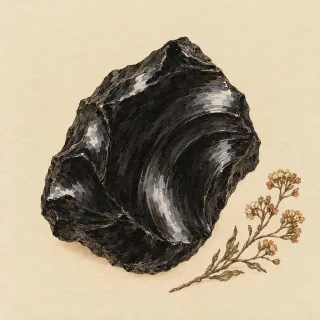
The physical-healing side of the obsidian meaning, in crystal practice, ties this stone to detoxification and digestive health. Modern holistic guides frequently suggest placing the stone near the stomach or base of the spine during meditation. Healers traditionally believe this placement supports the body's natural waste elimination systems and improves circulation in the extremities. Some practitioners also use warmed obsidian stones in physical massage therapy to soothe aching muscles and release physical tension. We note that these are traditional beliefs, and you should always seek professional medical care for physical ailments. When handling raw or freshly broken obsidian, you must exercise extreme physical caution. Obsidian is a volcanic glass with a Mohs hardness of 5 to 5.5. It exhibits a conchoidal fracture pattern. This means the stone breaks into smooth, curved surfaces with incredibly sharp, razor-like edges. Ancient cultures utilized this precise characteristic to manufacture surgical blades and arrowheads. A chipped obsidian sphere or a broken raw chunk will cut your skin easily. You must handle rough specimens carefully and sweep up any dropped fragments immediately to prevent injury.
Emotional & Spiritual Healing
Crystal healers consider obsidian a powerful tool for establishing emotional boundaries. In traditional practice, users carry the stone when they feel drained by demanding coworkers, family members, or stressful social situations. Practitioners view the stone as a protective barrier that prevents the wearer from absorbing external emotional turbulence. When you struggle with people-pleasing tendencies, contemporary healers suggest holding obsidian to reinforce your personal resolve and find the courage to say no. The tradition also links this volcanic glass to the release of old romantic attachments. If you are struggling to move past a previous relationship, practitioners recommend meditating with obsidian to sever lingering emotional ties. They traditionally believe the stone helps you identify the toxic cycles you repeat in your personal life. This allows you to break bad habits and approach future relationships with a clearer, more grounded perspective. These emotional applications rely on personal reflection and intentionality. Holding the stone gives you something tangible to return to while you maintain healthy emotional distance and prioritizing your own mental well-being during chaotic times.
Chakra Association
Modern chakra theory strictly assigns obsidian to the Root chakra, known in Sanskrit as Muladhara. This vital energy center sits at the base of the human spine. Practitioners believe the Root chakra governs your fundamental sense of safety, physical survival, and connection to the physical world. When this chakra falls out of balance, traditional guides state that you will experience feelings of lethargy, severe anxiety, and profound disconnection from reality. Crystal healers use obsidian to anchor a wandering mind back to the present moment. During a typical chakra balancing session, a practitioner will place a piece of black obsidian near the client's feet or directly on the lower pelvis. They traditionally believe the dense, heavy properties of the volcanic glass pull excess, erratic energy down from the upper chakras and discharge it safely into the earth. This grounding process purportedly restores your sense of stability and physical security. Healers often recommend Root chakra meditation with obsidian for individuals who spend long hours working on computers or living entirely in their heads.
This is tradition and practice, not medical, financial, or life advice.
How Do You Use Obsidian Day to Day?
Wearing Obsidian
Wearing obsidian jewelry requires careful consideration of the stone's physical properties. With a Mohs hardness of 5 to 5.5, this volcanic glass scratches easily and chips upon hard impact. Jewelers recommend wearing obsidian in pendants, necklaces, or earrings, where the stone remains safe from daily bumps and abrasions. If you choose an obsidian ring or bracelet, ensure the setting provides a protective metal bezel around the stone's edges. In crystal practice, healers traditionally suggest wearing obsidian jewelry below the waist to stay close to the Root chakra. Carrying a tumbled piece in your pants pocket serves as an excellent, low-risk alternative to wearing fragile rings.
Obsidian in Your Home
Practitioners who lean on the obsidian meaning for home protection frequently place a piece near the entryway to establish a boundary around the living space. In traditional Feng Shui and modern crystal layouts, placing black obsidian near the front door or in the entryway acts as a filter for outside energy. Healers traditionally believe this placement stops the stress of the workday from entering your personal sanctuary. You can also place an obsidian sphere in a home office to anchor your focus and minimize digital distractions. Because of its dark, heavy appearance, you should balance obsidian with lighter elements or stones in your decor to maintain a visually welcoming environment.
Meditation with Obsidian
Obsidian serves as an intense focal point for grounding meditations. Crystal practitioners recommend sitting with your feet flat on the floor and a smooth palm stone resting in one hand. As you breathe deeply, traditional guides suggest visualizing a heavy cord extending from the stone, down through your body, and rooting deep into the earth. You can also incorporate an obsidian mirror into your practice for traditional scrying. Users dim the lights, light a candle, and gaze softly into the dark reflection to encourage introspective thought. We remind you that these meditation techniques offer a structured way to practice mindfulness and quiet a racing mind.
Cleansing & Charging
You must clean obsidian with a gentle approach to avoid physical damage. As a brittle volcanic glass, it responds poorly to extreme temperature shocks and harsh chemical cleaners. Wash your stone with lukewarm water and a mild soap, then dry it immediately with a soft microfiber cloth. You must absolutely avoid prolonged soaking or the use of ultrasonic cleaners, which can cause micro-fractures to propagate. In spiritual traditions, practitioners avoid salt water cleansing for obsidian. They traditionally prefer passing the stone through the smoke of burning sage or resting it on a bed of dry earth overnight to clear its accumulated energy.
Crystal Combinations
Obsidian pairs well with these crystals for complementary energy in crystal healing practice:
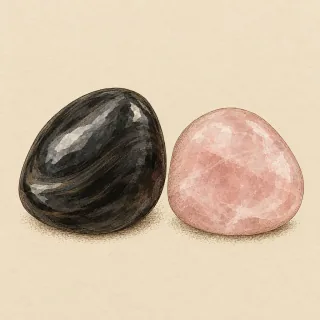
- Rose Quartz for In crystal healing practice, pairing rose quartz with obsidian balances deep psychological shadow work with gentle, nurturing emotional support.
- Clear Quartz for Practitioners traditionally use clear quartz alongside obsidian to amplify the volcanic glass's grounding effects while providing mental clarity.
Caring for Obsidian
Cleaning: Warm soapy water and a soft cloth; handle with care.
Avoid: Glass-like conchoidal fracture means it chips easily. Avoid impacts and store it separately from harder stones.
Your crystal profile
Is Obsidian Your Birthstone?
Month
Day
Obsidian is linked to Scorpio. Enter your birthday above to see if it matches your sign.
Pairs well with
Obsidian at a glance
- Also known as
- Black obsidian, snowflake obsidian, mahogany obsidian, Apache tears
- Tradition
- Shadow work and protective grounding, per the obsidian meaning in modern practice
- Chakra / element
- Root (Muladhara) / Earth
- In one line
- The obsidian meaning centers on emotional protection, confronting inner shadows, and energetic grounding, tied to this rapidly cooled volcanic glass.
- Try this first
- Hold a tumbled piece in your hand while journaling to focus your mind during periods of emotional stress.
- Do not
- Keep away from sharp impacts and extreme temperature changes, as this brittle glass will chip easily.
Kunz, The Curious Lore of Precious Stones, 1913, p.99
Obsidian in Modern Practice
Modern practitioners incorporate the obsidian meaning into daily grounding routines and introspective rituals.
At midnight in your bedroom during a journaling session
At midnight in your dimly lit bedroom, you sit on the floor with a piece of black obsidian resting on your root chakra. You are working through an intense journaling session about past emotional blockages. In traditional crystal healing, practitioners utilize this dark volcanic glass to confront difficult, suppressed emotions during shadow work. You hold the stone tightly while writing out your frustrations on the paper. The practice dictates that the dense material helps absorb chaotic energy. You take three slow breaths, visualizing the stone anchoring your thoughts firmly to the floor beneath you.
Walking onto a crowded subway car in New York City at rush hour
Walking onto a crowded subway car in New York City at 5:00 PM, you feel overwhelmed by the noise and close quarters. You reach into your coat pocket and wrap your fingers around a smooth tumbled mahogany obsidian stone. Crystal healers traditionally recommend this iron-streaked variety for intense personal protection and rapid grounding in chaotic environments. You focus your attention entirely on the physical texture of the smooth glass. According to modern folklore, carrying the stone helps establish a solid energetic boundary between you and the exhausted commuters pressing in from every direction.
Waiting on a crowded subway platform during evening rush hour in Chicago
The platform is packed, the announcements keep changing your train's track, and everyone around you is visibly irritated. You close your hand around a piece of snowflake obsidian in your coat pocket, feeling the smooth, cool glass and the raised texture of its pale cristobalite flecks. In contemporary crystal practice, this quiet physical contact is meant to interrupt the spiral of frustration before it builds. You press your feet flat against the concrete and let that sensation take over. The stone works as a deliberate cue to stay grounded until your train finally arrives.
Historical Tensions in Obsidian Usage
Early gemological records reveal a real tension in the obsidian meaning across different societies, which used this volcanic glass for opposite purposes.
Sacred Divination Versus Static Burial Object
On page 99 of his 1913 survey, George Frederick Kunz catalogs an obsidian mask dating to the Twelfth Dynasty of Egypt. This striking artifact, later held in the collection of Mrs. Henry Draper, served a strictly funerary purpose as a static burial object. Thousands of miles away, Kunz documents a vastly different application for this identical volcanic material. Ancient Mexican cultures manufactured polished, strongly convex obsidian mirrors specifically for active divination. According to pages 204 and 205, this Mesoamerican scrying tradition successfully crossed into Renaissance Europe. Dr. John Dee, the famous Elizabethan mathematician, acquired and used a Mexican obsidian mirror in his recorded experiments with crystal vision. Two disparate civilizations utilized the same black volcanic glass for entirely separate supernatural applications. The Egyptian tradition utilized the stone to permanently cover the deceased, while European occult practitioners actively employed it to seek visions of the future.
Royal Curiosity Versus Utilitarian Craft
Kunz records a distinct divide between how European aristocracy and indigenous Mesoamerican craftsmen treated obsidian. On page 195, Kunz traces the provenance of a single polished slab of black Mexican obsidian. The English writer Horace Walpole kept this specific specimen in his famous Strawberry Hill collection. Walpole wrote a label stating the Earls of Peterborough had long owned the stone. By 1853, it passed to Lord Londesborough, and eventually to Prince Alexis Soltykoff. To these wealthy Europeans, the slab represented a rare, named-provenance curiosity for display. Meanwhile, page 256 describes the ancient Mexican lapidaries who viewed obsidian as an essential, everyday material. The Aztec tradition revered four patron gods who taught humans how to cut and polish this volcanic glass. Indigenous craftsmen manufactured thousands of utilitarian labrets and earflaps from the material. The Europeans hoarded single slabs as exotic trophies. The native cultures wove the glass directly into their daily religious and bodily adornment.
Frequently Asked Questions
Who should wear obsidian?
Anyone seeking emotional grounding and personal protection utilizes obsidian in modern crystal practice. Traditional healers recommend this volcanic glass for individuals navigating stressful work environments or intense periods of personal grief. The stone serves as a physical touchstone for those who feel scattered, anxious, or overwhelmed by daily responsibilities. Because practitioners tie obsidian to the Root chakra, they frequently advise individuals doing heavy shadow work or trauma processing to carry a piece for stability. We remind readers that crystal recommendations belong to spiritual tradition. You should wear the stone if its dark, glassy aesthetic appeals to your personal style.
What zodiac sign is obsidian for?
Modern astrologers and crystal healers primarily pair obsidian with the zodiac sign Scorpio. Scorpios possess a reputation for emotional depth, intensity, and a drive to uncover hidden truths. These astrological traits align closely with obsidian's traditional use as a scrying mirror and a tool for deep psychological exploration. Crystal practitioners traditionally believe the stone helps Scorpios ground their turbulent feelings and protect their sensitive inner nature from external negativity. While anyone can wear the stone, contemporary practice strongly emphasizes the Scorpio connection due to the shared themes of transformation and hidden power.
What are the different types of obsidian?
Geologists recognize several distinct varieties of obsidian based on natural inclusions and formation conditions. Classic black obsidian features a pure, dark, glassy appearance. Snowflake obsidian contains small, white, clustered crystals of the mineral cristobalite, which resemble snowflakes against the dark background. Mahogany obsidian exhibits reddish-brown streaks caused by iron oxide or hematite trapped during the cooling process. Rainbow and gold sheen obsidian display a colorful, metallic flash resulting from microscopic gas bubbles layered within the glass. Apache tears are small, rounded, translucent nodules of obsidian usually found embedded in a grayish perlite matrix.
Is obsidian safe to wear every day?
You can wear obsidian every day if you choose appropriate jewelry settings and exercise proper care. As a natural glass with a Mohs hardness of 5 to 5.5, obsidian remains significantly softer than common quartz-family stones. It will scratch if rubbed against harder materials and can chip or shatter if dropped on a hard surface. Jewelers recommend pendants and earrings for daily wear, as these pieces experience less physical impact. If you wear an obsidian ring daily, you must select a design with a protective bezel setting and remove it during manual labor or exercise.
How do you cleanse obsidian?
Cleaning obsidian requires avoiding extreme temperatures and physical shocks. Because it is a brittle mineraloid, sudden shifts from hot to cold water can cause the glass to crack. You should wipe the surface with a soft, dry cloth to remove fingerprints and dust. If necessary, rinse the stone briefly in lukewarm water and dry it immediately. You must avoid ultrasonic cleaners and harsh chemicals entirely. For spiritual cleansing, crystal healers traditionally avoid saltwater soaks. Practitioners prefer smudging the stone with incense or resting it on a clear quartz cluster to refresh its energetic properties.
What Kunz Actually Documented About Obsidian
George Frederick Kunz recorded the specific historical material behind the obsidian meaning in his 1913 text.
- Early cultures used obsidian for both static burial masks and convex divination mirrors.
Kunz 1913, p.99
On page 99, Kunz catalogs two entirely distinct artifacts fashioned from the same dark material. He first documents an obsidian mask originating from the Twelfth Dynasty of Egypt. This piece belonged to the late De Lesseps Collection before passing to Mrs. Henry Draper. On the exact same page, Kunz lists an obsidian mirror from Oaxaca, Mexico, housed in the Trocadéro Museum in Paris. He notes that ancient Mexicans made wonderful mirrors from this material. They polished one side flat while making the other side strongly convex. The Trocadéro collection also included a pyrite mirror carved with symbolic representations, showing the high level of Mesoamerican lapidary skill. - European astrologers repurposed Mexican obsidian mirrors for crystal vision experiments.
Kunz 1913, pp.204-205
Spanning pages 204 and 205, Kunz explicitly connects ancient Mesoamerican divination tools to Renaissance English occultism. He states that mirrors made of this black volcanic material saw regular use for divination practices in ancient Mexico and neighboring countries. Kunz then documents a specific cross-cultural transmission of these unique artifacts. He reports that Dr. John Dee, the famous mathematician and astrologer to Queen Elizabeth I, actively employed one of these Mexican obsidian mirrors in his own experiments with crystal vision. This establishes a direct historical timeline showing how indigenous scrying tools migrated across the Atlantic ocean. The dark volcanic glass transformed from a native religious implement into a highly prized mystical instrument within the private chambers of sixteenth-century European astrological researchers. - Ancient Aztec lapidary gods supposedly invented the cutting and polishing of obsidian ornaments.
Kunz 1913, p.256
On page 256, Kunz details the mythological origins of indigenous Mesoamerican lapidary work. He describes the four gods of the ancient Mexican lapidaries. The indigenous culture looked upon these specific deities as the discoverers and original teachers of the art of cutting precious stones. These gods supposedly taught human craftsmen how to pierce and polish hard materials. Kunz explicitly names obsidian, rock-crystal, and amber as the primary materials used in this divine craft. The craftsmen used these techniques to manufacture wearable labrets and earflaps. The text also credits these same four deities with the invention of necklaces and bracelets, firmly linking the volcanic glass to deep-rooted religious traditions of bodily adornment in the Americas.
References
“The safest cleaning methods are also the easiest.”