 BirthstoneMeaning
 Blue Sapphire Meaning
 Lapis Lazuli Meaning
 Rose Quartz Meaning
 Onyx Meaning
 Labradorite Meaning
 Malachite Meaning
 Jade Meaning
 Agate Meaning
 Carnelian Meaning
 Clear Quartz Meaning
 Black Tourmaline Meaning
 Smoky Quartz Meaning
 Sodalite Meaning
 Obsidian Meaning
 Fluorite Meaning
 Selenite Meaning
 Hematite Meaning
 Howlite Meaning
Birthstone Chart by Month and Zodiac
A complete month-by-month guide to modern and traditional birthstones, with colors and zodiac sign overlaps.
Jewelry convention: the modern column follows the current U.S. month list. Historical tradition: the traditional column records older alternatives. Colors describe appearance; zodiac overlaps use fixed date ranges, not a birth chart.
| Month | Modern Stone | Traditional Stone | Color | Zodiac Signs |
|---|---|---|---|---|
| January |  | |||
| February |  | |||
| March |  Aquamarine Aquamarine Bloodstone Bloodstone | Bloodstone | | |
| April |  | |||
| May |  | |||
| June |    | |||
| July |  | |||
| August |    | |||
| September |  | |||
| October |   | |||
| November |   | |||
| December |    |
Free Printable Birthstone Chart
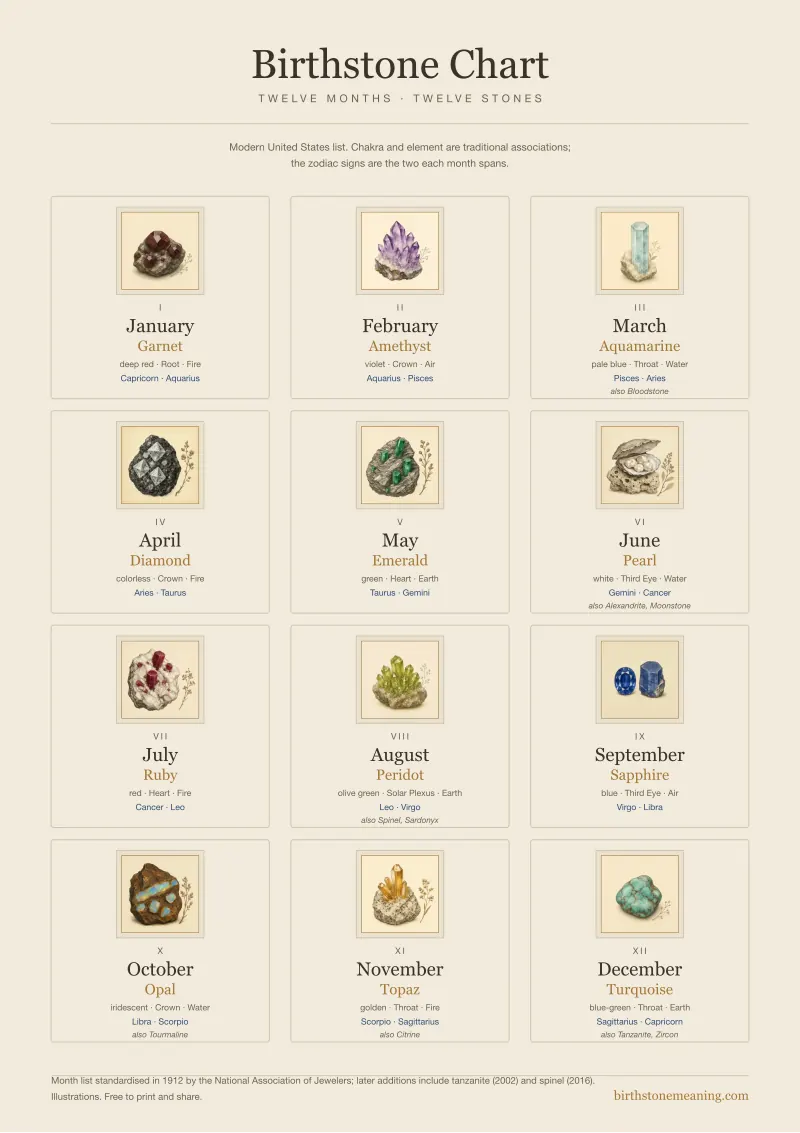
One sheet, twelve months. Each month shows its stone with a watercolor illustration, the stone’s color, the chakra and element crystal practice files it under, the two zodiac signs the month spans, and the extra official stones for the six months that carry them.
The printable birthstone chart is sized for A4 and US Letter, so it prints without scaling on either. Take the PDF for a clean print or the PNG to drop into a document. Free, and no email required.
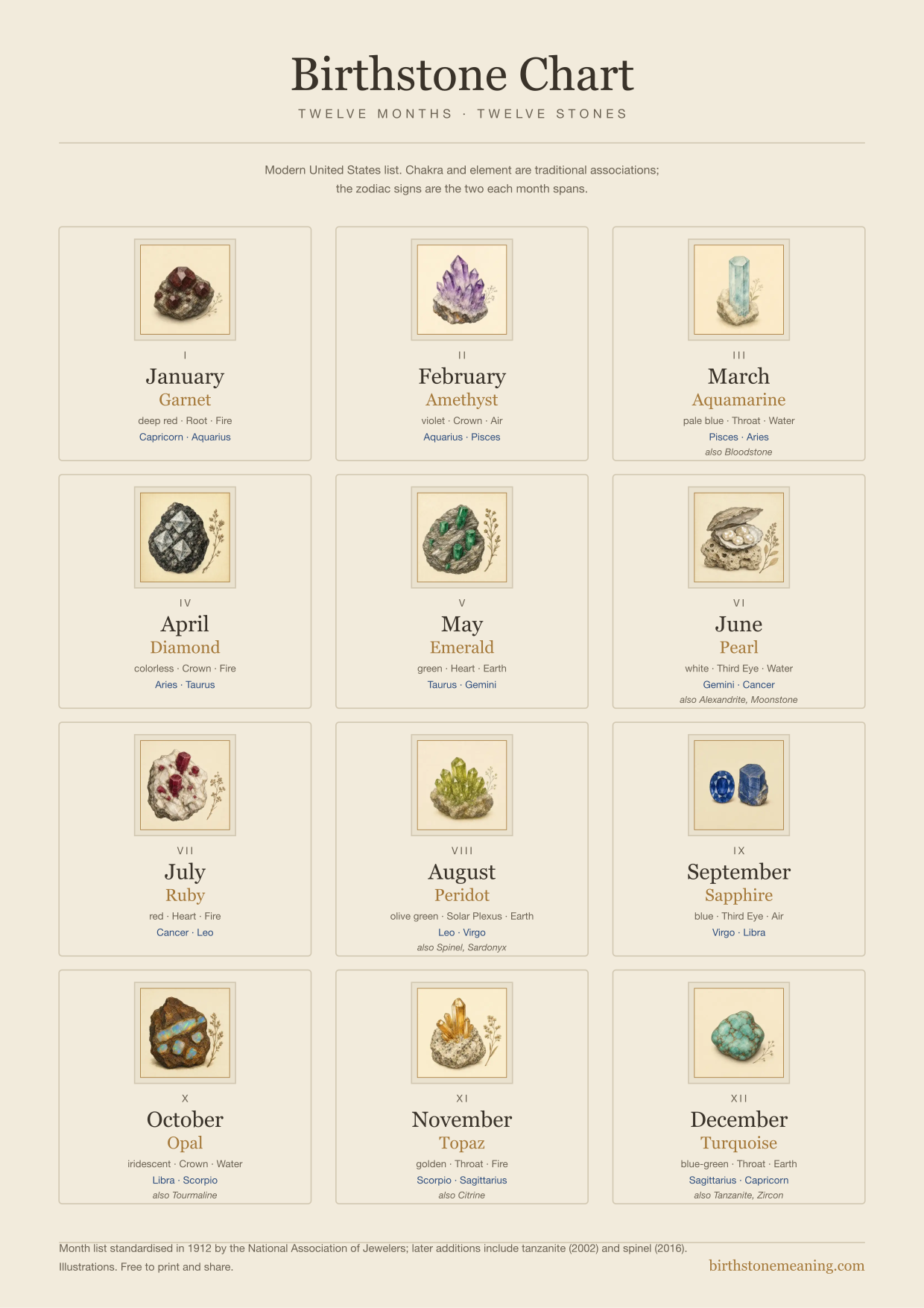
Use this chart on your own site
Copy this and the chart appears with a credit link back here.
<a href="https://birthstonemeaning.com/birthstone-chart">
  <img src="https://birthstonemeaning.com/downloads/birthstone-chart.png"
       alt="Birthstone chart by month" width="620" />
</a>
<p>Birthstone chart by <a href="https://birthstonemeaning.com">birthstonemeaning.com</a></p>
Birthstone Quick Guide
Each birthstone carries a distinct meaning rooted in centuries of cultural tradition. Here is a one-line summary for every month of the year.
| Month | Stone | Key Meaning |
|---|---|---|
| January | Garnet | Protection, strength, and vitality |
| February | Amethyst | Calm, clarity, and spiritual connection |
| March | Aquamarine | Peace, courage, and clear communication |
| April | Diamond | Purity, eternal love, and invincibility |
| May | Emerald | Growth, harmony, and heart healing |
| June | Pearl | Wisdom, serenity, and feminine energy |
| July | Ruby | Passion, courage, and life force |
| August | Peridot | Abundance, renewal, and light |
| September | Sapphire | Truth, loyalty, and mental focus |
| October | Opal | Creativity, inspiration, and magic |
| November | Topaz | Confidence, manifestation, and warmth |
| December | Turquoise | Protection, healing, and good fortune |
Zodiac Birthstone Chart
Zodiac signs cross two calendar months, so a zodiac birthstone chart needs a stated method. On this site, the modern sign stone comes from the later calendar month spanned by that sign. The traditional column records a separate historical zodiac association; it is not part of the 1912 monthly standard.
 AriesDiamond · traditional Bloodstone
 TaurusEmerald · traditional Sapphire
 GeminiPearl · traditional Agate
 CancerRuby · traditional Emerald
 LeoPeridot · traditional Onyx
 VirgoBlue Sapphire · traditional Carnelian
 LibraOpal · traditional Peridot
 ScorpioTopaz · traditional Aquamarine
 SagittariusTurquoise · traditional Topaz
 CapricornGarnet · traditional Ruby
 AquariusAmethyst · traditional Garnet
 PiscesAquamarine · traditional Amethyst
How Sign, Stone and Month Connect
All 12 modern sign stones run straight to their month. Only 4 of the 12 traditional stones do: 5 land on another month and 3 on no month at all.
sign → stone → month · one thread per path · solid = modern sign stone · dashed = traditional sign stone · faint = month alternate with no sign · hover to trace, click a thread to pin, names open their pages
Hover a thread or a name to trace it. Click a thread to pin it.
Read it left to right. Each sign sends a solid thread to its modern stone, and that stone runs on to the month it belongs to, which is exactly the derivation rule stated below. The dashed threads are the older zodiac tradition, and they cross. Taurus reaches for sapphire, the September stone. Capricorn reaches for ruby, the July stone. Three signs reach for agate, onyx and carnelian, which no month list has ever carried, so those threads stop at the stone. The chart is the visible version of the point the Pavitt table makes below: the two systems were never one list.
Where This Site's Modern Zodiac Column Comes From
The rule is mechanical, and worth stating plainly because it explains every mismatch below. Each sign straddles two calendar months. This site's modern zodiac stone is the modern birthstone of the later of those two months, every time, for all twelve signs. Aries runs into April, so Aries gets April's diamond. Capricorn runs into January, so Capricorn gets January's garnet. That column is therefore a restatement of the 1912 American month list, read through a zodiac lens. It was never a record of what any older tradition assigned to a sign, and Pavitt's chapters are a record of exactly that. Two different questions, two different answers, and the table below is what happens when you lay one over the other.
Where Does This Chart Disagree With Pavitt’s 1914 Zodiac?
Line this site's zodiac columns up against Pavitt's 1914 chapters and the two columns behave very differently. 11 of 12 traditional-stone entries here already match Pavitt's own chapter gem for gem, word for word in most cases. The modern column tells a different story. Only 2 modern-stone entries, Aries's Diamond and Libra's Opal, appear anywhere in Pavitt's book under the sign this site lists them for. The other 10 are not simply absent from the old record. In 9 cases they turn out to be Pavitt's stone for a completely different sign. The tenth sign, Leo, only drifted to a period name; no clean one-for-one swap happened there.
| Sign | This site | Pavitt 1914 |
|---|---|---|
| Aries | Diamond | The one clean match: Pavitt lists Bloodstone and Diamond together for Aries, just in the opposite order this site uses. (Pavitt 1914, p.137) |
| Taurus | Emerald | This site's modern Emerald is Cancer's stone in Pavitt's book, not Taurus's; Taurus's own pair is Sapphire and Turquoise. (Pavitt 1914, p.154) |
| Gemini | Pearl | Modern Pearl belongs to Cancer in Pavitt's chapter. Gemini's actual 1914 stones are Agate and Chrysoprase, matching this site's traditional column. (Pavitt 1914, p.168) |
| Cancer | Ruby | Modern Ruby is Capricorn's stone in the 1914 book. Cancer's own first-listed gem, per Pavitt, is Emerald, the exact stone this site hands to Taurus. (Pavitt 1914, p.178) |
| Leo | Peridot | Both site fields miss Pavitt's exact wording here. Onyx is a near neighbor of his Sardonyx, and Chrysolite was a period name sometimes used for what is now sold as Peridot. (Pavitt 1914, p.192) |
| Virgo | Blue Sapphire | Modern Sapphire is Taurus's stone in Pavitt's book. Virgo's own 1914 gems are Cornelian, a spelling variant of Carnelian, and Jade. (Pavitt 1914, p.206) |
| Libra | Opal | Modern Opal matches Pavitt's Libra chapter exactly. Traditional Peridot does not appear there at all; the closest cousin, Chrysolite, is Leo's stone. (Pavitt 1914, p.217) |
| Scorpio | Topaz | Modern Topaz is Sagittarius's stone in the 1914 book. Scorpio's own four gems, per Pavitt, are Beryl, Aquamarine, Carbuncle, and Lodestone. (Pavitt 1914, p.230) |
| Sagittarius | Turquoise | Modern Turquoise is Taurus's second stone in Pavitt's chapter. Sagittarius's own stones are Topaz, its universally accepted primary, and Chrysolite as a lesser second. (Pavitt 1914, p.241) |
| Capricorn | Garnet | Modern Garnet is Aquarius's stone in the 1914 book. Capricorn's own five gems, per Pavitt, run Ruby, Spinel, Malachite, Black Onyx, and Jet. (Pavitt 1914, p.251) |
| Aquarius | Amethyst | Modern Amethyst is Pisces's one stone in Pavitt's chapter. Aquarius's own gems are Garnet and the Zircon family, Jargoon, Hyacinth, and Jacinth among them. (Pavitt 1914, p.262) |
| Pisces | Aquamarine | Modern Aquamarine is Scorpio's stone in the 1914 book. Pisces gets exactly one gem from Pavitt: Amethyst, the same stone this site's own traditional column already names. (Pavitt 1914, p.272) |
A Diamond, an Empire, and One Writer's Hope
Pavitt did not stop at listing Aries's stones. In 1914 he wrote that England itself sat 'under the influence of the Zodiacal House of Aries, the house of the diamond,' and said he hoped the empire would prosper because of it. He had just finished telling the story of the Koh-i-Noor: seized during the annexation of the Punjab, handed to Lord Dalhousie, and presented to Queen Victoria in 1850. Brahmin belief, he adds, blamed the stone for the Crimean War and for the Sepoy Mutiny seven years after it arrived in London. A gem chart, in his hands, was never only personal reading. It was a claim about the fortune of a country.
A Gem Trader Born in Paris in 1605
Pavitt's other diamond story starts smaller and ends darker. Tavernier, a French traveller born in Paris in 1605, spent years trading gems across the East before selling what became the Hope Diamond in 1668. Pavitt frames the chain of misfortune that supposedly followed later owners as a warning about large diamonds taken by force, not diamonds in general, a distinction the chart's own Aries entry, Diamond paired peacefully with Bloodstone, carries no hint of.
The birthstone chart at a glance
- Also known as
- Pavitt's zodiac-gem system, Part II of the 1914 book
- Tradition
- 1914 British zodiac-gem system, one sign, one primary gem
- Chakra / element
- Not assigned in Pavitt's source table. Chakra and element tags on this site's stone guides come from a separate, later crystal-healing framework and are not part of the 1914 zodiac system.
- In one line
- Eleven of twelve signs on this site's traditional column already match Pavitt's 1914 chapter gem for gem. The modern column matches for only two.
- Try this first
- Check your sign against the Pavitt comparison table below before assuming your 'modern' stone and your 'traditional' stone come from the same old book.
- Do not
- Reading this zodiac table as an extension of the 1912 monthly birthstone standard. The two systems are unrelated, and this site keeps them on separate pages on purpose.
Pavitt 1914, p.137
Where the Modern and Traditional Columns Trip People Up
The chart's two-column system is clean until a reader tries to use both columns for the same sign.
A Taurus reader cross-checking Pavitt's 1914 book online out of curiosity
They find Sapphire and Turquoise for Taurus, exactly this site's own traditional column. Then they check the modern column, Emerald, and go looking for it in the same chapter. It is not there. It sits one chapter over, under Cancer, and nothing on the page they started from says so.
Someone buying a Sagittarius-themed gift and reading three sites in a row
Two of the three list Turquoise as Sagittarius's stone. Pavitt's own 1914 chapter, page 241, names Topaz and Chrysolite and nothing else. The buyer has no way to know two of the three sites just repeated the same crossed pairing without ever checking the primary text.
A reader who already read the Aries page and expects the same clean match everywhere
Aries is the easy case: Bloodstone and Diamond, both genuine Aries stones, just listed in reverse order from Pavitt's own p.137. Ten of the other eleven signs do not work out that cleanly. Assuming every sign matches this cleanly is the mistake this chart exists to correct. Pavitt even ties Aries's diamond to national fortune, crediting Lord Dalhousie's 1850 gift of the Koh-i-Noor to Queen Victoria as proof the sign favors England.
A reader landing straight on the Pavitt comparison table from a search result
They see 'mismatch' next to ten of twelve signs and assume the site made an error. The table is not correcting today's page. It shows where two different centuries disagree, one dated 1914, the other current jewelry-trade convention, and it names both without picking a winner.
Two Signs Are Wearing Each Other's Stone
Pavitt's 1914 zodiac-gem chapters name one gem per sign. Lay them next to this site's own chart and two pairs turn out to be carrying the wrong sign's name.
Taurus's 'Modern' Emerald Is Cancer's Stone in 1914
Page 154 of Pavitt's Taurus chapter says exactly two gems govern the sign: 'The Gems of this House are the Sapphire and Turquoise, which are especially suitable for the expression of the Taurean qualities.' No Emerald. Forty pages later, at p.178, Pavitt opens the Cancer chapter with Emerald listed first among five stones. This site's own traditional-stone field for Taurus already reads Sapphire, matching Pavitt word for word. The modern-stone field reads Emerald, and Emerald is recorded as Cancer's gem, not Taurus's.
Sagittarius's 'Modern' Turquoise Is Taurus's Second Stone
Pavitt's Sagittarius chapter (p.241) is unambiguous: 'The gem best suited and universally accepted as most favourable for this type is the Topaz; and the Chrysolite is also fortunate for them.' Turquoise never comes up. It is reputed to be Taurus's second gem, paired with Sapphire on p.154, the same page that settles the Taurus-Emerald question above. Two different signs on this site's modern column are each holding a stone that the 1914 record hands to the other sign. Line the two conflicts up and the pattern is not two isolated errors, it is one crossed pair.
The Book Behind the Pavitt Comparison Table
Three citations anchor the swapped-stone claims above and the comparison table beneath them, all drawn from Pavitt's zodiac-gem system, a separate tradition from Kunz's twelve-tribes-of-Israel gem list covered on the spiritual-meaning page.
- Aries is the one sign where this site's modern stone (Diamond) and traditional stone (Bloodstone) both check out against Pavitt's own chapter, just discussed in the opposite order the site lists them.
Pavitt 1914, p.137
Pavitt's Aries chapter states plainly which two stones govern the house before treating each one in turn, Bloodstone first, Diamond second: 'The gems of this House are the Bloodstone and Diamond.' It is the one chapter in the book where the site's two-tier system does not manufacture a mismatch. - Pavitt's Taurus chapter names only Sapphire and Turquoise, with no Emerald anywhere in it.
Pavitt 1914, p.154
The chapter states plainly: 'The Gems of this House are the Sapphire and Turquoise, which are especially suitable for the expression of the Taurean qualities.' - Pavitt's Sagittarius chapter names Topaz as the sign's primary, universally accepted stone, with Chrysolite as a lesser, 'also fortunate' second stone, a two-tier structure inside the 1914 book itself.
Pavitt 1914, p.241
This shows the site's own primary and secondary framing was not invented for the chart. Pavitt distinguishes a principal stone from a supplementary one for at least this sign, in his own words: 'The gem best suited and universally accepted as most favourable for this type is the Topaz; and the Chrysolite is also fortunate for them.'
The History of Birthstone Charts
The idea that specific gemstones belong to specific months is ancient, but the first formal birthstone chart is surprisingly recent. Jewelers of America traces the official U.S. list to 1912, when its predecessor, the American National Retail Jewelers Association, established a standardized set of calendar-month stones (Jewelers of America). It did not create an official zodiac list.
The U.S. list changed over time. Tanzanite joined December in 2002 (GIA, Winter 2002, p. 378), and spinel joined August in 2016 (Jewelers of America). Current charts can therefore show several accepted stones for a month.
The Traditional Birthstone System
Historical symbolism is separate from a jewelry standard. In Antiquities 3.186 (Whiston translation), Josephus interprets the twelve breastplate stones as the twelve months or zodiac signs. The passage records a symbolic interpretation; it does not prescribe the modern month-by-month gemstone list.
Some traditional associations are very old: garnet for January appears in fifteenth-century German texts. Others reflect regional customs that the modern list replaced. Bloodstone for March, for example, was standard in Britain but unfamiliar in America. The traditional list was never standardized by a single authority, and sources sometimes disagree on one or two months.
Throughout this site, we present both systems side by side. Where the modern and traditional stones differ, we note both and explain the historical reason for the difference. There is no “right” list, only older and newer conventions, each with its own story.
Birthstone Colors and Symbolism
Each birthstone carries distinctive colors that have driven its cultural associations for centuries. January’s garnet ranges from deep red to orange, connected in medieval texts to vitality and safe travel. April’s diamond throws a prismatic fire that lapidary writers turned into a symbol of clarity and of a promise meant to outlast the people making it. August’s peridot holds one olive green that the Egyptians named for the sun. December’s tanzanite shifts from blue to violet as the light moves, and its folklore is barely fifty years old, which makes it the easiest tradition on the chart to trace.
Color also matters practically, because a stone’s hue decides how it sits against a metal setting and against your own skin. The chart above lists each month’s associated color alongside the stone name for quick reference. If color matters most to you, compare the modern and traditional columns. March’s aquamarine (pale blue) and bloodstone (dark green with red specks) offer very different looks for the same birth month.
How to Choose Your Birthstone
If your birth month has more than one listed stone, the choice is personal. Some people take the modern stone because it stands up to being worn every day, and diamond, ruby and sapphire all do. Others take the traditional stone for the older story attached to it. March is the clearest case. Bloodstone carries millennia of warrior symbolism that aquamarine, its modern replacement, never picked up.
A practical approach: browse both columns for your month, check the durability and care requirements of each stone, and pick the one that suits your lifestyle and personal connection. The zodiac sign column may suggest a third option drawn from astrological tradition. Read the individual zodiac birthstone guides for care advice, wearing tips, and deeper meaning for each stone.
How to Use This Chart
Find your birth month in the complete birthstone list above and compare the modern and traditional stones. Stone names link to in-depth crystal guides with healing properties, care advice, and zodiac connections. The zodiac names link to live sign guides. If you want a date-of-birth lookup, use our Birthstone Finder to compare the month and zodiac systems side by side.
If you would rather take the months one at a time, the birthstone calendar opens each month on its own card, with the stone’s color, its traditional chakra and element, the additional official stones, and the two zodiac signs that month overlaps.
This chart answers what each month’s stone is. For what the older traditions claimed those stones did, including the chakra and element each one inherited and the places the twelve traditions contradict each other, see the spiritual meaning of birthstones, where every claim is labeled as belief.
Sources & Editorial Basis
Month assignments follow the Jewelers of America birthstone list. Care guidance is checked against the Gemological Institute of America. Everything else here is folklore, astrology and crystal practice. We label each claim as tradition and name the text or the period we traced it to wherever one exists.
“The safest cleaning methods are also the easiest.”
Birthstone Chart FAQ
What is my birthstone?
Your monthly birthstone comes from your calendar birth month. Use the modern column in the chart for the current U.S. list, compare the traditional column for older alternatives, or use the Birthstone Finder for a date-of-birth and zodiac comparison.
How do birthstones work?
Birthstones are cultural assignments. Modern U.S. lists match gems to calendar months, while older regional and zodiac traditions can associate the same birthday with a different stone.
What's the difference between modern and traditional birthstones?
The modern U.S. month list was standardized by a jewelers' trade association in 1912 and updated later. Traditional lists predate that standard and vary by period and place, so reputable sources sometimes show different alternatives.
Can I wear a birthstone that isn't for my month?
Yes. Birthstone lists are traditions, not rules. Choose any gemstone whose color, history, durability, or personal connection suits you, and follow care guidance appropriate to that material.
What is the rarest birthstone?
Alexandrite, a June alternative on the modern list, is generally considered the rarest. It changes color, reading green in daylight and reddish under lamplight, and very few places on earth have ever produced it.
Can I wear multiple birthstones together?
Yes. Plenty of people wear their month stone with a zodiac stone, or wear a birthstone that belonged to somebody in the family. Crystal tradition reads some pairings as complementary, amethyst with rose quartz being the usual example, and the choice stays personal. One practical rule: give each stone its own pouch, because a tough one will chew on a delicate one overnight.
How do I choose between my month and zodiac birthstone?
If your month and zodiac stones differ, you do not have to pick one. The monthly list (standardized in 1912) and the zodiac tradition (centuries older, varies by source) are independent systems. Some people prefer the monthly stone for its wider recognition in jewelry; others feel more connected to the zodiac stone because it reflects personality traits associated with their sign. Our Birthstone Finder compares both side by side for any birthday.
Do birthstones have healing properties?
The properties people attribute to birthstones come from folklore, astrology and crystal practice. This site publishes that material and labels every claim as tradition, naming the century and the text we traced it to wherever one exists. Nothing here is a scientific claim, and nothing here is medical advice.