 BirthstoneMeaning
 Aries Birthstone
 Taurus Birthstone
 Gemini Birthstone
 Cancer Birthstone
 Leo Birthstone
 Virgo Birthstone
 Libra Birthstone
 Scorpio Birthstone
 Sagittarius Birthstone
 Capricorn Birthstone
 Aquarius Birthstone
 Pisces Birthstone
 Peridot Meaning
 Garnet Meaning
 Amethyst Meaning
 Aquamarine Meaning
 Diamond Meaning
 Pearl Meaning
 Ruby Meaning
 Blue Sapphire Meaning
 Opal Meaning
 Turquoise Meaning
 Moonstone Meaning
 Tourmaline Meaning
 Citrine Meaning
 Tanzanite Meaning
 Alexandrite Meaning
 Spinel Meaning
 Sardonyx Meaning
 Zircon Meaning
 Lapis Lazuli Meaning
 Rose Quartz Meaning
 Onyx Meaning
 Labradorite Meaning
 Malachite Meaning
 Jade Meaning
 Agate Meaning
 Carnelian Meaning
 Clear Quartz Meaning
 Black Tourmaline Meaning
 Smoky Quartz Meaning
 Sodalite Meaning
 Obsidian Meaning
 Fluorite Meaning
 Selenite Meaning
 Hematite Meaning
 Howlite Meaning
 September Birthstone
November Birthstone Meaning: Topaz, Citrine and a Long Mix-Up
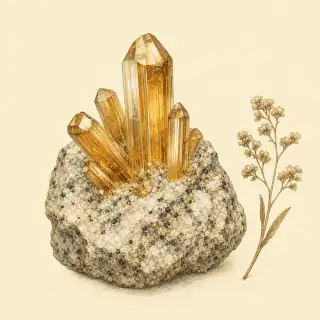
Two golden gems answer November, and the pair has been confused for centuries. The November birthstone meaning covers topaz, tied in old lapidary writing to strength and clear thinking, and citrine, traditionally associated with abundance and warmth. Citrine was sold under the topaz name for so long that shop labels still carry the error.
- Warmth
- Abundance
- Broken spells
The One Month Where the Old Count and the New List Agree
Treat this section as cultural history. Every November birthstone meaning below was recorded by medieval lapidaries, by traders with something to sell, or by modern practitioners, and no laboratory has ever confirmed one of them.
Topaz
Strength was the promise medieval lapidary texts made for topaz, along with a strange specific claim: the stone was believed to break enchantments and reveal poison by changing color. Greek writers before them held that it could make a wearer invisible in an emergency, and warriors are said to have carried it on that understanding. Egyptian tradition read the golden stone as light from the sun god Ra, caught and held. Crystal healing practice today keeps the calmer half of that inheritance, traditionally linking topaz to clear thinking and steady confidence.
| Chakra | Throat (Blue) / Solar Plexus (Golden) |
| Element | Fire |
| Zodiac | Scorpio, Sagittarius |
| Colors | Colorless, Blue, Yellow, Orange (Imperial), Pink |
Citrine
Money follows citrine through most of its folklore. Traders traditionally kept a piece in the till or the ledger drawer, which earned it the nickname the merchant's stone, and crystal healing practice still associates it with abundance and self-belief. Its color did the symbolic work: a warm yellow gem read as captured sunlight, so cheerfulness and vitality attached themselves early and never left. Greek carvers were shaping it into ornaments between 300 and 150 BCE, well before any of those meanings were written down.
| Chakra | Solar Plexus (Manipura) |
| Element | Fire |
| Zodiac | Leo |
| Colors | Yellow, Golden, Orange-brown, Honey |
How November's Stones Get Used
The traditions recorded for topaz are unusually concrete, down to a named writer and a stated method.
You encounter a medieval remedy while reading about topaz
Kunz records St. Hildegard’s wine-and-topaz remedy for dim vision. It shows how medieval writers assigned medical powers to gems. Do not repeat it: keep wine and stones away from your eyes. Topaz is not a treatment for failing eyesight.
Studying for something hard, or preparing an argument
Medieval lapidary writing credited topaz with strength and clear thinking, and crystal healing practice keeps that reading for anyone about to think under pressure.
A day you want warmth around you
Citrine's modern practice reading is warmth and abundance, and practitioners keep it where they work and leave it there. The reading is recent, and this page marks it as recent.
Marking a beginning
The golden colour both November stones share was traditionally tied to the sun's warmth, so practitioners put them on for openings and leave endings to other stones.
Can You Wear November’s Stones Every Day?
Topaz feels indestructible right up until the moment it is not. There is one flat direction inside the stone, and a blow at the wrong angle splits it in a single motion. Nothing about how tough it feels protects it from that.
- Treat a topaz ring as knock-sensitive whatever anyone tells you about how hard it is. Polishing cannot repair a split, and a split happens in one motion.
- Ultrasonic cleaners are the wrong tool for topaz, and steam adds heat on top of the vibration. Lukewarm water, a drop of dish soap and a soft-bristled brush is the entire procedure.
- Sunlight is citrine's weakness. Long exposure takes the yellow out, so a windowsill jewelry dish is a slow way to lose the color you paid for and a drawer costs nothing.
- Sudden temperature changes damage both stones for different reasons. Keep each of them well away from a hot car dashboard and a steam vent.
- Store the two apart from tougher neighbors. A sapphire or a diamond sharing the same pouch will mark citrine without any effort at all.
November's Agreement Stops at the Zodiac Table
November is unusual on this chart: the modern list and the older record name the same stone. That agreement ends the moment a third table enters.
All Eight Tables Named the Same Stone
Kunz's 1913 count of eight older gem lists gives topaz every vote available for November, with a single stray vote going to pearl. On a chart where most months are contested, this is the rare case where centuries-old records and the modern trade list land together.
Scorpio Is Given Something Else Entirely
Kunz's zodiac table cuts the month in half. Sagittarius, which takes over from November 21, is given topaz there, matching the calendar chart. Scorpio, which runs the first three weeks, is given the stone that led October's older tally, unrelated to topaz.
The Indian List Sends Topaz to December
There is a third table in the same book, drawn from Indian practice. It puts cat's-eye on November, a stone no European list names for any month, and moves topaz to the end of the year. Two traditions agreeing does not make a consensus.
Citrine Arrived Late and Without an Old Text
Topaz carries the full weight of the eight-table record. Citrine reached the American list in a later revision and has no comparable showing in the older tables, so what is said about it today rests on modern practice writing, not on the record Kunz was documenting.
Topaz or Citrine for a November Birthday?
Either one is correct. The 1912 list drawn up by American jewelers gave November to topaz by itself. The Jewelry Industry Council revised that list in 1952, and citrine joined topaz the same year tourmaline joined opal in October. Charts printed before the revision show one name for November, charts printed after it show two, and both describe the same official list at different moments.
Confusion followed the pair into the shops, because the two names were tangled long before either reached a birthstone chart. Citrine was sold as topaz for centuries, and the trade names left over from that habit are still circulating. Madeira topaz, Spanish topaz and smoky topaz contain no topaz whatsoever. Anything labeled topaz with no qualifier should be the real thing, and anything sold with a place name in front of it is worth a direct question.
Which Zodiac Signs Cover November Birthdays?
November spans two zodiac signs, and the boundary sits three weeks into the month. The Scorpio window closes on November 21, and Sagittarius takes the rest of the month from November 22. Someone born on November 9 is a Scorpio, whose modern zodiac stone is topaz, so the month chart and the sign chart agree for most of the month. Someone born on November 29 is a Sagittarius, whose modern zodiac stone is turquoise, and turquoise belongs to December on the month chart. The mismatch is ordinary. Month stones were fixed by the jewelry trade, zodiac stones descend from older astrological writing, and the two systems were never brought into line.
November Birthstone Questions People Ask
What is the official November birthstone?
Topaz and citrine are both official. Topaz held November alone from 1912, and the Jewelry Industry Council's 1952 revision added citrine. A chart printing a single name for November is printing the pre-1952 version.
Are topaz and citrine the same stone?
They are two unrelated stones that happen to share a color. Topaz is the tougher of the two and splits along one flat plane if it takes a bad blow at the wrong angle; citrine shrugs off knocks and dislikes sunlight instead. Trade names such as Madeira topaz describe citrine, and that habit is where most of the confusion started.
Is blue topaz a November birthstone?
Yes, and it is the same stone as golden topaz. Nearly all of it starts out colorless and is then irradiated and heated, a permanent treatment that reputable sellers disclose. Blue topaz shows up in December displays too, on retail habit alone, with no list behind it.
What color is the November birthstone?
Golden yellow through orange for both stones, and that shared color is how they came to share a month. Topaz also occurs colorless, blue and pink, and its orange-red imperial variety is the most valuable. Citrine runs yellow to honey-brown and stops there.
Is citrine or topaz better value for a November gift?
Citrine costs less at every size and takes daily wear reasonably well. Topaz gives more brilliance and asks to be kept clear of hard knocks in return. For a ring worn constantly, citrine in a protective setting is the lower-risk choice.
Is November the month where old and new actually agree?
Yes, and it is unusual for that. Topaz took every one of the eight historical tables for November, with a single stray vote for pearl. The disagreement only appears when you bring in the zodiac chapter, which gives Scorpio a different stone.
Do topaz and citrine carry different spiritual meanings?
Crystal healing practice traditionally links topaz to clear thinking and confidence, and citrine to abundance and optimism. Medieval writers went further, believing topaz could break spells outright. Every line of that is folklore, and no laboratory has found a gemstone producing any such effect.
November hands you one warm color delivered by two unrelated stones. Topaz is the more brilliant of the pair, and it wants a setting that keeps it clear of trouble. Citrine costs far less, and its only real enemy is a sunny windowsill. Sources for every dated claim sit at the bottom of this guide. The November birthstone meaning is kept in its own section and labeled as the belief it is.
November also has a flower on the calendar, the chrysanthemum. The birth flower chart tracks it alongside every month's birthstone.
Sources for November's Claims
These are the pages behind the claims above, all from the same public-domain study.
- All eight older gem lists named topaz for November
Kunz 1913, p.316
The tally gives topaz all eight votes, with a single stray vote for pearl and nothing else recorded. - Kunz's zodiac table splits the month between two different stones
Kunz 1913, p.345-347
Sagittarius appears there with topaz, dated November 21 to December 21, while Scorpio appears with the stone that led October's older tally. - St. Hildegard's topaz remedy for dimness of vision
Kunz 1913, p.389
“The use of a topaz to cure dimness of vision is strongly recommended by St. Hildegard. To attain the desired end the stone was to be placed in wine and left there for three days and three nights.” This quotation records a historical medical belief. It is not an eye-care instruction; do not put wine or gemstones in contact with your eyes. - An Indian month table assigns topaz to December, not November
Kunz 1913, p.331
That list gives November to cat's-eye and moves topaz to the year's last month.
References
- Topaz, Gemological Institute of America (GIA)
- Topaz, International Gem Society
- perseus.tufts.edu/hopper/text?doc=Perseus:text:1999.02.0137:book=37:chapter=32
- gutenberg.org/files/57978/57978-h/57978-h.htm
- Citrine, Gemological Institute of America (GIA)
- Citrine, International Gem Society
“The safest cleaning methods are also the easiest.”

 ?
?