 BirthstoneMeaning
 Aries Birthstone
 Taurus Birthstone
 Gemini Birthstone
 Cancer Birthstone
 Leo Birthstone
 Virgo Birthstone
 Libra Birthstone
 Scorpio Birthstone
 Sagittarius Birthstone
 Capricorn Birthstone
 Aquarius Birthstone
 Pisces Birthstone
 Peridot Meaning
 Garnet Meaning
 Amethyst Meaning
 Aquamarine Meaning
 Diamond Meaning
 Emerald Meaning
 Ruby Meaning
 Blue Sapphire Meaning
 Opal Meaning
 Topaz Meaning
 Moonstone Meaning
 Tourmaline Meaning
 Citrine Meaning
 Tanzanite Meaning
 Alexandrite Meaning
 Spinel Meaning
 Sardonyx Meaning
 Zircon Meaning
 Lapis Lazuli Meaning
 Rose Quartz Meaning
 Onyx Meaning
 Labradorite Meaning
 Malachite Meaning
 Jade Meaning
 Agate Meaning
 Carnelian Meaning
 Clear Quartz Meaning
 Black Tourmaline Meaning
 Smoky Quartz Meaning
 Sodalite Meaning
 Obsidian Meaning
 Fluorite Meaning
 Selenite Meaning
 Hematite Meaning
 Howlite Meaning
 September Birthstone
December Birthstone Meaning: Three Blue Stones for One Month
Three stones, three shades of blue, one month. December birthstone meaning runs through turquoise, traditionally worn for protection and honest speech, zircon, tied in old lore to restful sleep, and tanzanite, associated with insight. Their arrival dates span ninety years, and the newest was found on one Tanzanian hillside.
- Safe travel
- Truthful speech
- Insight
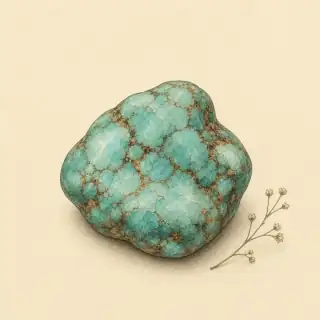
Ruby Outvoted Turquoise Almost Completely
The December birthstone meaning below comes from lapidary tradition and crystal healing practice, flagged as belief because that is what it is.
Turquoise
Protection on the road is turquoise's oldest job. Persian riders, Silk Road merchants and traders in the American Southwest all carried it as a guard against falls and misfortune, and the habit turns up in cultures with no contact between them. Crystal healing practice traditionally assigns turquoise to honest speech, and practitioners hand it to people walking into a difficult conversation.
| Chakra | Throat (Vishuddha) |
| Element | Earth |
| Zodiac | Sagittarius, Capricorn |
| Colors | Sky blue, Robin's egg blue, Green-blue, Blue with brown matrix |
Zircon
Sleep and honor are the qualities medieval European lapidaries assigned to zircon, which they knew as jacinth. It was traditionally believed to keep a traveler from harm and to drive off bad dreams. Modern crystal healing practice keeps the sleep association and adds prosperity.
| Chakra | Crown (Sahasrara) |
| Element | Earth |
| Zodiac | Pisces |
| Colors | Blue, Colorless, Yellow, Orange, Red, Green, Brown |
Tanzanite
Tanzanite is too young for ancient folklore, which makes its symbolism unusually easy to trace. The gem reached the market in 1968, and crystal healing writers of the following decades assigned it to insight and calm expression on the strength of its violet-blue color. Practitioners traditionally connect it to the third eye and the throat.
| Chakra | Third Eye and Throat |
| Element | Air |
| Zodiac | Sagittarius |
| Colors | Violet-blue, Blue-violet, Purple |
How December's Stones Get Put to Use
The December birthstone meaning splits three ways in practice: turquoise, zircon and tanzanite each carry a different job in the older record.
Setting out on a long or nervous journey
Kunz records jacinth as a travellers’ amulet reputed to ward off plague and injuries. Those are historical claims, without evidence of protection. A departure gift can symbolize a wish for safe return; a gemstone cannot prevent infection or injury.
Walking into a conversation you have been avoiding
Crystal healing practice traditionally ties turquoise to honest speech, and practitioners wear it before a talk that needs plain words.
You come across a story about jacinth and lightning
Old lore credited a jacinth, or wax impressed with its seal, with turning lightning away. That protective-charm story offers no safety measure. A stone or seal cannot make it safe to remain outside in a storm.
Needing calm before speaking in public
Tanzanite's folklore is younger than the stone's arrival on the market in the late 1960s, and the practice writers who followed tied its violet-blue to insight and clear expression. It is recent, and this page says so.
Can You Wear December’s Stones Every Day?
December's three stones each have a separate weak point, and none of them is obvious from holding the stone. Turquoise drinks. Tanzanite splits. Zircon chips along its edges.
- Turquoise takes up oil, sunscreen and sweat, and absorbed liquid will turn a bright blue permanently green. Get dressed first and put the piece on last, then reverse the order at the end of the day.
- A dry cloth is the entire cleaning routine for turquoise. Water carries dissolved soap into the stone and a cleaning machine drives it deeper, and none of it ever comes back out.
- One flat direction inside a tanzanite will split under a knock. Pendants and earrings are the safe settings, and a tanzanite ring wants a bezel around it.
- Zircon chips along its edges long before anything else shows. Store it apart from tougher stones and expect wear where the edges meet.
- Sunlight is worth avoiding for all three. Turquoise fades and greens under it, and some zircon drifts back toward its original color after a long summer on a sill.
Where December's Old and New Lists Split
December's modern chart leads with turquoise. The older eight-table count and the zodiac table both lean somewhere else, and by a wide margin.
Six Votes to Two
Count the eight older lists Kunz set side by side and ruby takes six of them for December. Turquoise, which leads the modern list, takes two, and the last two scatter between chrysoprase and bloodstone. The calendar table and the historical count point at different stones with little overlap.
Capricorn's Zodiac Stone Follows the Older Count
Kunz's zodiac table gives Capricorn ruby, the same stone that led the tally above, with its own verse: “Those who live in Capricorn No trouble shall their brows adorn If they this glowing gem have worn, The ruby.” Sagittarius, the other sign touching December, is given topaz there, a stone the calendar chart files under November.
Kunz Argued Against the Committee That Made the Modern List
He did not simply record the 1912 decision. On the page before he reproduces it, he warns that once the spirit of commercialism pure and simple is allowed to dictate the choice of these stones according to the momentary interest of dealers, people will lose interest in birthstones altogether. The man who preserved the modern list for us disapproved of how it was made.
Zircon's Older Name Belongs to Another Month's Argument
Zircon was long called jacinth, and jacinth is one of the two stones that contest January in the older tables. The same stone under two names sits on two different months depending on which century you are reading, which is a good measure of how stable these lists are.
When Did Tanzanite Join December’s List?
December answers to three names, and that is where the confusion starts. When the American trade fixed its calendar-month list in 1912, December held turquoise alongside lapis lazuli, and lapis has since dropped off the modern chart. A 1952 revision added zircon. Tanzanite joined in 2002, ninety years after the original list. All of this describes calendar months, and zodiac signs run on their own date boundaries and their own stone traditions.
Blue topaz turns up constantly in December searches, and topaz belongs to November on the very same chart. The blue material on the market is almost always colorless topaz that has been irradiated and heated, a standard and permanent treatment. Shops stock it in December because it is cheap and the color suits the month, so treat that pairing as commercial.
Which Zodiac Signs Cover December Birthdays?
December splits between Sagittarius and Capricorn. Sagittarius runs to December 21, and Capricorn opens on December 22 and carries on into January. Born on December 5, your month stone is turquoise and Sagittarius's modern zodiac stone is turquoise too, so both systems point the same way. Born on December 28, your month stones are still December's three, while Capricorn's modern zodiac stone is garnet, which belongs to January on the month chart. The two systems were built for different purposes.
December Birthstone Questions People Ask
What is the December birthstone called?
December carries three names on the modern American chart: turquoise, zircon and tanzanite. Turquoise is the oldest of the three and the one most jewelers print first. Retailers usually display only one. The month ends up looking like it has a single answer.
Is the December birthstone turquoise or topaz?
Turquoise. Topaz belongs to November on the same month chart. Blue topaz appears in December displays because its color suits the month and the material is cheap to produce, and that placement comes from retail practice with no birthstone list behind it.
December birthstone: tanzanite, zircon or turquoise?
All three are official, and they arrived at different times. Turquoise came in 1912, zircon in a 1952 revision, tanzanite in 2002. Pick by durability if the piece will be worn hard. Zircon takes daily wear best of the three, and turquoise takes it worst.
Is zircon the same as cubic zirconia?
No, and the near-identical names are the only thing they share. Zircon comes out of the ground, and some of it has been sitting there since close to the beginning of the planet. Cubic zirconia is grown in a laboratory to imitate diamond and has only existed since the 1970s. A seller who blurs the two is either careless or counting on you being.
Which December stone came off the older list?
Turquoise. It carried the month on its own in most older American and European lists, with lapis lazuli beside it on the 1912 chart. Zodiac tradition takes a separate route: December's Sagittarius portion is usually linked to topaz, and its Capricorn portion to ruby.
Why does the old record favour ruby for December?
Ruby took six of the eight historical tables, against two for turquoise. Kunz's zodiac chapter gives Capricorn ruby as well. The modern chart's turquoise answer comes from the 1912 trade committee, whose reasoning Kunz himself criticised in print.
What does the December birthstone mean spiritually?
Protection and honest speech are the qualities traditionally attached to turquoise, and crystal healing practice links it to the throat. Zircon carries older associations with restful sleep, and tanzanite with insight. All of this is belief inherited from lapidary writing and modern crystal practice, with no clinical support.
Three stones for one month is the record of a list that kept being revised. Turquoise brings five thousand years of use and needs the most care. Zircon brings a persistent name problem. Tanzanite brings one hillside and one color. Everything on the meaning side of this page is inherited belief, dated and sourced where the record allows. The December birthstone meaning on this page is tradition throughout, and the pages behind it are named above.
December also has a flower on the calendar, the narcissus. The birth flower chart tracks it alongside every month's birthstone.
Sources for December's Claims
Each claim above is anchored to a page in the same public-domain study.
- The older tally gave ruby six votes for December against turquoise's two
Kunz 1913, p.316
The count records ruby with six, turquoise with two, and the remaining two split between chrysoprase and bloodstone. - Capricorn's zodiac verse names ruby, matching the older tally
Kunz 1913, p.345-347
The Capricorn entry is dated December 21 to January 21 and its verse closes on the ruby. - Kunz warned against the commercial interest behind the modern list
Kunz 1913, p.318
“Once we allow the spirit of commercialism pure and simple to dictate the choice of such stones, according to the momentary interest of dealers, there is grave danger that the only true incentive to acquire birth-stones will be weakened…” - Jacinth, zircon's older name, was a traveller's amulet
Kunz 1913, p.81
“The jacinth was more especially recommended as an amulet for travellers, because of its reputed value as a protection against the plague and against wounds and injuries.” Kunz is recording a reputed power, not evidence that an amulet prevents disease or injury.
References
- Turquoise, Gemological Institute of America (GIA)
- Turquoise, International Gem Society
- perseus.tufts.edu/hopper/text?doc=Perseus:text:1999.02.0137:book=37:chapter=33
- gutenberg.org/files/57978/57978-h/57978-h.htm
- Zircon, Gemological Institute of America (GIA)
- Zircon, International Gem Society
- Tanzanite, Gemological Institute of America (GIA)
- Tanzanite, International Gem Society
“The safest cleaning methods are also the easiest.”

 ?
?