 BirthstoneMeaning
 Aries Birthstone
 Taurus Birthstone
 Gemini Birthstone
 Cancer Birthstone
 Leo Birthstone
 Virgo Birthstone
 Libra Birthstone
 Scorpio Birthstone
 Sagittarius Birthstone
 Capricorn Birthstone
 Aquarius Birthstone
 Pisces Birthstone
 Garnet Meaning
 Aquamarine Meaning
 Diamond Meaning
 Emerald Meaning
 Pearl Meaning
 Ruby Meaning
 Blue Sapphire Meaning
 Opal Meaning
 Topaz Meaning
 Turquoise Meaning
 Moonstone Meaning
 Tourmaline Meaning
 Citrine Meaning
 Tanzanite Meaning
 Alexandrite Meaning
 Spinel Meaning
 Sardonyx Meaning
 Zircon Meaning
 Lapis Lazuli Meaning
 Rose Quartz Meaning
 Onyx Meaning
 Labradorite Meaning
 Malachite Meaning
 Jade Meaning
 Agate Meaning
 Carnelian Meaning
 Clear Quartz Meaning
 Black Tourmaline Meaning
 Smoky Quartz Meaning
 Sodalite Meaning
 Obsidian Meaning
 Fluorite Meaning
 Selenite Meaning
 Hematite Meaning
 Howlite Meaning
 September Birthstone
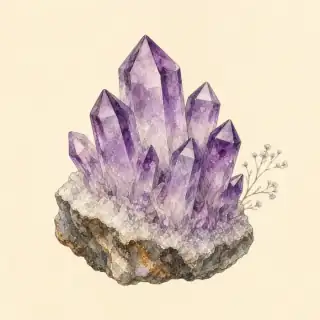
What Amethyst Crystal Means and How to Use It
Amethyst crystal meaning is associated with sobriety, clarity, and reflection in the traditions discussed here. The old belief that it prevented drunkenness was already disputed by Pliny. This guide separates that history from optional modern uses: a keepsake, a writing prompt, or a reminder to pause. A purple stone cannot explain why you found this page or what is happening in your life. You decide whether its stories mean something to you.
What Is the Spiritual Meaning of Amethyst in Your Life?
The first person to write down that amethyst stops you from getting drunk was calling it a con. In the first century, Roman author Pliny recorded this belief in Book 37, section 40 of Natural History. He flatly called it a falsehood spread by magi who wrote out of contempt for ordinary people. The tradition everyone repeats is two thousand years old, and the first man to record it called out the scam. People wanted an edge in rooms full of sweet talk. They wanted to keep their wits sharp while others lost control. The famous story about Bacchus turning a maiden into purple stone is another modern misunderstanding. Crystal sites repeat it as ancient Greek myth. In reality, French poet Rémy Belleau invented the entire tale in a poem published in 1576. Even February holds a surprising paper trail. The National Association of Jewelers chose amethyst as the official February stone during a 1912 meeting in Kansas City. Gemologist George Frederick Kunz recorded the vote in his 1913 book, The Curious Lore of Precious Stones, where he openly argued against their commercial list. When you hold amethyst, you carry real human history.
Amethyst can stand for a boundary you choose to keep. The purple stone is a reminder; deciding what you will accept remains your work. Think of the message you keep checking at midnight, or the invitation you accepted despite needing time alone. Name one change you want to make. A ring or a stone beside your phone can mark that choice without turning someone else's mood into an invisible force you need to block.
Zodiac Connection
This guide pairs amethyst with Pisces and Aquarius as modern symbolic readings. For Pisces, use the theme of reflection to ask which feelings are yours to act on. For Aquarius, use it to ask which idea you want to develop next. These are prompts based on familiar sign descriptions, not claims about everyone born under a sign. Crowley's amethyst correspondence with The Wheel of Fortune belongs to a separate occult table and does not establish either zodiac pairing.
The associations below trace to folklore and crystal practice. No study backs them.
How Can You Use Amethyst as a Reminder to Pause?
Physical Healing
A small amethyst crystal on your desk can mark the start of a task. Choose the task before you sit down, move distracting tabs out of view, and set the stone beside your written plan. This is a routine you arrange yourself. The stone does not attract opportunities or change how colleagues treat you. Its role is to keep a chosen intention visible while you do the work.
Emotional & Spiritual Healing
After a difficult Sunday evening, you might use amethyst as a prompt for a short journal entry: what happened, what you assumed, and what you can do next. You do not have to turn heartbreak or grief into a lesson immediately. Set the stone aside if the exercise feels like another demand. A symbolic object can accompany reflection without being responsible for recovery.
Chakra Association
This guide uses the modern crystal-practice association between amethyst and the Crown Chakra, Sahasrara. That is an esoteric correspondence. It does not describe a mineral acting on the brain. For a symbolic exercise, picture violet above your head while keeping the stone in your hand. Let that image stand for time away from demands. Vivid dreams, messages from guides, and an opened energy center are beliefs people may attach to the practice; this guide does not promise those experiences.
This is tradition and practice, not medical, financial, or life advice.
How Do You Use Amethyst Day to Day?
Wearing Amethyst
Wear an amethyst bracelet on whichever wrist is comfortable, or choose a pendant you enjoy seeing. Some modern crystal practitioners describe the left side as receptive; that symbolism does not make one wrist a filter against other people's emotions. Before a difficult conversation, touch the stone and recall the one point you wanted to make. The gesture is a cue you chose, and the words still come from you.
Amethyst in Your Home
An amethyst on the nightstand can mark the end of the working day. Put your phone away, leave tomorrow's list outside the bedroom, and let the stone be a familiar visual detail. At a desk, it can remind you to take a break from the screen. By the door, it can represent a welcoming home. These placements do not clear an energy field or protect against burnout.
Meditation with Amethyst
Try a brief reflection with the amethyst crystal resting in your palm. Sit comfortably and choose a length that suits you; no special number of minutes is required. Name one worry in a notebook, then distinguish what you know from what you are guessing. If violet light is an image you enjoy, imagine it while you pause. It is a visualization you supply, not a vibration emitted by the stone.
Cleansing & Charging
If you enjoy a monthly ritual, set amethyst indoors one evening and name an intention for the coming month. Full-moon timing is optional symbolism. It does not remove emotional residue from quartz. A clean dish is enough; smoke and another crystal are unnecessary. For actual dirt, follow the care instructions. Keep the stone away from prolonged direct sunlight, which can fade its purple color.
Crystal Combinations
Amethyst pairs well with these crystals for complementary energy in crystal healing practice:
- Sapphire for Symbolic pairing: combining spiritual calm with mental clarity and focused wisdom
- Diamond for Symbolic pairing: pairing amethyst's calming imagery with clarity and light
Amethyst answers to air and the crown chakra, so practice reaches for it when you need altitude on a problem. Garnet is the opposite instruction, fire held at the root, and people pair the two when they want a clear head without floating off. The garnet guide spells out that grounding half, down to the element and chakra it is filed under.
Caring for Amethyst
Cleaning: Lukewarm water with a little soap, then a soft brush. Rinse it, dry it, put it back on.
Avoid: Never charge amethyst on a sunny windowsill. That ritual is everywhere online, and sunlight takes the purple out for good.
Amethyst at a glance
- Also known as
- Bishop's stone, in older jewelry trade language
- Tradition
- Sobriety charm and business aid, per Leonardo via Kunz
- Chakra / element
- Crown chakra, Air
- In one line
- Historically a stone for keeping your head, not for feeling floaty.
- Try this first
- Hold it before you send the message you've drafted five times.
- Do not
- Don't credit it with an ancient Greek myth. The Bacchus story is a 1576 French poem.
Kunz, The Curious Lore of Precious Stones, 1913, pp.58-59, 406
Moments That Call For It
Specific situations, drawn from what the stone was actually used for.
Before you send an email you've rewritten five times
Kunz attributes claims about amethyst and judgment to Camillo Leonardo's lapidary. You can borrow that theme without crediting the stone with the power. Before sending an angry email, put the stone beside the keyboard and reread the message. Check the facts and decide whether it says what you intend.
The first night in a place that doesn't feel like home yet
Set the amethyst on a secure nightstand if it is a familiar keepsake in an unfamiliar room. Write down one thing you want to do tomorrow. This guide proposes that small routine; it does not come from an ancient sleep instruction. You do not need to test whether the stone improves your rest.
Walking into a negotiation where the other side has the leverage
Kunz records that Camillo Leonardo credited amethyst with business shrewdness. A salary talk or lease renewal lets you take that theme as a prompt for writing questions. Keep the stone in your pocket if you like, and read the terms before agreeing. The lapidary claim does not improve your judgment for you.
Not What You Read
Two claims about amethyst don't hold up the way crystal sites repeat them.
A French Poem, Not a Greek Myth
Rémy Belleau invented the Bacchus story in a French poem published in 1576, and Kunz's footnote on page 406 says so plainly. The maiden turned to stone, the tiger, the spilled wine: all of it is Renaissance verse called Amours et nouveaux eschanges des pierres précieuses. That puts the famous origin story more than a century younger than the printing press, and its roots are European, with nothing classical about them. Sites that call it ancient Greek lore are repeating a sixteenth-century poet's invention as if it predated Homer.
One Stone, A Dozen Jobs
Camillo Camillo Leonardo's lapidary, recorded by Kunz on pages 58 and 59, credit amethyst with restraining wicked thoughts, sharpening the wit, and giving an edge in business, on top of sobering a drinker and cooling excessive desire. The same stone was also carried by soldiers for protection, given to hunters for luck, and worn against plague. Modern practice keeps one job from that whole list, calm and clarity, and quietly drops the business sense, the plague ward, and the hunting luck without explaining why those parts didn't survive.
Frequently Asked Questions
What does amethyst crystal mean spiritually?
Amethyst crystal meaning centers on mental stillness, emotional boundaries, and spiritual clarity: crystal practice treats it as a stone that quiets racing thoughts and steadies your sense of self. The name traces to the Greek amethystos, not intoxicated, and the belief that a purple stone kept a drinker steady is nearly two thousand years old. The Roman writer Pliny recorded it in Book 37 of his Natural History, then called it a falsehood spread by magi who wrote out of contempt for ordinary people, the first man to write the claim down is also the first to call it a scam. Traditionally believed to calm the mind and strengthen intuition, amethyst is February's birthstone and is paired on this site with Pisces and Aquarius.
Which tarot card connects with amethyst?
This guide pairs Amethyst with Wheel of Fortune. Aleister Crowley put amethyst on row 21 of Column XL in 777, printed 1909, and row 21 is this card's own path. It is the only dated, named source pairing any stone with this card. These are correspondences within the named esoteric framework. They do not establish an effect on health or provide information about future events.
Which chakra does amethyst open?
This guide uses the modern crystal-practice association between amethyst and the Crown Chakra, Sahasrara. That is an esoteric correspondence. It does not describe a mineral acting on the brain. For a symbolic exercise, picture violet above your head while keeping the stone in your hand. Let that image stand for time away from demands. Vivid dreams, messages from guides, and an opened energy center are beliefs people may attach to the practice; this guide does not promise those experiences.
What happens when you sleep with amethyst under your pillow?
Sleeping with amethyst under your pillow is a folk practice for quieting racing thoughts and clearing mental residue from a busy day, not a documented physical effect. People who follow the custom describe it as creating a calmer space around the bed and supporting more vivid, memorable dreams, though none of that has been measured in any study. If you try it, a small tumbled stone works better than a large point, since sharp edges under a pillow are simply uncomfortable. Some practitioners set the stone on a nightstand instead for the same intention with less risk of knocking it onto the floor mid-sleep. Either placement is symbolic upkeep, the same category as a nightly journal entry, not a treatment for insomnia or anxiety.
Can you wear amethyst every day?
Yes, an amethyst crystal can be worn every day; nothing about the stone requires resting periods the way some cleansing rituals suggest for other gems. In crystal practice, wearing it on the left wrist or as a pendant is treated as building an energetic shield meant to deflect negativity and hold your attention steady in crowded, draining spaces, the left side is considered the receptive side in this tradition, the one that takes in ambient energy from a room. The rest periods you see recommended elsewhere for an amethyst crystal have no dated source behind them; this site looked for one and found none. The only real caution is prolonged direct sunlight, which can fade its violet color over months of exposure, not a spiritual rule about overuse.
Which zodiac signs should wear amethyst?
Pisces and Aquarius share the pairing with amethyst on this site, for different reasons rooted in each sign's traits not any dated historical source. Pisces is a water sign associated with heightened emotional absorption; in crystal practice amethyst is offered as a stabilizing counterweight, turning that sensitivity into grounded intuition not overwhelm. Aquarius runs on fast, future-facing ideas, and the stone is offered as a way to anchor big-picture thinking into follow-through. Crowley's 1909 table places amethyst with the Wheel of Fortune and Jupiter, not any specific sign, so it supports no zodiac pairing at all. The Pisces and Aquarius connection is this guide's own reading of the stone's traditional calming reputation against each sign's usual habits.
How do you cleanse and charge an amethyst crystal?
If you enjoy a monthly ritual, set amethyst indoors one evening and name an intention for the coming month. Full-moon timing is optional symbolism. It does not remove emotional residue from quartz. A clean dish is enough; smoke and another crystal are unnecessary. For actual dirt, follow the care instructions. Keep the stone away from prolonged direct sunlight, which can fade its purple color.
How do you know if amethyst is working for you?
You know amethyst is working, in the language of crystal practice, when you notice yourself reacting less impulsively to drama, sleeping more peacefully, and making decisions without the usual second-guessing. Practitioners describe a growing trust in their own instincts and a steadier baseline calm, especially in situations (a tense group chat, a demanding boss) that used to trigger an immediate spike of anxiety. None of this is a measurable outcome the stone produces; it is a description of what people notice when they have built a regular practice of pausing with the stone in hand before reacting. If nothing shifts for you, that is a fair result too. The value some people find is in the pause itself, not in the object.
Crystal practice also pairs amethyst with a card from the tarot deck. The Wheel of Fortune tarot guide covers that card's upright and reversed meaning, plus the zodiac sign tradition assigns to it.
Where This Traces Back
Named pages, not a vague ancient tradition.
- The Bacchus myth is a 1576 French poem, not ancient Greek lore
Kunz 1913, p.406, fn.52
Kunz's footnote names the source as Rémy Belleau's poem on precious stones, not a classical text. - Leonardo credited amethyst with sharpening business sense and restraining bad impulses
Kunz 1913, pp.58-59
The same notes add protection for soldiers, luck for hunters, and a ward against plague, a wider list than modern practice keeps.
References
- Amethyst, Gemological Institute of America (GIA)
- Amethyst, International Gem Society
- perseus.tufts.edu/hopper/text?doc=Perseus:text:1999.02.0137:book=37:chapter=40
- gutenberg.org/files/57978/57978-h/57978-h.htm
“The safest cleaning methods are also the easiest.”

 ?
?