 BirthstoneMeaning
 Aries Birthstone
 Taurus Birthstone
 Gemini Birthstone
 Cancer Birthstone
 Leo Birthstone
 Virgo Birthstone
 Libra Birthstone
 Scorpio Birthstone
 Sagittarius Birthstone
 Capricorn Birthstone
 Aquarius Birthstone
 Pisces Birthstone
 Peridot Meaning
 Garnet Meaning
 Amethyst Meaning
 Aquamarine Meaning
 Diamond Meaning
 Emerald Meaning
 Pearl Meaning
 Ruby Meaning
 Blue Sapphire Meaning
 Opal Meaning
 Topaz Meaning
 Turquoise Meaning
 Moonstone Meaning
 Tourmaline Meaning
 Citrine Meaning
 Tanzanite Meaning
 Alexandrite Meaning
 Spinel Meaning
 Sardonyx Meaning
 Zircon Meaning
 Lapis Lazuli Meaning
 Rose Quartz Meaning
 Onyx Meaning
 Labradorite Meaning
 Malachite Meaning
 Jade Meaning
 Agate Meaning
 Carnelian Meaning
 Clear Quartz Meaning
 Black Tourmaline Meaning
 Smoky Quartz Meaning
 Sodalite Meaning
 Obsidian Meaning
 Fluorite Meaning
 Selenite Meaning
 Hematite Meaning
 Howlite Meaning
 September Birthstone
Eight of Pentacles Meaning: Apprenticeship, Skill, and Steady Work
This is tradition and practice, not medical, financial, or life advice.
The Eight of Pentacles means dedication to a specific craft, steady employment, and the slow development of real skill. Arthur Edward Waite described this card as a sign of craftsmanship and business practice in its preparatory stages. Drawing this card suggests your current focus requires persistent, repetitive work to achieve mastery.
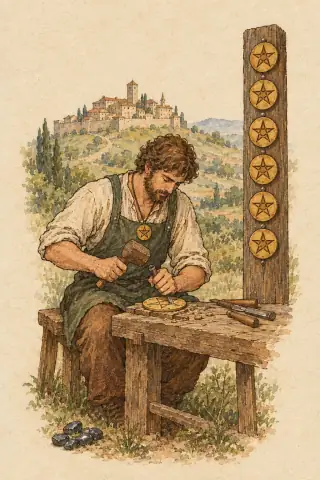
Understanding the Eight of Pentacles
In his 1911 publication The Pictorial Key to the Tarot, Arthur Edward Waite described the imagery of this card simply: "An artist in stone at his work, which he exhibits in the form of trophies." When this card appears upright in a reading, it points directly to this steady, diligent labor. Waite associated the card with "work, employment, commission, craftsmanship, skill in craft and business." He explicitly noted this often represents a "preparatory stage." You are putting in the required hours to master a trade, build a relationship, or finish a complex project. The work here requires repetition and intense focus. You sit at the bench and strike the chisel again and again until the technique becomes second nature. Many modern readers interpret this card as a call to eliminate distractions and concentrate entirely on the single task at hand. The trophies Waite mentions represent tangible results from focused effort. Your dedication produces visible, concrete outcomes. The Eight advises you to embrace the unglamorous phases of your journey. Keep your head down, refine your technique, and commit to the daily grind of genuine skill building.
When this Minor Arcana card appears reversed, Waite's 1911 text offers two distinctly different interpretations. First, he associates the reversed card with a failure of effort: "voided ambition, vanity, cupidity, exaction, usury." This points to laziness, taking shortcuts, or caring exclusively about appearing successful while avoiding the actual labor. You might find yourself abandoning a project because the required daily practice feels too tedious and unrewarding. Second, Waite provides an entirely separate angle, stating it can also signify "the possession of skill, in the sense of the ingenious mind turned to cunning and intrigue." In this register, the reversed Eight represents a highly competent person misusing their talents for dishonest or manipulative ends. The skill exists in abundance, yet the craftsman applies it toward fraud, cybercrime, or elaborate deception. When you draw this card upside down, evaluate your current situation carefully. Ask yourself whether you lack the necessary discipline to finish a demanding task. Alternatively, assess whether someone with genuine, undeniable expertise is quietly manipulating the system for personal gain.
Where Traditions Disagree: Dual Meanings and Modern Additions
- The reversed meaning of this card often suffers from severe oversimplification in modern tarot guides. Many quick-reference resources reduce the reversed card to a single concept: laziness, boredom, or a lack of focus. However, Waite’s original 1911 text clearly supports a dual meaning. He specifically outlined a lack of effort—labeling it "voided ambition"—alongside the active misuse of actual talent, calling it "the possession of skill... turned to cunning and intrigue." A skilled scam artist, a corrupt accountant, or a malicious hacker perfectly embodies this second meaning. Readers who flatten the reversed card into simple boredom miss this darker, highly specific interpretation of weaponized competence. You must evaluate the surrounding cards to determine which of these two reversed meanings applies.
- Modern crystal-and-tarot websites routinely pair the Eight with hematite, suggesting the stone perfectly matches the card’s focus-oriented, grounding energy. You will often see this presented as an ancient or official pairing rooted in mystical history. In truth, there is no documented historical source for a stone correspondence with minor arcana pip cards. Aleister Crowley’s 1909 reference book 777 provides an extensive table of precious stones, yet Column XL of that text only covers the twenty-two paths of the Major Arcana. The association with hematite belongs entirely to modern practitioner convention. Readers adopted this pairing recently to match the card's industrious energy with the stone's grounding properties. It does not stem from any foundational esoteric text.
The Eight of Pentacles in Daily Life
You sit at your kitchen table every Friday evening to discuss household finances and weekly scheduling with your partner. In love, this card represents this exact kind of unglamorous, consistent effort. You build a strong foundation through reliable communication and showing up daily to handle the practical matters.
Your supervisor assigns you to audit three years of expense reports in a quiet, isolated office. This card signals a phase of heads-down, highly repetitive labor. You must complete these tedious preparatory stages and prove your attention to detail before you earn a promotion or launch a highly visible initiative.
You transfer fifty dollars into your high-yield savings account on the first of every month without fail, ignoring the temptation to spend it. This card supports deliberate, disciplined financial habits. Your wealth grows through steady accumulation and strict adherence to a long-term budget, avoiding risky stock market gambles entirely.
You spend two hours every morning practicing scales on your acoustic guitar before leaving for your day job. Upright, this card validates your dedication to slow, deliberate practice. Mastery requires countless hours of invisible repetition, and your current daily routine successfully builds genuine, lasting competence for the future.
Stone & Sign Correspondence
Hematite. Modern tarot practitioners commonly pair this card with hematite, a stone associated with mental focus, physical grounding, and disciplined persistence. This pairing makes excellent thematic sense for a card representing steady, repetitive work. However, there is no documented historical source for this specific correspondence. The foundational esoteric tables, such as Aleister Crowley's 777, only list precious stones for the twenty-two Major Arcana paths. The link between hematite and the Eight remains a purely modern convention. Contemporary readers adopted the pairing to match the card's industrious, detail-oriented energy.
Virgo. In the Golden Dawn system, this Pentacles card corresponds to the Sun in the first decan of Virgo, covering 0 to 10 degrees of the sign. The Golden Dawn titled this card the "Lord of Prudence." This placement features a unique structural detail: it stands as one of only three first-decans in the entire zodiac ruled by the planet of the preceding sign. Virgo's natural planetary ruler is Mercury. However, this specific decan takes the Sun as its sub-ruler, carrying the solar energy over from Leo. The imagery of an apprentice craftsman illuminated by the Sun while doing precise, Virgo-style detailed labor aligns perfectly with this specific astrological attribution.
Common Misconceptions About This Card
Many people assume the Eight guarantees imminent wealth simply because the imagery depicts hard work. They read it as a basic guarantee of immediate financial success. This interpretation misses a critical nuance in Waite's 1911 definition. Waite specifically notes the card represents craftsmanship "perhaps in the preparatory stage." The Eight indicates you are actively building the foundation, making it entirely too early to expect a massive final payoff. Additionally, beginners frequently misunderstand the reversed card as representing pure laziness. Waite clearly outlined that a reversed Eight can mean "the ingenious mind turned to cunning and intrigue." The reversed card represents significant effort applied toward malicious or fraudulent goals. The labor exists, channeled into an elaborate scam.
Eight of Pentacles FAQ
- What does the Eight of Pentacles mean in love?
- In love readings, this card points to putting genuine, consistent effort into your partnership. Tradition holds that this energy favors showing up reliably and learning what your partner actually needs on a daily basis. The focus belongs on practical maintenance, abandoning grand romantic gestures. If you are single, it suggests you need to put deliberate, sustained effort into meeting people. Relationships require the same steady, attentive work as learning a complex new trade. This card asks you to commit fully to that ongoing, often unglamorous process of mutual growth.
- What does the Eight reversed mean?
- A reversed Eight indicates two very different problems. First, it can mean a lack of effort or commitment. You might find yourself cutting corners, feeling bored by repetitive tasks, or giving up on a project before reaching competence. In a relationship, workaholic tendencies might crowd out your partner. Second, based on Waite's original meanings, it represents real skill misapplied toward dishonest ends. A highly competent person might use their talents for fraud, cunning, or manipulation, choosing to exploit the system and abandon honest contribution entirely.
- Is the Eight a yes or no card?
- The upright Eight generally reads as a yes, specifically for questions concerning skill-building, formal education, or steady work eventually paying off. It confirms you are on the right track if you keep practicing your craft. Reversed, the card flips to a clear no. A negative pull suggests the current undertaking demands skills you have not yet developed. It also indicates you are rushing the necessary process. You must slow down, abandon the search for shortcuts, and hone your craft before expecting a positive outcome.
- What does the Eight mean for career?
- For career questions, this is the card of the apprentice or the focused specialist. It favors steady skill development, further training, and deliberate practice. Avoid flashy achievements or sudden promotions at this time. You are currently in a building phase, deep in repetitive tasks that will eventually lead to true mastery. Tradition suggests you should avoid taking any shortcuts right now. Put in the long hours at the workbench, refine your professional techniques, and accept that your current preparatory labor will yield tangible, lasting results later.
- Does the Eight represent a specific person in a reading?
- While typically viewed as an action or situation, this card frequently represents a specific type of person in your life. Many readers use this card to signify an apprentice, a devoted student, or a deeply focused craftsman. This individual possesses immense dedication to their specific field and often prefers quiet, detailed work. They are reliable and methodical. Occasionally, they miss the bigger picture because they remain entirely focused on the intricate details directly in front of them.
Primary Sources
- A. E. Waite, The Pictorial Key to the Tarot (Rider & Son, 1911). Public-domain divinatory meanings and image description for this card, Part III. Text as transcribed on Wikisource.
Explore More Tarot
Tarot is a tradition of symbolic interpretation, not a method of prediction. Treat every answer here as a prompt for reflection. Nothing on this page is medical, legal, or financial advice.
Sources & Editorial Basis
Month assignments follow the Jewelers of America birthstone list. Care guidance is checked against the Gemological Institute of America. Everything else here is folklore, astrology and crystal practice. We label each claim as tradition and name the text or the period we traced it to wherever one exists.
“The safest cleaning methods are also the easiest.”