 BirthstoneMeaning
 Aries Birthstone
 Taurus Birthstone
 Gemini Birthstone
 Cancer Birthstone
 Leo Birthstone
 Virgo Birthstone
 Libra Birthstone
 Scorpio Birthstone
 Sagittarius Birthstone
 Capricorn Birthstone
 Aquarius Birthstone
 Pisces Birthstone
 Peridot Meaning
 Garnet Meaning
 Amethyst Meaning
 Aquamarine Meaning
 Diamond Meaning
 Emerald Meaning
 Pearl Meaning
 Ruby Meaning
 Blue Sapphire Meaning
 Opal Meaning
 Topaz Meaning
 Turquoise Meaning
 Moonstone Meaning
 Tourmaline Meaning
 Citrine Meaning
 Tanzanite Meaning
 Alexandrite Meaning
 Spinel Meaning
 Sardonyx Meaning
 Zircon Meaning
 Lapis Lazuli Meaning
 Rose Quartz Meaning
 Onyx Meaning
 Labradorite Meaning
 Malachite Meaning
 Jade Meaning
 Agate Meaning
 Carnelian Meaning
 Clear Quartz Meaning
 Black Tourmaline Meaning
 Smoky Quartz Meaning
 Sodalite Meaning
 Obsidian Meaning
 Fluorite Meaning
 Selenite Meaning
 Hematite Meaning
 Howlite Meaning
 September Birthstone
Sodalite Meaning and Healing Properties Explained
The sodalite meaning centers on rational thought, honest communication, and objectivity. Crystal practitioners treat this deep blue stone as a tool for clearing mental clutter and speaking plainly. Named for its sodium content in 1811, sodalite later became closely tied to Canada, where a single 1913 survey listed it as the country's characteristic gem.
| Chakra | Throat (Vishuddha) |
| Element | Water |
| Zodiac | Libra |
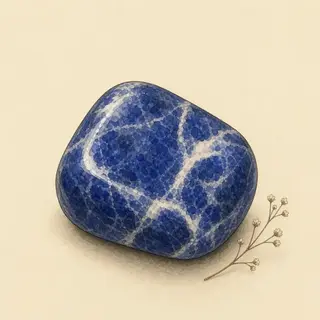
| Color | Royal blue, Blue with white veining, Gray-blue, Violet-blue |
What is the spiritual Sodalite meaning?
Sodalite carries a shorter written history than most gemstones on this site. Thomas Thomson, a Scottish chemist, first scientifically described the mineral in 1811 from material collected in Greenland, naming it for its high sodium content. For decades afterward it remained a scientific curiosity more than a gem. That changed after large deposits of vivid blue material turned up near Bancroft, Ontario, in the 1890s, giving the mineral a genuine national identity in Canada. George Frederick Kunz's 1913 survey of gemstones reflects that identity directly: in his own table pairing a characteristic stone to each nation, meant, in his words, to carry a kind of talismanic power for the people born there, Canada's entry reads simply, sodalite. Modern crystal practitioners have built a fuller tradition around the stone than Kunz's brief table entry, treating its cool blue color and calm, opaque surface as symbols of clear thinking and truthful speech. Because the mineral's own recorded history involves plainly stating a chemical fact, sodium content, as its very reason for being named, practitioners often lean on that origin as a natural metaphor for the stone's association with plain, accurate communication.
People reach for sodalite when a decision or a conversation calls for a level head over a reactive one. Practitioners describe the stone as useful for quieting an overactive inner critic, the voice that spins simple facts into worst-case scenarios. Holding a piece of sodalite before a difficult discussion is a common practice, framed as a way of steadying your own thinking before you try to steady someone else's. The stone's deep, even blue is often described as visually calming, giving anxious or racing thoughts a single steady point to rest on. Because sodalite's tradition leans so heavily on truth and objectivity, some practitioners use it specifically before conversations where they are tempted to soften or avoid an honest answer, treating the stone as a quiet prompt to say what is actually true.
Zodiac Connection
Libra is ruled by Venus and traditionally associated with balance and fair judgment, which lines up naturally with sodalite's own tradition of rational thought and honest communication already established above, since weighing a matter fairly depends on seeing it clearly and describing it truthfully.
Sodalite's association with clear thought and honest speech is a modern crystal-practice tradition, not a finding from any laboratory. Treat these claims as symbolic guidance drawn from folklore and personal practice, unverified outside that tradition.
How do practitioners use Sodalite for healing?
Physical Healing
In crystal practice, sodalite is associated with the throat and the head, the parts of the body most directly involved in speaking and thinking. Practitioners sometimes place a piece at the base of the throat during a session, reasoning that its cool surface encourages a relaxed jaw and an unhurried voice. People who spend long stretches of the day talking, teaching, presenting, negotiating, sometimes keep a piece on their desk as a tactile reminder to pace their speech. The stone's moderate hardness of 5.5 to 6 makes it easy to carry as a smooth, comfortable worry stone, handled during long calls or meetings without concern for scratching. This physical, tactile habit is one of the more ordinary ways people put the sodalite meaning into daily practice.
Emotional & Spiritual Healing
Sodalite's healing tradition leans heavily on emotional honesty. Practitioners describe the stone as useful for naming a feeling accurately without talking around it, treating the process of holding the stone and stating a feeling plainly as a small act of discipline. This makes it a common recommendation during disagreements, where practitioners suggest holding the stone while each person states their view as factually as possible before responding. Some also use sodalite to work through self-doubt, framing the stone's association with objectivity as a tool for separating an anxious feeling from the facts that actually support or contradict it. The practice is less about calming the emotion directly and more about giving a person a steadier way to examine it.
Chakra Association
Modern practitioners connect sodalite to the Throat chakra, known as Vishuddha, the energy center traditionally linked to communication and self-expression. Its deep blue color matches the hue conventionally assigned to this chakra in most modern systems. Practitioners place the stone directly on the throat during meditation, pairing it with slow breathing meant to loosen tension in the jaw and neck before speaking. A commonly cited use is preparing for a conversation where clarity matters more than diplomacy, treating the chakra work as a rehearsal for speaking plainly, not for performing confidence.
This is tradition and practice, not medical, financial, or life advice.
How Do You Use Sodalite Day to Day?
Wearing Sodalite
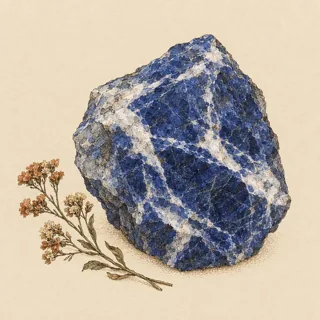
Sodalite appears most often in pendants worn near the throat, chosen deliberately for that placement given the stone's association with communication. Its Mohs hardness of 5.5 to 6 is soft enough that it benefits from a protective setting that shields its edges, particularly in a ring worn daily. Beads and cabochons are common because the stone's rich blue color and white calcite veining show well in a smooth, rounded cut. Because sodalite can be mistaken for lapis lazuli at a glance, some buyers specifically choose visibly veined material to make the identification clear at a distance. Extended contact with household chemicals or acidic cleaners should be avoided, since the stone's moderate hardness leaves it more vulnerable to etching than harder gems.
Sodalite in Your Home
A piece of sodalite on a desk used for writing, negotiating, or studying is a common placement, chosen for its traditional link to clear thinking. Some practitioners keep a piece near the phone or in a home office specifically for difficult calls, treating its presence as a small prompt toward calm, factual conversation. Because the stone is associated with truthful communication, a piece is sometimes placed in a shared family space, like a kitchen table, as a quiet symbol of honest conversation among household members, a small domestic echo of the sodalite meaning itself. Large raw chunks are popular as bookends or paperweights in a study, both for their deep color and their traditional association with steady, rational thought.
Meditation with Sodalite
A simple meditation practice involves resting a flat piece of sodalite directly on the throat while lying down, breathing slowly, and mentally rehearsing something true you have been avoiding saying. Some practitioners hold a piece in each hand while sitting upright, focusing on the sensation of cool stone against the palms as a way of settling scattered thoughts before a session of journaling or planning. Because the mineral's own history is tied to a specific chemical fact, its sodium content, some practitioners use that origin as a meditation anchor, returning attention to one simple, verifiable detail whenever the mind wanders into speculation or worry.
Cleansing & Charging
Clean sodalite with a soft cloth and mild soapy water, avoiding prolonged soaking since its moderate hardness makes it more porous than harder gems. Ultrasonic and steam cleaners should be avoided entirely, since both can damage the stone's calcite veining. Many practitioners cleanse sodalite by resting it near, not directly on, a larger cluster of clear quartz overnight, treating the harder stone's traditional clarity as a way of refreshing sodalite's own association with clear thought. A brief rinse in cool running water followed by air drying is sufficient for pieces worn daily.
Crystal Combinations
Sodalite pairs well with these crystals for complementary energy in crystal healing practice:
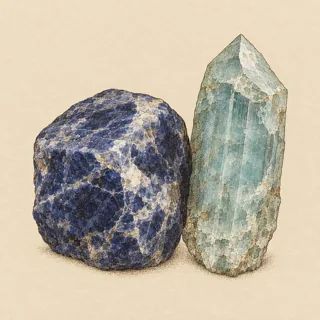
- Aquamarine for Both stones are traditionally linked to calm, clear communication, and practitioners pair them to support honest conversation with a gentler, more soothing tone than sodalite alone.
- Turquoise for Turquoise's long tradition as a protective communication stone pairs naturally with sodalite's focus on truthful speech, giving the combination both courage and clarity.
Caring for Sodalite
Cleaning: Warm soapy water and a soft cloth; avoid ultrasonic cleaners.
Avoid: Moderately soft; avoid scratching, acids, and prolonged heat exposure.
Your crystal profile
Is Sodalite Your Birthstone?
Month
Day
Sodalite is linked to Libra. Enter your birthday above to see if it matches your sign.
Pairs well with
Sodalite at a glance
- Also known as
- Canada's national gem, per Kunz's 1913 table
- Tradition
- Traditionally believed to support rational thought and honest communication
- Chakra / element
- Throat (Vishuddha) / Water
- In one line
- A deep blue sodium aluminum silicate tied to clear thinking and truthful speech.
- Try this first
- Hold a piece while rehearsing a difficult conversation to prompt plain, honest wording.
- Do not
- Ultrasonic cleaners and prolonged soaking, which can damage its calcite veining.
Kunz, The Curious Lore of Precious Stones, 1913, p.363
When to Reach for a Clear-Thinking Stone
The sodalite meaning points toward moments when what a person needs most is a level head and a plain answer.
Ten minutes before sending an email you have rewritten five times.
You hold a smooth piece of sodalite in your palm and read your draft out loud one more time. The stone's tradition of plain, honest communication gives you a prompt to cut the hedging language and say what you actually mean. Practitioners describe this as separating the anxious impulse to soften a message from the factual content the message actually needs to carry.
Sitting across from a friend during a disagreement you still have not named out loud.
You set a piece of sodalite on the table between you before the conversation starts. Crystal practice treats this small gesture as an agreement to speak plainly and stop talking around the actual issue. Holding the stone while you state your side of things as factually as you can is a common way practitioners use it to keep a hard conversation from drifting into blame.
Late on a Sunday night, planning the week ahead and feeling scattered.
You rest a piece of sodalite on your desk next to your planner and take a few slow breaths before writing anything down. The stone's traditional association with clear, rational thought is used here as a cue to separate what actually needs doing from the vague anxiety about the week that tends to crowd it out.
Named Canada's Gem, Explained in Two Words
Kunz's 1913 survey ranks among the most detailed gem histories of its era, which makes its treatment of sodalite an unusually narrow exception.
A National Gem With No Elaboration
George Frederick Kunz built a table pairing a characteristic stone to each nation, explaining that the idea, drawn from older custom, held that a national gem carried a kind of talismanic power for the people born there. Most entries in that same table connect to pages of discussion elsewhere in Kunz's book. Canada's entry does not. It reads simply, sodalite, with no further comment anywhere in the text. The book that devotes paragraphs to a single carnelian seal or a single sixteenth-century crystal ball gives Canada's own named gem exactly one word.
A Modern Mineral the Record Nearly Skipped
Sodalite is not a stone too new for Kunz to have known; it had already been scientifically described for over a century by the time he wrote. Thomas Thomson named the mineral in 1811 from Greenland material, and vivid Canadian deposits near Bancroft, Ontario, had already been commercially significant for two decades before Kunz's 1913 book appeared. Despite that, nineteenth and early twentieth century gem literature said very little about sodalite compared to older, more storied stones. The one written record this project can point to, Kunz's own table, documents that Canada claimed the stone, not why it mattered.
Frequently Asked Questions
What is the core sodalite meaning in crystal practice?
The core sodalite meaning is rational thought and honest communication. Practitioners treat this deep blue stone as a tool for cutting through mental clutter and speaking plainly, often reaching for it before a conversation or decision that calls for clarity over reactive emotion. The tradition draws loosely on the stone's own history: it was named in 1811 for a plain chemical fact, its sodium content, which practitioners sometimes read as a fitting origin for a stone associated with stating things accurately.
Why does Kunz's 1913 book say so little about sodalite?
Kunz's own survey names sodalite as Canada's characteristic national gem in a table covering stones from dozens of countries, but gives it no further discussion anywhere else in the book. The mineral was not too new for Kunz to know about: it had already been named in 1811, decades before he wrote. The one-line treatment reflects a real gap in Kunz's own research. Canadian deposits were already commercially significant by the time his book appeared, so the omission says more about his sources than about the stone's importance to the modern sodalite meaning practitioners describe today.
How is sodalite different from lapis lazuli?
Sodalite and lapis lazuli share a similar rich blue color and are frequently confused at a glance, but lapis lazuli is a rock made of several minerals, including the gold-flecked mineral pyrite, while sodalite is a single mineral, a sodium aluminum silicate chloride, that typically shows white calcite veining, not the gold flecks lapis lazuli is known for. Sodalite also registers slightly softer on the Mohs hardness scale, at 5.5 to 6 compared to lapis lazuli's 5 to 5.5, though the two overlap closely enough that a jeweler's inspection is the most reliable way to tell them apart.
How do you clean and care for sodalite jewelry?
Clean sodalite with a soft cloth and mild soapy water, avoiding prolonged soaking, since its moderate hardness of 5.5 to 6 makes it more porous than harder gems. Skip ultrasonic and steam cleaners entirely, since both can damage the stone's characteristic white calcite veining. A quick rinse in cool running water followed by air drying is enough for pieces worn regularly, and storing sodalite separately from harder stones like quartz or topaz prevents accidental scratching.
Who should wear sodalite?
Professionals and mediators requiring clear thinking highly value this deep blue stone. Crystal folklore associates its water element energy with supporting truthful speech and rational thought. Practitioners traditionally recommend it for rehearsing difficult conversations. By connecting to the throat chakra, it is believed to prompt plain and honest wording during crucial interactions.
What zodiac sign is sodalite for?
Astrological beliefs closely tie this deep blue mineral to Libra. People born under this sign constantly strive for balance and fairness in their relationships. Crystal practitioners say the throat chakra energy of the stone encourages them to communicate their true feelings openly. Folklore holds that its rational properties support their natural diplomatic skills.
What the Record Actually Says About Sodalite
Kunz's own 1913 text and a modern mineralogical source together cover what little the historical and scientific record says about this stone.
- Kunz's 1913 survey names sodalite as Canada's characteristic national gem.
Kunz 1913, p.363
In a table pairing a representative stone to each nation, meant to carry a kind of talismanic significance for that country's people, Kunz lists Canada's entry simply as sodalite, with no further elaboration anywhere else in the book. - Sodalite was scientifically named in 1811 for its sodium content, based on material from Greenland.
mindat.org, Sodalite mineral data, 2026
Mindat's mineralogical record documents sodalite's 1811 description by the Scottish chemist Thomas Thomson, its formula and Mohs hardness of 5.5 to 6, and its occurrence in alkaline igneous rock including the Bancroft, Ontario deposits that later made the stone commercially significant in Canada.
References
“The safest cleaning methods are also the easiest.”