 BirthstoneMeaning
 Aries Birthstone
 Taurus Birthstone
 Gemini Birthstone
 Cancer Birthstone
 Leo Birthstone
 Virgo Birthstone
 Libra Birthstone
 Scorpio Birthstone
 Sagittarius Birthstone
 Capricorn Birthstone
 Aquarius Birthstone
 Pisces Birthstone
 Garnet Meaning
 Aquamarine Meaning
 Diamond Meaning
 Emerald Meaning
 Pearl Meaning
 Ruby Meaning
 Blue Sapphire Meaning
 Opal Meaning
 Topaz Meaning
 Turquoise Meaning
 Moonstone Meaning
 Tourmaline Meaning
 Citrine Meaning
 Tanzanite Meaning
 Alexandrite Meaning
 Spinel Meaning
 Sardonyx Meaning
 Zircon Meaning
 Lapis Lazuli Meaning
 Rose Quartz Meaning
 Onyx Meaning
 Labradorite Meaning
 Malachite Meaning
 Jade Meaning
 Agate Meaning
 Carnelian Meaning
 Clear Quartz Meaning
 Black Tourmaline Meaning
 Smoky Quartz Meaning
 Sodalite Meaning
 Obsidian Meaning
 Fluorite Meaning
 Selenite Meaning
 Hematite Meaning
 Howlite Meaning
 September Birthstone
What Peridot Crystal Means and How to Use It
Peridot crystal meaning, in this guide, centers on renewal and reflection. Its protective folklore and disputed old names offer stories to explore, without showing that it removes grudges or reveals a hidden truth. You hold a stone once hunted in total darkness. The ancient writer Diodorus Siculus recorded that guards patrolled a Red Sea island under orders to execute any trespasser. Even official gatherers could not spot the gem by day. In noon glare, it vanished against rock. In his account, it revealed itself after nightfall by its own radiance. This ancient report does not establish an observed property of modern peridot. Searchers marked the glowing ground, walked away, and returned the next morning to collect what night uncovered. That hunt matches what you feel at two in the morning. Daylight asks you to perform. Peridot asks what shines when the crowd goes home.
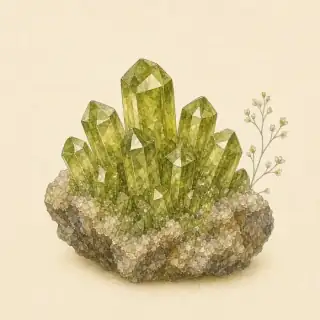
Why Was Peridot Hidden in the Dark for Generations?
This stone carries a history of mistaken identity and quiet power. During the Crusades, European travelers brought large green gems back from the East. Many entered church collections catalogued as emeralds. The most famous rest in Cologne Cathedral, set into the Treasury of the Three Magi. Some measure nearly two inches across. Pilgrims admired them as emeralds. They were peridots the whole time. Carrying value while people call you by the wrong name is a familiar pain. If you have ever felt misjudged, this stone shares that history. George Frederick Kunz noted in 1913 that chrysolite, the historical name for peridot, had to be set in gold to exert full power against night fears. Another formula required piercing the stone, stringing it on donkey hair, and binding it to the left arm to repel dark spirits. These are historical charm instructions. The metal and hair do not make a stone protect its wearer.
Peridot's night-fear lore can become a metaphor for something you are reluctant to face. It does not show that the stone removes resentment. If you keep revisiting an old argument, write down what remains unresolved and whether any action is possible. Keep the peridot crystal beside the page if you like the association. You need not forgive someone, confront them, or reach closure to satisfy a stone's meaning.
Zodiac Connection
Kunz's zodiac table assigns chrysolite to Libra, with a verse about release from an evil spell. This site interprets that old gem name as peridot, while recognizing the identification problem in historical terminology. Leo and Virgo are our modern pairings. We use warmth and careful attention as reflection themes; the peridot crystal does not regulate ego or silence an inner critic. Six of Kunz's eight historical month lists put chrysolite in September, while the 1912 trade list gives peridot an alternate August position.
Peridot's associations below are folklore, and folklore is not a scientific claim.
How Can Peridot Symbolize Renewal?
Physical Healing
Before a meeting, you might use peridot's green color as a reminder of the point you want to state clearly. Write the point and the evidence supporting it before putting on the ring. A symbol can mark preparation. It cannot command respect, make doors open, or determine how other people respond. Your account of what happened matters more than whether the stone felt powerful.
Emotional & Spiritual Healing
At the end of the day, put peridot beside a note about something you would handle differently next time. Add one thing you could reasonably do tomorrow. This optional exercise gives the green stone a personal association with another attempt. It does not burn away guilt, cure sleeplessness, or require you to wake up optimistic. Leave the note unfinished if you need more time.
Chakra Association
The Solar Plexus and Heart are peridot's pairings in the modern crystal framework used here. They represent will and connection within that framework. Holding the stone in your palm can mark a reflection on how to be clear and considerate at once. No energy center has to be diagnosed as blocked, and the mineral does not align two parts of the body.
This is tradition and practice, not medical, financial, or life advice.
How Do You Use Peridot Day to Day?
Wearing Peridot
Kunz records a gold-setting rule in chrysolite's protective folklore. A gold setting can recall that story, but it does not protect against night fears; no costly metal is necessary for a meaningful keepsake. Wear peridot on either hand or as a pendant you enjoy. A left-hand energy filter is a modern belief, not a feature of the jewelry. Use a secure setting and protect the stone from blows.
Peridot in Your Home
Set peridot near the notebook where you plan your week. Let it stand for a question about renewal: which task needs another attempt, and which can you stop doing? At the bedside it can mark the end of that planning session. It does not interrupt scarcity fears or quiet a mind by itself. Keep the display clear of heat and accidental knocks.
Meditation with Peridot
The story of a green stone found after dark is ancient testimony, not proof that peridot glows by its own light. You can still borrow the image for a short reflection. Hold the peridot crystal and ask which overlooked detail deserves attention. Write the detail and how you could check it. A green-flame visualization, if you use one, is imagined imagery. It does not clear your thoughts as a force.
Cleansing & Charging
Place peridot on a clean cloth and speak one intention you want to revisit. You can choose an evening under the full moon as a personal calendar marker. This guide proposes the exercise; the historical gold-setting story does not prescribe it. Moonlight does not recharge the stone, and smoke is unnecessary. Follow the care instructions when the surface needs cleaning.
Crystal Combinations
Peridot pairs well with these crystals for complementary energy in crystal healing practice:
- Opal for Symbolic pairing: combining optimistic renewal with creative emotional expression
- Rose Quartz for Symbolic pairing: pairing heart-chakra work and emotional openness
- Clear Quartz for Symbolic pairing: traditionally believed to represent peridot's imagery for intention-setting
- Garnet for Symbolic pairing: balancing optimism and renewal with grounding Root Chakra stability
Peridot held August alongside sardonyx for most of a century, until the American trade added spinel in 2016 and turned it into a three-stone month. The August birthstone guide sets out how the three divide the month and which one each tradition reaches for first.
Caring for Peridot
Cleaning: Warm soapy water and a soft brush. Keep peridot out of cleaning machines and away from steam.
Avoid: Wipe it after wear, because sweat alone will dull the surface and lemon juice or vinegar does worse. Never move it from cold to hot in a hurry.
Peridot at a glance
- Also known as
- Called topazius by the ancients, a name history later handed to the stone we now call topaz.
- Tradition
- Historical lapidaries required peridot set in gold to work against night fears; a plain setting reportedly fell short.
- Chakra / element
- Heart and solar plexus, Earth. Assigned by present-day practice, not by Kunz.
- In one line
- Peridot's calendar spot and its old name both trace back to disputes nobody ever resolved.
- Try this first
- If you're facing an August birthday gift decision, say plainly that peridot's month is disputed, and that Kunz objected to the change.
- Do not
- Don't call any old green stone labeled 'topaz' a mistake before you check whether it's actually peridot under an older name.
Kunz, The Curious Lore of Precious Stones, 1913, p.67, p.291, p.297, p.320.
Real Moments to Work With Peridot
Occasions that suit a stone whose whole story is about being mistaken for something else.
You inherit a family ring described in an old Bible or letter as 'topaz,' and the stone in the setting is green, not yellow.
Don't assume someone mislabeled it recently. Ancient writers used 'topazius' for the stone we call peridot today, and 'chrysolite' for what we now call topaz. The two names swapped somewhere along the way and stuck. A green stone called topaz in an old document is more likely peridot wearing its ancestor's name than a mistake made by whoever wrote the label. Get it checked before you assume the wrong thing.
You're shopping for an August birthday gift and the store chart lists peridot like it's always belonged to that month.
It hasn't, and the man who documented the change said so in print. Six of the eight historical lists Kunz gathered gave that stone's slot to September, and he called the 1912 switch to August 'another undesirable change' in his own book. Buy the peridot if it's the right stone for the person, just don't repeat the settled-tradition line on the card. Say it's the stone with a documented dispute behind it instead.
You've been carrying resentment toward someone who hurt you months ago and you know it's not helping you anymore.
Kunz records protective beliefs about chrysolite set in gold. If you like the symbol, hold a peridot crystal while writing about what remains unresolved. Decide whether you want to talk to someone you trust. This is an optional reflection exercise, with no promise that speaking once will release resentment.
The Name Swap and the Move Kunz Opposed
Peridot spends its whole history answering to another stone's name, and peridot crystal lore still carries the confusion. What follows is folklore and crystal tradition, not a statement about the mineral itself.
The Topaz in Your Old Book Is Actually Me
Ancient writers describing 'topazius' were talking about the stone you're holding right now, not the yellow gem sold as topaz today. Kunz traced the mix-up: the ancients called peridot topazius and called what we now sell as topaz chrysolite, then somewhere between antiquity and the modern gem trade the two names traded places for good. Every classical or early Biblical reference to a glowing 'topaz' predates that swap and is almost certainly describing a green stone, and peridot is the green one. Read an old text about a radiant topaz and the stone on the page is probably this one.
Kunz Called This Move 'Undesirable', Twice
Kunz didn't just record the 1912 reshuffle, he pushed back on it in his own book. He called the change that dropped peridot from its historical month down to a secondary slot for August 'another undesirable change,' and the word 'another' means he'd already flagged a different swap as a mistake on the very same page. Every birthstone chart printed since 1912 treats August as peridot's settled home, no asterisk, no dispute noted. The person compiling the record that year called it wrong while it was still happening, and nobody ever undid it.
Frequently Asked Questions
What is a peridot crystal good for?
Peridot crystal meaning in practice centers on warmth without ego and quiet emotional openness, but the stone's documented history is as much about mistaken identity as it is about virtue. Many of Cleopatra's famous 'emeralds' are now believed to have been peridots from Zabargad island, which Egyptians worked for over 3,500 years, posting guards with orders to kill trespassers. Ancient Romans called peridot the 'evening emerald' specifically because its green color did not darken under lamplight the way true emerald does, a practical distinction, not a poetic one. Peridot has a documented history of being carried into church treasuries under the wrong name, most famously in the Treasury of the Three Magi in Cologne Cathedral, where large peridots were catalogued and admired for centuries as emeralds.
Does peridot appear in any tarot table?
This guide pairs Peridot with The Hermit, The Sun. Peridot sits on row 20 of Column XL in Crowley's 777, printed 1909, The Hermit's own path. Peridot forms in olivine deep underground, pulled from the dark to catch the light. Peridot marks two rows in Crowley's 777 (1909), row 20 of Column XL for The Hermit and row 30 for The Sun. Peridot flashes gold green in direct light, plain as this card. These are correspondences within the named esoteric framework. They do not establish an effect on health or provide information about future events.
Why is peridot the birthstone for August?
The peridot crystal's placement on the August birthstone calendar traces to a single trade vote, not ancient tradition. Six of the eight historical lists Kunz gathered for his 1913 research assign September, not August, to chrysolite, peridot's older name. At the Kansas City meeting in August 1912, the jewelers' trade voted September over to sapphire instead and dropped peridot to an alternate position for August, behind sardonyx as the primary choice. Kunz openly objected to this specific change in his 1913 book, calling it undesirable and inconsistent with the historical record he had just laid out. Peridot's August association, in other words, is the result of a committee reshuffling several stones at once in a single afternoon, not a tradition with any depth behind it.
Which zodiac sign matches peridot?
This site pairs peridot with Leo and Virgo in modern astrology, alongside Libra from Kunz's own dated 1913 zodiac list, which assigned the stone to that sign with a printed verse about freeing yourself from an evil spell. For Leo, peridot's traditional warmth without ego is offered as a check on Leo's sun-ruled intensity, keeping confidence from tipping into self-absorption. For Virgo, the same stone is offered as a way to quiet an overactive inner critic, turning Virgo's attention to detail toward self-compassion, not perfectionism. Libra carries the historical, sourced claim from Kunz's research; Leo and Virgo are this site's own modern reading of the stone's traits against each sign's typical patterns, and this site distinguishes the two and does not present all three as equally documented.
What ancient ritual rules exist for peridot?
Old lapidary instruction recorded by George Frederick Kunz in 1913 set specific rules for the peridot crystal's protective use: the stone, then called chrysolite, had to be set in gold to exert its full power against night terrors, since a plain or improperly mounted stone was believed to fall short of its potential. A separate, more elaborate ritual required piercing the stone, threading it onto donkey hair, and binding the whole assembly to the left arm to repel dark spirits specifically, a method distinct from simply wearing the stone as jewelry. Kunz recorded these as documented historical practices not his own recommendation. Modern practice generally skips the donkey hair and the piercing, keeping the underlying idea that peridot needs a deliberate, careful setting to do the symbolic work people ask of it.
Why was peridot mistaken for emerald in European cathedrals?
European travelers returning from the Crusades brought large green gems back from the East, and many of these entered church collections catalogued simply as emeralds. The most famous examples remain in Cologne Cathedral, set into the Treasury of the Three Magi, with some pieces measuring nearly two inches across; pilgrims for centuries admired them specifically as emeralds. Modern gemological analysis has identified these stones as peridot, most likely sourced from Zabargad island in the Red Sea, which the Egyptians worked and guarded for over 3,500 years. The mistake persisted because peridot and emerald share a similar green color under many lighting conditions, and pre-modern gemology had no reliable way to distinguish the two minerals, a case of misidentification that lasted for centuries in one of Europe's most visited church treasuries.
Which chakra connects to peridot?
The Solar Plexus and Heart are peridot's pairings in the modern crystal framework used here. They represent will and connection within that framework. Holding the stone in your palm can mark a reflection on how to be clear and considerate at once. No energy center has to be diagnosed as blocked, and the mineral does not align two parts of the body.
How do you energetically cleanse peridot?
Place peridot on a clean cloth and speak one intention you want to revisit. You can choose an evening under the full moon as a personal calendar marker. This guide proposes the exercise; the historical gold-setting story does not prescribe it. Moonlight does not recharge the stone, and smoke is unnecessary. Follow the care instructions when the surface needs cleaning.
The Primary Record Behind Peridot's Claims
Where the name confusion and the September argument behind peridot crystal practice are written down.
- The ancients called peridot 'topazius,' the name now attached to an entirely different yellow gem.
Kunz 1913, p.291
Kunz records the name swap between topazius and chrysolite, tracing how each label moved to the other stone. - What the ancients called 'chrysolite' is the stone sold today as topaz, not peridot.
Kunz 1913, p.297
The reverse half of the same naming swap, confirmed on a separate page of Kunz's record. - Kunz called the 1912 committee's move of peridot's slot to a secondary position for August 'another undesirable change.'
Kunz 1913, p.320
Quoted directly: "another undesirable change," written the same year the trade adopted the current calendar.
References
- Peridot, Gemological Institute of America (GIA)
- Peridot, International Gem Society
- gutenberg.org/files/57978/57978-h/57978-h.htm
“The safest cleaning methods are also the easiest.”

 ?
?