 BirthstoneMeaning
 Aries Birthstone
 Taurus Birthstone
 Gemini Birthstone
 Cancer Birthstone
 Leo Birthstone
 Virgo Birthstone
 Libra Birthstone
 Scorpio Birthstone
 Sagittarius Birthstone
 Capricorn Birthstone
 Aquarius Birthstone
 Pisces Birthstone
 Peridot Meaning
 Garnet Meaning
 Amethyst Meaning
 Aquamarine Meaning
 Diamond Meaning
 Emerald Meaning
 Pearl Meaning
 Ruby Meaning
 Blue Sapphire Meaning
 Opal Meaning
 Topaz Meaning
 Turquoise Meaning
 Moonstone Meaning
 Tourmaline Meaning
 Citrine Meaning
 Tanzanite Meaning
 Alexandrite Meaning
 Spinel Meaning
 Sardonyx Meaning
 Zircon Meaning
 Lapis Lazuli Meaning
 Rose Quartz Meaning
 Onyx Meaning
 Labradorite Meaning
 Malachite Meaning
 Jade Meaning
 Agate Meaning
 Carnelian Meaning
 Clear Quartz Meaning
 Black Tourmaline Meaning
 Smoky Quartz Meaning
 Sodalite Meaning
 Obsidian Meaning
 Fluorite Meaning
 Selenite Meaning
 Hematite Meaning
 Howlite Meaning
 September Birthstone
Jade Meaning and Healing Properties Explained
Jade meaning covers two different minerals, nephrite and jadeite, which share one name but not one chemistry. Chinese tradition treated jade as an amulet for luck, love, and family continuity for centuries. Gemologist George Frederick Kunz documented these customs in 1913, alongside a separate Spanish word origin tied to kidney-healing folklore.
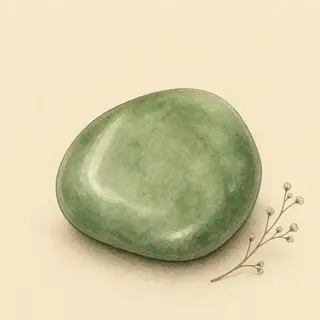
| Chakra | Sacral (Svadhisthana) |
| Element | Earth |
| Zodiac | Virgo |
| Color | Green, White, Lavender, Yellow, Black, Orange |
What Is the Traditional Spiritual Jade Meaning?
The cultural jade meaning begins with a distinction most casual buyers never learn. George Frederick Kunz opens his 1913 chapter on the stone with a direct definitional claim: "The name jade includes two distinct minerals, nephrite and jadeite." Nephrite is a calcium-magnesium silicate from the amphibole group, and it was the jade used across ancient China for most of its history. Jadeite is a sodium-aluminum silicate from the pyroxene group, generally rarer and more vividly colored, and it did not reach China in significant quantities until the eighteenth century, arriving overland from Myanmar. Both minerals share the name jade because they share a similar toughness and a similar range of green coloring, and not because they share one chemical formula. Kunz documented an entire ecosystem of Chinese jade amulets on pages 84 and 85 of his book. Friends exchanged a jade carving of two men called "Two Brothers of Heavenly Love." Families gave a young girl a jade phoenix ornament when she came of age. A newly married couple received a jade figure of a man riding a unicorn and holding castanets, a piece meant to signal that an heir would arrive in due time. The richest single custom Kunz records is the jade nuptial cup, carved in the shape of a cock, from which both bride and groom drank at Chinese wedding feasts. Kunz explains the legend behind its shape: a devoted white cock watched its young mistress drown herself in a well after losing her lover, and the bird then sought death in the same well, "so as not to be separated from its mistress." The cup's shape carries that story of loyalty into every wedding table where it appeared.
You can read the jade meaning behind the nuptial cup as a story about loyalty that outlasts loss. The cock in the legend does not save its mistress. It only refuses to be separated from her, even in death, and Chinese tradition placed that exact refusal at the center of a wedding cup two people would drink from together. You might sit with that image when you think about what commitment actually asks of you, separate from any promise of a happy ending. The coming-of-age phoenix and the unicorn-rider carry a gentler version of the same emotional logic. Both mark a threshold, one from girlhood into adulthood, the other from single life into marriage and family. Practitioners today use jade at their own thresholds for similar reasons: a graduation, a move, the start of a long project. You hold the stone not because it changes the outcome, but because it marks that you are choosing to step forward anyway. The Two Brothers of Heavenly Love amulet adds a third layer, about friendship, not romance. Exchanging a jade carving of two men was a way of naming a bond as durable and worth protecting, the same posture the newlywed and coming-of-age pieces took toward marriage and adulthood.
Zodiac Connection
Virgo pairs naturally with a stone whose central legend is about devoted service and loyalty carried through to a painstaking, exact conclusion, qualities this sign already prizes.
Jade's associations with loyalty, thresholds, and family are traditional and symbolic, not scientific claims about the mineral's effect on emotion or the body. Its folk-medicine history is real as history, not as modern evidence about the body.
How Do Practitioners Use Jade in Healing Traditions?
Physical Healing
The physical jade meaning in folk tradition ties directly to the stone's own Spanish name. George Frederick Kunz records, on page 383 of his book, that the word jade comes from the Spanish piedra de hijada, meaning "stone of the flank," a name given because Indigenous peoples in the Americas used the stone for ailments of the kidneys. Kunz notes that the mineral name nephrite grew out of the same idea. He adds that people in ancient times regarded jade as an aid during childbirth. Modern crystal practitioners do not carry the kidney-specific folklore forward in detail, but they do treat jade as a stone for physical steadiness, an idea consistent with its historical reputation as a stone people reached for during difficult physical moments. This practice rests on documented naming history and folklore. It makes no medical claim about the stone's effect on the body today. Practitioners also point to jade's genuine physical toughness as a loose metaphor for bodily resilience. A stone that resists chipping and fracturing, despite a moderate Mohs hardness, becomes a symbol for a body that holds up under pressure, even when it does not look especially hard on the surface.
Emotional & Spiritual Healing
The emotional jade meaning in modern practice centers on steady, quiet commitment, not dramatic transformation. Practitioners describe jade as a stone for people already inside a long relationship or a long project, not one for a sudden crisis. You might hold a piece during a stretch where a marriage, a friendship, or a piece of work asks for patience more than a breakthrough. The nuptial cup legend gives this a specific emotional texture: loyalty measured by what someone does when there is nothing left to gain by staying loyal. Practitioners sometimes use jade during a hard anniversary, a difficult family visit, or any moment when a long-term bond is being tested, not celebrated. The coming-of-age phoenix custom adds a second emotional register, about growth, not endurance. You might use jade specifically during a transition you chose for yourself, treating the stone as a small, physical marker of having crossed a threshold you cannot uncross.
Chakra Association
Crystal healers commonly assign jade to the Sacral chakra, called Svadhisthana, located in the lower abdomen. Practitioners connect this placement to jade's own folklore around childbirth and family continuity, from the newlywed's unicorn-rider figure to the ancient belief, recorded by Kunz, that jade assisted during labor. The tradition holds that a balanced Sacral chakra supports creativity, intimate relationships, and a healthy relationship to change, themes that map closely onto jade's actual recorded customs: marriage, coming of age, and family continuity. Practitioners hold a piece low on the abdomen during meditation, focusing on one relationship or creative project that needs patient attention, not urgency. Some practitioners also connect the chakra work back to the nuptial cup story directly, treating the cup's theme of costly loyalty as a template for the kind of sustained emotional commitment Sacral chakra work is meant to support.
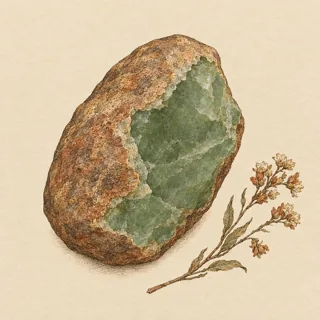
This is tradition and practice, not medical, financial, or life advice.
How Do You Use Jade Day to Day?
Wearing Jade
Jewelers carve jade into pendants, bangles, and rings, taking advantage of its unusual toughness compared with its moderate Mohs hardness of roughly 6 to 7, depending on whether the piece is nephrite or jadeite. A jade bangle worn daily can survive decades of ordinary wear, which is part of why the stone became a family heirloom material across so many generations in China. Wearing it low, near the waist, leans on the traditional jade meaning tied to the Sacral chakra.
Jade in Your Home
Display a carved jade figure, echoing the coming-of-age and newlywed pieces Kunz recorded, on a shelf associated with family milestones. Many households keep a piece near photographs of weddings, graduations, or new babies, extending the practical jade meaning behind those customs into an ordinary domestic space. A simple, unmarked jade pebble works as well as an elaborate carving for this purpose.
Meditation with Jade
Hold a smooth piece low against your abdomen, near the traditional Sacral chakra placement, while seated. Bring to mind one relationship or project that needs patience, not a dramatic decision. Some practitioners recall the nuptial cup legend specifically, using the idea of loyalty without guaranteed reward as a focus point for several minutes of quiet breathing.
Cleansing & Charging
Jade's toughness makes it more forgiving to clean than most gemstones, though jadeite generally tolerates more handling than nephrite does. Rinse a piece under the tap and dry it with a soft cloth; that is usually enough for both minerals. Avoid harsh chemical cleaners and prolonged heat, since either can dull the polish on carved detail over time. Many practitioners simply wipe a piece down after wearing it, treating the small ritual as a version of the same daily attention the stone's own marriage and family folklore describes.
Crystal Combinations
Jade pairs well with these crystals for complementary energy in crystal healing practice:
- Rose Quartz for Practitioners pair jade with rose quartz to combine jade's theme of long-term loyalty with rose quartz's gentler, opening quality.
- Moonstone for Practitioners combine jade with moonstone for major life transitions, echoing jade's own coming-of-age and marriage customs.
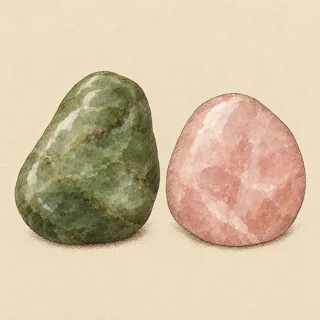
Jade works the Sacral chakra for creativity and flow, a different register from the Crown-chakra clarity crystal practice assigns clear quartz. The clear quartz guide covers that Crown chakra work and how practitioners use the stone day to day.
Caring for Jade
Cleaning: Warm soapy water and a soft cloth; jade resists cracking and chipping remarkably well, even though its surface can still be scratched by harder materials.
Avoid: Avoid chemicals and extreme heat; treated jade (polymer-impregnated) needs extra gentle handling.
Your crystal profile
Is Jade Your Birthstone?
Month
Day
Jade is linked to Virgo. Enter your birthday above to see if it matches your sign.
Pairs well with
Jade at a glance
- Also known as
- Nephrite and jadeite are the two true minerals sold as jade
- Tradition
- A stone of loyalty, thresholds, and family continuity
- Chakra / element
- Sacral (Svadhisthana) / Earth
- In one line
- A term for two distinct minerals, nephrite and jadeite, both central to Chinese marriage, coming-of-age, and friendship customs.
- Try this first
- Hold a piece low against your abdomen and think of one commitment that needs patience, not a breakthrough.
- Do not
- Harsh chemical cleaners and prolonged heat, which can dull carved detail.
Kunz, The Curious Lore of Precious Stones, 1913, p.83
When People Actually Reach for Jade
Crystal practitioners describe using jade at specific, recognizable moments tied to commitment and transition.
The morning of your tenth wedding anniversary
You take out a jade pendant you have not worn in months and put it on before breakfast. You think about the nuptial cup legend, about loyalty that costs something, not loyalty that stays easy. You are not expecting a perfect day. You are marking that you are still here, choosing this, the way jade has marked that same choice at weddings for centuries.
The night before your child's first day at a new school
You set a small carved jade figure on the kitchen table where your child will see it at breakfast. You tell them, briefly, that people once gave pieces like this to mark a big change. You are not promising the day will go well. You are giving them a small, physical object to hold onto during a threshold, the same role jade played in the coming-of-age customs Kunz recorded.
Three months into a difficult, unglamorous project at work
You keep a jade pebble on your desk, not because it inspires you, but because it survives being handled roughly, day after day, without cracking. You pick it up when the project stalls again. You use its physical toughness as a reminder that showing up through a slow, unglamorous stretch is its own kind of commitment, closer to the nuptial cup's loyalty than to any dramatic breakthrough.
One Name, Two Minerals, and a Contested History
Kunz's own opening definition creates a real tension that jewelers and collectors still navigate today.
Nephrite's Long History Against Jadeite's Late Arrival
George Frederick Kunz states plainly, on page 83 of his 1913 book, that the name jade includes two distinct minerals, nephrite and jadeite. Nephrite had been worked in China for thousands of years before jadeite arrived from Myanmar in significant quantities in the eighteenth century. Collectors and dealers in Kunz's own era disagreed about which mineral deserved the name's full prestige: some treated nephrite as the true, historic jade and jadeite as a newer, showier rival, while others prized jadeite's brighter, more saturated color above nephrite's quieter tones. Kunz records the two-mineral definition without resolving that argument, leaving the word jade to cover both stones despite their different chemistry, different sources, and different reputations among collectors of his time.
A Devotion Legend Beside a Kidney Cure
Kunz's own book holds two very different explanations for why people valued jade, recorded dozens of pages apart. On pages 84 and 85, he records the nuptial cup legend, where a stone's meaning comes from a story about emotional loyalty. On page 383, he records a completely different explanation: the Spanish name piedra de hijada, "stone of the flank," exists because Indigenous peoples in the Americas used the stone specifically for kidney ailments, a practical medical folklore with nothing to do with weddings or devotion. Kunz never connects these two traditions, and nothing in his text suggests Chinese wedding custom and Spanish American folk medicine influenced each other. The same word, jade, carries an emotional legend on one continent and a folk-medicine explanation on another, with Kunz simply recording both as separate facts.
Frequently Asked Questions
What is the traditional jade meaning in crystal practice?
The traditional jade meaning centers on loyalty, thresholds, and family continuity. George Frederick Kunz documented an entire system of Chinese jade customs in 1913, including amulets exchanged between friends, ornaments given to girls at coming of age, figures given to newlyweds, and a nuptial cup whose shape comes from a legend about a devoted bird. Modern crystal practitioners extend these themes into steady, long-term emotional work, treating jade as a stone for patient commitment more than sudden transformation.
What is the difference between nephrite and jadeite?
Nephrite and jadeite are two chemically different minerals sold under the single name jade. Nephrite is a calcium-magnesium silicate from the amphibole group and was the primary jade used throughout most of Chinese history. Jadeite is a sodium-aluminum silicate from the pyroxene group, generally rarer and more vividly colored, and it did not reach China in significant quantities until the eighteenth century, when it arrived from Myanmar. Kunz himself opens his 1913 chapter on the stone by naming this exact distinction.
Why is jade associated with weddings and marriage?
Chinese tradition used several different jade objects at weddings and around marriage. Newlyweds received a jade figure of a man riding a unicorn and holding castanets, meant to signal that an heir would arrive in due time. Wedding feasts sometimes featured a jade cup shaped like a cock, from which both bride and groom drank, its shape drawn from a legend about a devoted bird that chose death over separation from its mistress. Kunz recorded both customs in his 1913 survey of the stone's history.
Is it true that jade helps with kidney problems?
This traces back to documented folklore about the jade meaning, not a medical finding. George Frederick Kunz recorded that the word jade descends from the Spanish piedra de hijada, meaning "stone of the flank," a name given because Indigenous peoples in the Americas historically used the stone for kidney ailments. Modern crystal practice inherits this naming history as a piece of tradition. No clinical evidence supports jade as a remedy for any kidney condition today.
Who should wear jade?
Individuals committed to long-term relationships and family continuity are often drawn to these beautiful minerals. Traditional folklore views the material as a powerful symbol of loyalty. Crystal practitioners associate its sacral chakra energy with moving gracefully through life thresholds. People seeking patience in their daily commitments frequently keep a piece nearby.
What zodiac sign is jade for?
Crystal astrologers typically pair this mineral with Virgo. This earth sign is known for dedication and practical loyalty. Traditional beliefs suggest the stable energy of the stone supports their methodical approach to family and friendships. Practitioners associate its sacral chakra connection with helping these individuals navigate major life transitions with gentle patience.
What Kunz Actually Documented About Jade
Jade's Kunz citations sit nearly three hundred pages apart in his 1913 survey, one covering culture and custom, the other covering the word's own medical origin.
- Jade is not one mineral but two, and Chinese tradition built an entire system of amulets and wedding customs around it.
Kunz 1913, p.83
Kunz opens his jade chapter by defining the name as covering two distinct minerals, nephrite and jadeite. He then documents Chinese amulets on the following pages, including the "Two Brothers of Heavenly Love" friendship carving, a phoenix ornament given to young girls at coming of age, a unicorn-rider figure given to newlyweds, and a nuptial cup shaped like a cock, whose form he traces to a legend of a devoted bird choosing death over separation from its mistress. - The word jade comes from a Spanish phrase tied to folk medicine for kidney ailments.
Kunz 1913, p.383
Kunz traces the name jade to the Spanish piedra de hijada, "stone of the flank," a name he says was given because Indigenous peoples in the Americas used the stone for kidney ailments. He notes that the mineral name nephrite comes from the same underlying idea, and that people in ancient times also regarded jade as an aid during childbirth.
References
“The safest cleaning methods are also the easiest.”