 BirthstoneMeaning
 Aries Birthstone
 Taurus Birthstone
 Gemini Birthstone
 Cancer Birthstone
 Leo Birthstone
 Virgo Birthstone
 Libra Birthstone
 Scorpio Birthstone
 Sagittarius Birthstone
 Capricorn Birthstone
 Aquarius Birthstone
 Pisces Birthstone
 Peridot Meaning
 Garnet Meaning
 Amethyst Meaning
 Aquamarine Meaning
 Diamond Meaning
 Emerald Meaning
 Pearl Meaning
 Ruby Meaning
 Blue Sapphire Meaning
 Opal Meaning
 Topaz Meaning
 Turquoise Meaning
 Moonstone Meaning
 Tourmaline Meaning
 Citrine Meaning
 Tanzanite Meaning
 Alexandrite Meaning
 Spinel Meaning
 Sardonyx Meaning
 Zircon Meaning
 Lapis Lazuli Meaning
 Rose Quartz Meaning
 Onyx Meaning
 Labradorite Meaning
 Malachite Meaning
 Jade Meaning
 Agate Meaning
 Carnelian Meaning
 Clear Quartz Meaning
 Black Tourmaline Meaning
 Smoky Quartz Meaning
 Sodalite Meaning
 Obsidian Meaning
 Fluorite Meaning
 Selenite Meaning
 Hematite Meaning
 Howlite Meaning
 September Birthstone
Onyx Meaning and Healing Properties Explained
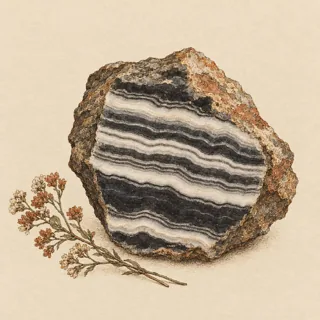
The onyx meaning centers on grounding, personal strength and protection. Crystal practitioners treat this banded black stone as an anchor for steady focus under pressure. George Kunz's 1913 survey of eight historical birthstone lists found onyx named for July more often than any other stone, a detail modern onyx meaning discussions rarely mention.

| Chakra | Root (Muladhara) |
| Element | Earth |
| Zodiac | Leo |
| Color | Black, Black and white banded, Brown and white |
What is the spiritual Onyx meaning?
The cultural onyx meaning rests on a long engraving tradition and a documented historical claim to the month of July. Engravers such as Gorlaeus catalogued onyx intaglio gems in both Paris in 1778 and Delft in 1601, including a monogram of Christ's name and a pair of gold rings set with onyx figures of Victory and game-cocks. Those catalogued pieces show onyx was valued across roughly two centuries of European gem engraving as a surface hard enough to hold fine detail yet soft enough to carve by hand. Kunz's own 1913 tally of eight historical birthstone lists, spanning Jewish, Roman, Arabian, Polish, Russian and Italian sources, found onyx named for July in five of the eight lists, more than any other stone. Sardonyx, carnelian, ruby and turquoise each received only a single vote. When the American jewelry trade revised its official list in 1912, ruby replaced onyx as July's primary stone. Onyx meaning discussions today rarely mention that the older historical record actually favored onyx by a wide margin. The Gorlaeus catalogues themselves survive as printed records of specific collections, not vague claims about ancient use: a named cataloguer, a named city and a specific year attach to each piece, which is unusually concrete documentation for a gemstone tradition this old.
Crystal practitioners treat onyx as a stone for holding steady during conflict or sustained pressure, not for lifting mood. Folklore describes the stone as absorbing or containing strong emotion, not amplifying it. Practitioners reach for it mainly before a confrontation, not after one has already passed. People hold a piece during a tense negotiation, using its smooth, cool weight as a physical reminder to stay measured, not reactive. Others keep onyx on a desk during a demanding stretch of work, treating its solid, opaque presence as a symbol of endurance through a long task, not a quick fix for stress.
Zodiac Connection
Leo rules personal willpower and public presence in traditional astrology, a natural fit for a stone whose folklore centers on steady strength under pressure, not quiet retreat.
The grounding, protection and Root chakra uses described here reflect crystal-practice tradition, not mineralogy or clinical research.
How does the Onyx meaning support healing work?
Physical Healing
Crystal practitioners incorporate onyx into routines built around stamina, not relaxation. People carry a tumbled piece during a physically demanding workday, using it as a tactile reminder to pace themselves, not push through exhaustion. Others place a flat piece at the base of the spine during rest, aligning it with the traditional Root chakra location. Some practitioners set a piece by their running shoes or gym bag, using the stone as a small daily prompt to show up for a workout even on a low-motivation day. The practice is entirely symbolic: no clinical evidence supports crystal healing, and onyx is used here purely as a tradition-based focus object for endurance.
Emotional & Spiritual Healing
Onyx is the stone practitioners reach for most often during a prolonged period of stress, not a single sharp shock. Tradition holds that sitting with the stone helps a person separate their own steady sense of self from a chaotic external situation. Some practitioners recommend holding a piece while naming one boundary they intend to hold firm during a difficult week. Others use it before public speaking, keeping a small piece in a pocket as a private reminder to stay composed under scrutiny. A smaller number of practitioners use onyx at the close of a stressful stretch, not during it, treating the act of setting the stone aside as a deliberate signal that the difficult period is over.
Chakra Association
The onyx meaning connects most directly to the Root chakra, known as Muladhara, which traditional systems place at the base of the spine. Practitioners sit with a flat piece resting between their feet or at the base of the spine during meditation, aiming to strengthen what they describe as a sense of physical and financial stability. A balanced Root chakra is said to support steady decision-making under pressure, not impulsive reactions. Some practitioners pair the stone with slow, deliberate breathing, imagining a dark, solid weight settling downward with every exhale. This practice is symbolic and rooted entirely in crystal-healing tradition, not in any measurable physiological process.
This is tradition and practice, not medical, financial, or life advice.
How Do You Use Onyx Day to Day?
Wearing Onyx
Onyx measures 6.5 to 7 on the Mohs scale, durable enough for daily rings, cufflinks and pendants. Engravers have favored it for signet rings for centuries because its flat bands hold fine detail well under a seal or monogram. Wearing a signet-style onyx ring on the dominant hand echoes this older tradition of carrying a personal mark, not a decorative stone. You can clean onyx jewelry with a soft, damp cloth, and it tolerates most jewelry cleaners well given its chalcedony hardness, though dyed black material can fade slightly with repeated exposure to harsh chemicals. Set in a low, flush bezel, onyx resists everyday knocks well enough for a ring worn during manual tasks most other stones would need removed for.
Onyx in Your Home
A polished onyx bookend or sphere works well on a desk in a home office, since practitioners treat the stone's solid, opaque presence as a symbol of focus, not decoration. Crystal tradition holds that placing onyx near the front door supports a household's sense of boundaries, marking a clear line between the outside world and home. You can also place a piece near a safe or filing cabinet, where tradition treats it as a grounding stone for financial matters. Because onyx is widely available and often inexpensive, large decorative pieces are easy to find. A pair of onyx bookends flanking a shelf of reference books reads as a deliberate, workmanlike choice, in keeping with the stone's older reputation as a material for signets and seals, not purely decorative jewelry.
Meditation with Onyx
Sit with a flat, palm-sized piece of onyx resting between your feet on the floor, letting its weight settle before you begin breathing slowly. Many practitioners hold a second, smaller piece in one hand during longer sessions, aligning both with the Root chakra. You can pair the stone with a simple repeated phrase, such as silently naming one boundary you intend to hold that day. Some longer sessions build in a visualization step, imagining roots extending downward from the base of the spine through the floor and into solid ground below. The goal in crystal practice is not to feel a physical sensation from the stone itself, but to use its solid presence as a steady anchor for the exercise.
Cleansing & Charging
Wipe onyx down with a barely damp microfiber cloth, since dyed black material can lose some color if it soaks too long. Practitioners commonly bury a piece in dry rice or soil overnight as a traditional energetic reset, treating the earth-based method as a natural fit for a Root chakra stone. Sound cleansing with a singing bowl is another common practice, letting the tone ring near the stone for under a minute. Skip prolonged salt-water soaking, which can dull the polish on carved or engraved pieces over time.
Crystal Combinations
Onyx pairs well with these crystals for complementary energy in crystal healing practice:
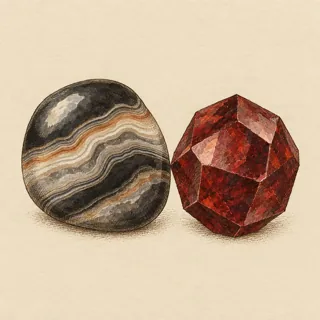
- Garnet for Practitioners pair onyx with garnet to combine grounding, Root-chakra focus with garnet's traditional association with stamina and drive.
- Ruby for Crystal tradition pairs onyx with ruby for courage under pressure, combining onyx's steady composure with ruby's bolder, more assertive reputation.
Onyx and zircon are both filed under the Earth element in crystal practice, despite sitting at opposite ends of the chakra system, root for onyx and crown for zircon. The zircon guide covers what that Crown chakra assignment means and zircon's own December birthstone history.
Caring for Onyx
Cleaning: Warm soapy water and a soft brush. Ultrasonic cleaning is safe for onyx.
Avoid: Avoid harsh chemicals and prolonged sun exposure, which can fade dyed onyx. Store away from heat sources.
Your crystal profile
Is Onyx Your Birthstone?
Month
Day
Onyx is linked to Leo. Enter your birthday above to see if it matches your sign.
Onyx at a glance
- Also known as
- Black Onyx, Banded Chalcedony
- Tradition
- Grounding, personal strength and protection under pressure
- Chakra / element
- Root (Muladhara) / Earth
- In one line
- A banded black stone with the strongest historical claim to July of any birthstone.
- Try this first
- Carry a small piece in your pocket on a day you expect confrontation.
- Do not
- Harsh chemical cleaners, which can fade dyed black material over time.
Kunz, The Curious Lore of Precious Stones, 1913, p.316
When people reach for Onyx in daily life
People tend to reach for onyx around a short list of high-pressure situations, not as a constant accessory.
Monday morning before a tense budget review
You slip a polished onyx cufflink or ring on before you leave for the office, deliberately choosing it over a brighter stone for the day. You expect pushback in the meeting. You touch the smooth, cool surface under the table when the conversation gets heated, using it as a private cue to answer questions calmly, not defensively.
Thursday night, an hour before a difficult family phone call
You sit at your kitchen table with a rough, unpolished piece of onyx in front of you. You are dreading the conversation you are about to have. You hold the stone in your closed fist for a minute, naming one boundary you intend to hold no matter how the call goes, then set it down and pick up the phone.
Sunday afternoon organizing bills at your desk
You keep a small onyx sphere on the corner of your desk while you sort through overdue paperwork. The task has been sitting untouched for weeks. You glance at the dark, solid stone each time you feel the urge to abandon the pile again, treating it as a quiet reminder to finish what you started. You set a small, specific goal, clearing one folder at a time, and place the stone on top of the finished stack each time you complete one, before you close the laptop.
Onyx won July five times over. Ruby still took the month.
George Kunz's own 1913 tally of eight historical birthstone lists gives onyx the strongest historical claim to July of any stone, yet the American jewelry trade handed the month to ruby that same year.
Five Votes Out of Eight
Kunz compiled eight separate historical birthstone lists drawn from Jewish, Roman, Arabian, Polish, Russian, Italian and other traditions spanning several centuries. For July, his own tally reads: onyx five, sardonyx one, carnelian one, ruby one, turquoise one. Onyx appears in five of the eight lists, a clear plurality, while ruby appears in only one. By Kunz's own count, no other July candidate came close to onyx's historical support. That tally sits in the same 1913 book that ultimately reported ruby's promotion to July, a detail the book records without resolving in onyx's favor.
Kunz's Own Objection to Warm Stones in Summer
The modern American list moved ruby into July from December, swapping places with turquoise. Kunz reports the jewelry trade's reasoning directly: a warmer-colored gem was thought to suit a warm summer month better than onyx's darker, cooler tone. He then argues against that logic in his own words: 'the contrary, however, is true; for it is in winter that we seek for warmth, while in the heat of summer nothing is more grateful than coolness.' Kunz traces the swap to the Polish list, suggesting it gained ground in Europe during the eighteenth century through Marie Leczinska, queen of Louis XV. He records the change. He does not endorse it.
Frequently Asked Questions
What is the onyx meaning behind its connection to July?
The onyx meaning tied to July comes from George Kunz's 1913 tally of eight historical birthstone lists, which found onyx named for July more often than any other stone, five times out of eight. Despite that historical plurality, the American jewelry trade's 1912 revision gave July to ruby instead. Kunz himself argued against the change, reasoning that a cooler stone suits a hot month better than a warm-colored one.
Is all black onyx naturally black?
Most solid black onyx sold today has been dyed to deepen and even out its natural color. Untreated onyx typically shows brown, gray or white bands, not a uniform black surface. The dyeing process is a long-standing, widely disclosed trade practice, not a modern deception, and it does not affect the stone's durability.
How can you tell onyx apart from sardonyx?
Onyx and sardonyx are both banded varieties of chalcedony, differing mainly in color. Onyx bands run through black, white or gray, while sardonyx bands include reddish-brown sard alongside white layers. Kunz's own historical tally lists them as separate stones, with sardonyx receiving a single July vote in the same survey where onyx received five. Sardonyx has carried a stronger folklore connection to communication and courage, while the onyx meaning most practitioners describe today leans more toward grounding and steady endurance.
Can onyx jewelry be worn every day?
Onyx measures 6.5 to 7 on the Mohs hardness scale, durable enough for daily rings, cufflinks and pendants. It resists everyday scratching well, though engraved or carved pieces should be handled a little more carefully to protect fine detail. Dyed black material can fade slightly with repeated exposure to harsh chemicals or prolonged sunlight, so occasional gentle cleaning is enough to keep it looking even.
Who should wear onyx?
People facing intense pressure often turn to this banded black stone. Practitioners associate its grounding earth energy with building personal strength during challenging times. Folklore holds that carrying it provides a solid foundation when dealing with confrontation. Anyone needing a steady root chakra anchor might find it highly beneficial.
What zodiac sign is onyx for?
In crystal astrology, Leo pairs wonderfully with this dark mineral. Individuals born under this fire sign naturally project immense personal power. Tradition connects the root chakra focus of the material to helping these strong personalities stay grounded under pressure. Astrologers believe it provides a stable earth element base for their leadership qualities.
What George Kunz actually recorded about Onyx
Kunz's 1913 survey gives onyx both a documented historical tally and a pair of named, dated engraved gems worth checking directly.
- Onyx appeared as the July birthstone in five of eight historical lists Kunz compiled, more than any other stone.
Kunz 1913, p.316
Kunz's own tally for July reads: onyx five, sardonyx one, carnelian one, ruby one, turquoise one, drawn from Jewish, Roman, Arabian, Polish, Russian, Italian and other historical birthstone traditions. - Onyx gems were catalogued as engraved seals and rings by name in both 1778 Paris and 1601 Delft collections.
Kunz 1913, p.136
Kunz reproduces an onyx gem engraved with a monogram of the name of Christ from the Cabinet de Pierres Antiques Gravees of Gorlaeus, Paris, 1778, and two gold rings set with engraved onyx gems of Victory and game-cocks from the Dactyliotheca of Gorlaeus, Delft, 1601.
References
“The safest cleaning methods are also the easiest.”