 BirthstoneMeaning
 Aries Birthstone
 Taurus Birthstone
 Gemini Birthstone
 Cancer Birthstone
 Leo Birthstone
 Virgo Birthstone
 Libra Birthstone
 Scorpio Birthstone
 Sagittarius Birthstone
 Capricorn Birthstone
 Aquarius Birthstone
 Pisces Birthstone
 Peridot Meaning
 Garnet Meaning
 Amethyst Meaning
 Aquamarine Meaning
 Diamond Meaning
 Emerald Meaning
 Pearl Meaning
 Ruby Meaning
 Blue Sapphire Meaning
 Opal Meaning
 Topaz Meaning
 Turquoise Meaning
 Moonstone Meaning
 Tourmaline Meaning
 Citrine Meaning
 Tanzanite Meaning
 Alexandrite Meaning
 Spinel Meaning
 Sardonyx Meaning
 Zircon Meaning
 Lapis Lazuli Meaning
 Rose Quartz Meaning
 Onyx Meaning
 Labradorite Meaning
 Malachite Meaning
 Jade Meaning
 Agate Meaning
 Carnelian Meaning
 Clear Quartz Meaning
 Black Tourmaline Meaning
 Smoky Quartz Meaning
 Sodalite Meaning
 Obsidian Meaning
 Fluorite Meaning
 Selenite Meaning
 Hematite Meaning
 Howlite Meaning
 September Birthstone
Birthstone Calendar by Month
This birthstone calendar lays out all twelve months. Each card gives the month’s main stone on the modern American list, its color, the chakra and element crystal practice files it under, and the two zodiac signs the month spans. Six months carry more than one official stone, and older traditional lists sometimes name a different one.
Start with your birthday
Everything on these cards is tradition. The chakra, the element and the keyword associations come from crystal practice and folklore, and the historical notes name the century and the source we traced them to.

January Birthstone: Garnet
deep red · Root chakraGarnet traveled. It turns up in Roman signet rings and in Anglo-Saxon grave goods a very long way from home, and the tradition that followed reads it as the stone for getting moving again.
- Traditional associations
- Constancy · Endurance · Homecoming
- Chakra · element (traditional)
- Root · fire
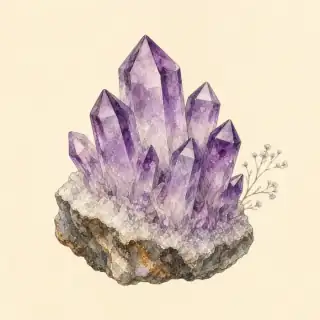
February Birthstone: Amethyst
violet · Crown chakraThe Greek word amethystos means not intoxicated, and the entire reputation of this stone starts there. Pliny wrote the claim down in the first century and dismissed it as a lie told by magicians.
- Traditional associations
- Sobriety · Focus · Restraint
- Chakra · element (traditional)
- Crown · air

March Birthstone: Aquamarine
pale blue · Throat chakraAqua marina, water of the sea, is what Rome named this stone, and the name is the whole reading. The tradition outlived the ships that carried it and now covers any crossing, including the ones you make indoors.
- Traditional associations
- Safe passage · Composure · Candor
- Chakra · element (traditional)
- Throat · water
Bloodstone held the March slot for centuries before aquamarine joined it on the modern list. Both are correct depending on which list you follow.
Also official for March
- Bloodstone: the older March stone, dark green flecked with red, carried by Roman soldiers for courage.
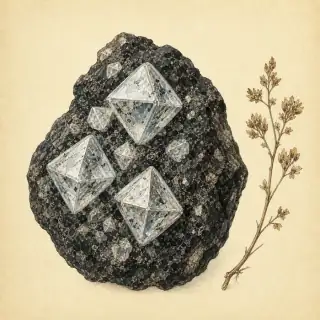
April Birthstone: Diamond
colorless · Crown chakraIn 1477 Archduke Maximilian of Austria gave Mary of Burgundy the first diamond engagement ring anybody wrote down. Six centuries on, it is still the stone people hand over when they mean a promise.
- Traditional associations
- Invincibility · Clarity · Commitment
- Chakra · element (traditional)
- Crown · fire
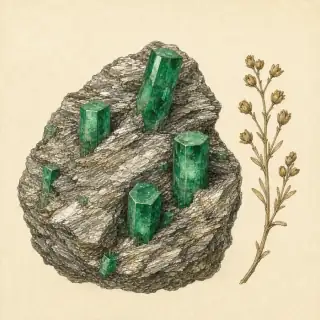
May Birthstone: Emerald
green · Heart chakraMedieval lapidaries warned that a liar wearing emerald would break the stone. Nobody takes that seriously now, and the link between this green and plain speech stayed in the record anyway.
- Traditional associations
- Fertility · Foresight · Patience
- Chakra · element (traditional)
- Heart · earth
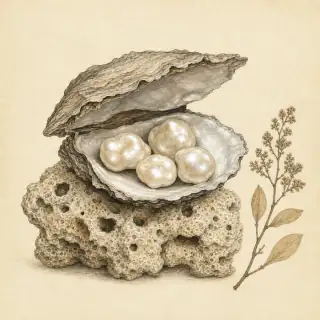
June Birthstone: Pearl
white · Third Eye chakraPearl is the one birthstone that was alive. It arrives on its own schedule, over years, with nobody deciding the shape, and tradition has read that slowness as the whole lesson.
- Traditional associations
- Purity · Humility · Quiet confidence
- Chakra · element (traditional)
- Third Eye · water
Also official for June
- Alexandrite: Green in daylight and red under lamplight, which suits anybody who behaves differently after dark.
- Moonstone: A floating blue sheen that shifts as you tilt it, long read as the stone of intuition.
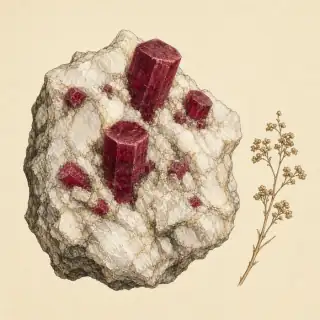
July Birthstone: Ruby
red · Heart chakraSanskrit texts called ruby ratnaraj, king of gems, and no other stone on this calendar carries a title. Its red has stood for devotion that will fight for you ever since.
- Traditional associations
- Courage · Vitality · Sovereignty
- Chakra · element (traditional)
- Heart · fire
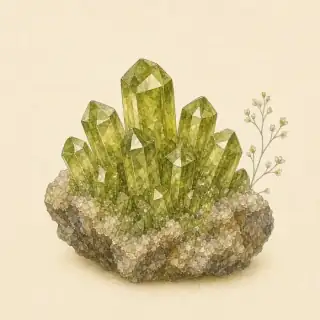
August Birthstone: Peridot
olive green · Solar Plexus chakraSolar from the start. Egypt tied peridot to the sun itself, and modern crystal practice keeps the link, reading that yellow-green as an outlook nothing much shakes.
- Traditional associations
- Renewal · Optimism · Night protection
- Chakra · element (traditional)
- Solar Plexus · earth
Sardonyx is the traditional August stone. Peridot leads the modern list, and spinel was added to it in 2016.
Also official for August

September Birthstone: Sapphire
blue · Third Eye chakraA bishop's ring put sapphire on the hand that handed down judgment, and the stone's reputation for a cool head starts there. The Princess of Wales now wears the blue sapphire from Princess Diana's engagement ring.
- Traditional associations
- Wisdom · Fidelity · Judgment
- Chakra · element (traditional)
- Third Eye · air
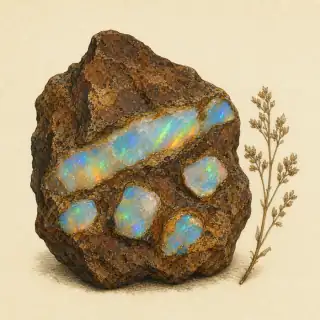
October Birthstone: Opal
iridescent · Crown chakraRome treated opal as the luckiest gem there was. Sir Walter Scott's 1829 novel Anne of Geierstein undid two thousand years of good press in one plot, and the superstition still trails the stone.
- Traditional associations
- Imagination · Transformation · Spontaneity
- Chakra · element (traditional)
- Crown · water
Also official for October
- Tourmaline: Added for its range, because one stone can carry two different colors at opposite ends.
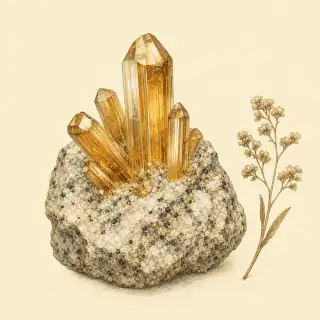
November Birthstone: Topaz
golden · Throat chakraMedieval lapidary texts gave topaz the job of breaking enchantments and revealing poison. It held that reputation for centuries, which is a long run for a claim nobody ever tested.
- Traditional associations
- Discernment · Generosity · Steadiness
- Chakra · element (traditional)
- Throat · fire
Also official for November
- Citrine: Yellow to amber, and crystal practice calls it the merchant's stone, for money and for nerve.
Zodiac
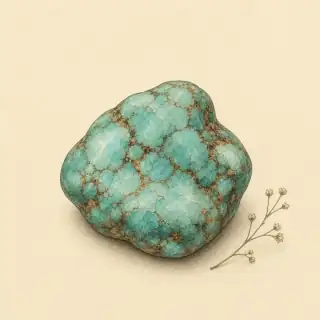
December Birthstone: Turquoise
blue-green · Throat chakraFive thousand years of people carrying it for luck connect Egypt, Persia and the American Southwest. Each of those traditions arrived separately at the same conclusion, which is that turquoise looks after a traveler.
- Traditional associations
- Protection · Friendship · Good health
- Chakra · element (traditional)
- Throat · earth
Also official for December
Zodiac
How to Use This Birthstone Calendar
Pick your birth month and day in the two selectors above. The birthstone calendar opens that month, names its stone, and tells you which of the two zodiac signs your date falls under. The month grid works on its own if you only want to browse: tap any month, or move between them with the arrow keys once one has focus.
Every month also has its own link, so the share row at the top hands you a URL that opens on the month you are reading, whichever month that is. One thing worth checking before you buy: six months carry more than one official stone, and a listing that names only one is often naming the cheaper option.
What the Birthstone Calendar Is Based On
Most birthstone charts you will find online descend from a list standardized in 1912 by the National Association of Jewelers, an American trade body. That list pairs a stone with each calendar month, and it was created to bring consistency to a market where every jeweler promoted a different set of stones. Later additions expanded several months: tanzanite joined December in 2002, and spinel joined August in 2016.
Traditional lists are older and vary across Poland, Russia, Britain, and the Arab world, all of them predating any attempt at standardization. That variation is why March appears as aquamarine on one chart and bloodstone on another, and why August shows peridot in one place and sardonyx in another. Both answers are right. They come from different lists.
Months With More Than One Birthstone
The six months with extra stones are March, June, August, October, November, and December. June, August, and December each carry three. The month cards above list every option with a note on each.
The additions were commercial. Natural alexandrite and fine pearl are expensive and hard to source, so moonstone gave June buyers a reachable option. Opal is soft and needs careful setting, so tourmaline gave October a hard-wearing alternative. When a month offers several stones, any of them is a legitimate choice.
Birthstone Calendar at a Glance
| Month | Modern stone | Color | Chakra & element | Zodiac signs |
|---|---|---|---|---|
| January | Garnet | deep red | Root · fire | Capricorn, Aquarius |
| February | Amethyst | violet | Crown · air | Aquarius, Pisces |
| March | Aquamarine | pale blue | Throat · water | Pisces, Aries |
| April | Diamond | colorless | Crown · fire | Aries, Taurus |
| May | Emerald | green | Heart · earth | Taurus, Gemini |
| June | Pearl | white | Third Eye · water | Gemini, Cancer |
| July | Ruby | red | Heart · fire | Cancer, Leo |
| August | Peridot | olive green | Solar Plexus · earth | Leo, Virgo |
| September | Sapphire | blue | Third Eye · air | Virgo, Libra |
| October | Opal | iridescent | Crown · water | Libra, Scorpio |
| November | Topaz | golden | Throat · fire | Scorpio, Sagittarius |
| December | Turquoise | blue-green | Throat · earth | Sagittarius, Capricorn |
Chakra and element pairings are traditional associations from crystal practice, and they are the columns worth reading if you plan to work with the stone. They tell you where practitioners place it and what intention they set with it. They are belief, and we label them that way every time they appear.
How the Birthstone Calendar Connects to Zodiac Signs
Every calendar month overlaps two zodiac signs, because sun-sign ranges begin between the 19th and the 23rd while the month system changes on the 1st. Someone born on May 3rd is a Taurus with emerald as a month stone; someone born on May 28th is a Gemini with the same month stone. The two systems run in parallel.
Leo's card above lists the traditional stone as Onyx. Pavitt's 1914 zodiac chapter for Leo (p.192) names Sardonyx and Chrysolite instead, two different names, one a close mineral cousin and one a period name for what is now usually called Peridot. The gap is tracked in full on the birthstone chart's Pavitt comparison table.
The 1912 list assigns stones to months. The zodiac stones on this site are therefore derived: we map each sign to the stones of the months it spans, then weigh the traditional symbolic associations recorded for that sign. The method is set out on the birthstone chart, and each zodiac guide states which stones are modern, which are traditional, and where the pairing came from.
Each card above carries a short line of traditional symbolism. All twelve of those traditions gathered in one place, with the chakra and element assigned to each stone and a tally of which centers hold three stones and which hold one, is on what birthstones mean spiritually.
If you would sooner meet one stone at a time than twelve at once, the daily stone rotation works through the same twelve gemstones one per calendar day, with the reading, the correspondences and one thing to actually do with the stone on each card.
One Trade Group's Answer to a Marketing Problem
In 1912 the National Association of Jewelers sat down to solve a sales problem, not a mystery. Every store in America was naming a different stone for the same month, and a customer walking from one shop to the next got two different answers to the same question. The association picked one stone per month and asked the whole trade to use it. Alexandrite joined the list as a June option decades later, in 1952. Tanzanite followed for December in 2002, and spinel joined August in 2016, each addition arriving for the same reason as the first: a cheaper or easier-to-source stone for a month that had only one option before.
The Tide That Only Comes Once Every 21 Years
Pavitt's 1914 zodiac book puts a number on a phrase everyone already uses without knowing where it came from. Indian tradition, he records, held that the finest blue Moonstones only washed ashore when the sun and moon lined up in a rare alignment, once every three seven-year lunar cycles, 21 years apart. He states plainly that the phrase 'once in a blue moon' traces back to that tide, a wait measured in years, not a color at all. June's moonstone sits three cards over from Cancer's card on this calendar. The 21-year math behind the phrase does not show up on either card.
The birthstone calendar at a glance
- Also known as
- The Moonstone blue-moon rule (India, per Pavitt 1914)
- Tradition
- Indian lunar-tide folklore recorded in Pavitt's Cancer chapter, 1914
- Chakra / element
- Moonstone: crown chakra, water element, per this site's crystal-healing correspondences, a separate, later system from Pavitt's zodiac gems.
- In one line
- The finest blue Moonstones were said to wash ashore only once every 21 years, when three seven-year lunar periods align.
- Try this first
- Check any month's zodiac overlap on the calendar above against the sign's traditional stone on the chart before assuming the two already agree.
- Do not
- Treating the 1912 month list and the zodiac-sign list as one continuous tradition. They are two separate systems that happen to share some stone names.
Pavitt 1914, p.182
Four Places This Calendar Meets a Real Question
Real situations this calendar's month-and-zodiac split actually has to answer.
Someone born May 28th checking which stone is 'theirs'
The month system hands them emerald, the same as everyone else born in May. The zodiac system hands them Gemini's stones, because May 28th sits five days into Gemini, not Taurus. Both calendars are correct on their own terms. They are answering two different questions about the same date.
A gift buyer scanning a month card for August
The card lists Peridot as the primary stone but flags Spinel and Sardonyx as also official, one added to the U.S. list in 2016, one far older. A buyer who only reads the headline stone risks paying more than they need to for the exact same calendar slot.
A reader landing on #leo from a search result
The card under Leo's tab shows the modern stone Peridot next to the traditional Onyx, and the 1914 record actually says Sardonyx and Chrysolite. That gap sits one click away on the birthstone chart's Pavitt comparison table, not buried in a footnote.
Midnight in Auckland versus midnight in Los Angeles, same rotation question
That is crystal-of-the-day's question, not this calendar's, but the calendar gets asked it anyway: does my stone change today or tomorrow? The month stone never moves with the clock. Only the zodiac overlap can shift, and only on the one or two days a month a sign boundary falls on.
Two Signs Whose Zodiac Stone Belongs Elsewhere
Pavitt's 1914 zodiac chapters name specific gems for each sign. Two of this calendar's traditional-and modern-stone entries land on a different chapter once you check the page Pavitt actually wrote them on.
Leo's Book Names Sardonyx and Chrysolite, Not Plain Onyx
Turn to page 192 of Pavitt's 1914 zodiac chapter and Leo's line reads plainly: 'The gems of the House are the Sardonyx, Chrysolite, Tourmaline, and Amber.' No 'Onyx' appears in that sentence. Sardonyx is a banded variety in the same mineral family as Onyx, not an identical stone, and 'Chrysolite' was the period name most often given to what is sold today as Peridot. Practitioners use Sardonyx and Chrysolite for Leo under the 1914 zodiac-gem system Pavitt recorded. This calendar's traditional-stone field currently reads Onyx: close to Sardonyx, not identical to it.
Pisces Gets One Stone in the 1914 Book: Amethyst
Pavitt's Pisces chapter (p.272) names exactly one gem: 'The gem of this House is the Amethyst, a semi-precious stone in varying shades of purple.' Aquamarine, which this calendar's modern-stone field currently gives to Pisces, is said to belong to Scorpio, forty pages earlier at p.230, alongside Beryl, Carbuncle, and Lodestone. A reader who moves from this calendar to the Pisces zodiac guide meets the older tradition contradicting the modern column point for point. This calendar names that split directly, without folding the two into one continuous story.
Three Records Behind the Calendar's Old-Tradition Notes
Citations for the moonstone, carbuncle, and Sepher de-Adam Kadmah material referenced above, each checked against page numbers already verified for this project.
- Indian tradition held that the finest blue Moonstones surfaced only once every 21 years, at a rare lunar alignment, and Pavitt ties that belief directly to the English phrase 'once in a blue moon.'
Pavitt 1914, p.182
In his Cancer chapter, Pavitt writes that the sun and moon must reach a particularly harmonious alignment, recurring at three seven-year lunar intervals, before the tides wash up the finest stones, and states this is the belief he traces the common English idiom to. - Medieval legend, repeated by Chaucer and Mandeville among others, held that a large glowing carbuncle served Noah as a lamp inside the Ark.
Pavitt 1914, p.232
Pavitt's Scorpio chapter records this legend as part of the carbuncle's reputation for glowing in darkness, attaching a specific Biblical episode and two named medieval writers to the claim, not leaving it as unattributed ancient lore. - An 11th-13th century Hebrew text names twelve angels, one presiding over each month of the year, a month-by-month spiritual calendar distinct from both the 1912 U.S. month list and the zodiac-gem system.
Kunz 1915, p.247
Kunz dates the Sepher de-Adam Kadmah to no later than the 13th century and describes 'the twelve princes, set over the twelve months of the year,' starting with Nisan. He also records the legend that the angel Raziel engraved the book on a sapphire and gave it to Adam.
Sources & Editorial Basis
Month assignments follow the Jewelers of America birthstone list. Care guidance is checked against the Gemological Institute of America. Everything else here is folklore, astrology and crystal practice. We label each claim as tradition and name the text or the period we traced it to wherever one exists.
“The safest cleaning methods are also the easiest.”
Frequently Asked Questions
- What are the 12 month birthstones?
- January is garnet, February amethyst, March aquamarine, April diamond, May emerald, June pearl, July ruby, August peridot, September sapphire, October opal, November topaz, and December turquoise. These are the primary stones on the modern list used in the United States. Six of those months carry additional official stones, and several have an older traditional stone that differs from the modern one.
- Which months have more than one birthstone?
- Six do. March adds bloodstone, June adds alexandrite and moonstone, August adds spinel and sardonyx, October adds tourmaline, November adds citrine, and December adds tanzanite and zircon. June, August, and December each carry three. The extra stones were added over the last century, usually to give buyers an option at a lower price than the original stone.
- What is the difference between modern and traditional birthstones?
- The modern list is the one most American jewelers use today. It descends from a standardized list published in 1912 by the National Association of Jewelers, with additions in later decades. Traditional lists are older and vary by region and era, so March can be aquamarine or bloodstone and August can be peridot or sardonyx. Both are legitimate; they simply come from different eras.
- Which birthstones are the rarest?
- Alexandrite, by a wide margin. It changes color from green to red as the light changes, almost none of it turns up naturally, and most June alexandrite on sale was grown in a workshop. Tanzanite comes second and has only been on the chart since 2002. Among the primary twelve, fine emerald and deep red ruby are the two you will hunt longest for.
- Is my birthstone based on my birth month or my zodiac sign?
- Both systems exist and they answer different questions. The month system is the one behind almost all birthstone jewelry, and it changes on the first of each month. The zodiac system follows sun-sign date ranges, which begin between the 19th and the 23rd, so anyone born near the end of a month falls under the next sign. If you were born on August 30th your month stone is peridot and your zodiac sign is Virgo.
- What is the difference between a birthstone calendar and a birthstone chart?
- A birthstone calendar is built around the twelve months one at a time, so you open your own month and read it without scanning past the other eleven. A chart puts everything into a single table you compare side by side, including traditional alternatives and zodiac overlaps. Both hold the same data. Use the calendar when you want your month, and the chart when you want to compare months or check what an older list assigns.
- Does the birthstone calendar change from year to year?
- No. The month assignments do not reset with a new year, so the stone for your birth month does not depend on when you check. The modern list has only expanded, and rarely: tanzanite joined December in 2002 and spinel joined August in 2016. A calendar that disagrees with this one is almost always working from an older traditional list. This calendar follows the current modern one, tanzanite and spinel included.