 BirthstoneMeaning
 Aries Birthstone
 Taurus Birthstone
 Gemini Birthstone
 Cancer Birthstone
 Leo Birthstone
 Virgo Birthstone
 Libra Birthstone
 Scorpio Birthstone
 Sagittarius Birthstone
 Capricorn Birthstone
 Aquarius Birthstone
 Pisces Birthstone
 Peridot Meaning
 Garnet Meaning
 Amethyst Meaning
 Aquamarine Meaning
 Diamond Meaning
 Emerald Meaning
 Pearl Meaning
 Ruby Meaning
 Blue Sapphire Meaning
 Opal Meaning
 Topaz Meaning
 Turquoise Meaning
 Moonstone Meaning
 Tourmaline Meaning
 Citrine Meaning
 Tanzanite Meaning
 Alexandrite Meaning
 Spinel Meaning
 Sardonyx Meaning
 Zircon Meaning
 Lapis Lazuli Meaning
 Rose Quartz Meaning
 Onyx Meaning
 Labradorite Meaning
 Malachite Meaning
 Jade Meaning
 Agate Meaning
 Carnelian Meaning
 Clear Quartz Meaning
 Black Tourmaline Meaning
 Smoky Quartz Meaning
 Sodalite Meaning
 Obsidian Meaning
 Fluorite Meaning
 Selenite Meaning
 Hematite Meaning
 Howlite Meaning
 September Birthstone
Selenite Meaning and Healing Properties Explained
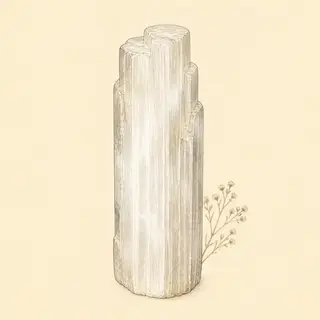
The selenite meaning connects deeply to mental clarity, lunar cycles, and spiritual purification in crystal healing practice. Practitioners traditionally use this translucent gypsum variety to clear mental fog and align the Crown chakra. The stone is widely believed to cleanse stagnant energy from spaces and other minerals.
| Chakra | Crown (Sahasrara) |
| Element | Air |
| Zodiac | Cancer |
| Color | Colorless, White, Pearly, Golden |
What Is the Traditional Spiritual Selenite Meaning?
Kunz's 1913 survey uses the words 'selenite' and 'moonstone' almost interchangeably when he preserves a striking sixteenth-century account from the French physician Antoine Mizauld, a real, separate example of how loosely the two names were once applied to the same lunar-linked stone. A traveler friend of Mizauld's owned a piece roughly the size of a gold noble coin that supposedly tracked the moon's phases across its surface. Mizauld refused to take the claim on faith, so he borrowed the stone for a full lunar month and watched it himself. He described a pale mark near the top that swelled as it drifted lower, filling out into a full circle by mid-month, then shrinking again on its way back up. The owner eventually dedicated this fascinating specimen to the young King Edward VI of England, who reigned from 1547 to 1553 and held a reputation for appreciating rare objects. Older astrological tables documented by Kunz on pages 350 and 351 of his research further solidify this tradition. Both independent tables explicitly assign this mineral to the moon, establishing a deep historical link.
In modern crystal healing practice, practitioners associate this mineral strongly with mental clarity and emotional purification. The pale, glowing appearance translates into a belief that the stone acts as a source of liquid light for the mind. Practitioners traditionally use it to clear away confusion, anxious thoughts, and emotional debris. Just as historical observers believed the stone physically mirrored the moon's shifting phases, modern users view it as a tool for navigating emotional cycles. Crystal healers suggest placing a piece nearby when you feel overwhelmed by outside influences. The traditional belief states that it creates a peaceful, tranquil environment encouraging honest self-reflection. Followers of crystal practice rely on it to sever energetic ties to past traumas or draining relationships. By promoting a deep sense of stillness, the mineral supposedly helps you step back from immediate emotional reactions. This provides you the mental space to observe your feelings safely. Users frequently report a sensation of lightness and peace when incorporating this translucent gypsum into their daily emotional wellness routines.
Zodiac Connection
Astrologers and crystal practitioners primarily link this stone to Cancer. This pairing stems directly from the mineral's ancient Greek etymology rooted in Selene, the moon goddess, and its long-documented historical associations with lunar cycles. Cancer is the only zodiac sign ruled entirely by the Moon. Some modern retail outlets occasionally pair it with Taurus for general grounding purposes. The Cancer association remains the most historically and practically reasoned connection in crystal tradition.
Modern claims regarding mental clarity and energetic cleansing are matters of traditional crystal practice. The mineral's slight water solubility is a verified mineralogical property of gypsum.
How Do Practitioners Use Selenite in Healing Traditions?
Physical Healing
The physical-healing side of the selenite meaning, in crystal healing traditions, points practitioners toward energetic support for the skeletal system and physical alignment. Believers suggest it promotes flexibility and helps ease tension in the physical body, particularly around the spine and joints. Some practitioners traditionally place raw wands along the back during sessions, aiming to clear physical blockages and encourage a free flow of vitality. You will also find claims that it supports restful sleep and cellular regeneration when placed near the bed. Separate from these traditional beliefs, you must handle the actual physical mineral with specific care. Gypsum sits at a mere 2 on the Mohs hardness scale. You can easily scratch it with a fingernail. More importantly, this mineral is slightly water-soluble. Prolonged exposure to moisture, soaking, or humid environments will actively dissolve, etch, or cloud the crystal's surface. A damp cloth might ruin a polished piece permanently. You must strictly avoid using water to clean this stone. Always opt for a soft, dry microfiber cloth to remove dust and maintain its luster.
Emotional & Spiritual Healing
Emotional healing traditions frame this mineral as the ultimate energetic reset button. Crystal practitioners teach that it possesses an unusually high vibration capable of sweeping away emotional heaviness. If you struggle with persistent negative loops or chronic worry, crystal healers often recommend holding a piece to center your thoughts. The traditional practice focuses on lifting the user out of lower emotional states like anger, jealousy, or resentment. Followers believe the stone's bright, clear energy acts as a mirror, helping you see your emotional landscape clearly without judgment. Practitioners often use it during periods of grief or sudden life transitions to maintain emotional stability. The belief maintains that it provides a protective, calming aura that prevents you from absorbing the chaotic emotions of others. By establishing this energetic boundary, the stone supposedly allows you to process your own feelings safely. Crystal healers value it as a tool for forgiveness, suggesting it helps you release old emotional baggage and approach challenging relationships with a calm mindset. Many individuals keep a piece nearby to manage daily stress.
Chakra Association
Crystal healers almost universally associate this mineral with the Crown chakra, known in Sanskrit as Sahasrara. Located at the very top of the head, this energy center represents pure consciousness, spiritual connection, and universal wisdom in traditional chakra systems. Practitioners believe a blocked Crown chakra leads to closed-mindedness, spiritual disconnection, or a rigid attachment to material concerns. The traditional belief states that placing this stone on or near the top of the head instantly clears blockages in this upper energy center. In energy work, healers use it to stimulate the flow of energy from the Crown down through the lower chakras, creating complete energetic alignment. Practitioners often describe its energy as a column of pure white light opening the mind to higher guidance. By activating the Sahasrara, the stone supposedly helps you access deeper intuition and broader perspectives on your life's purpose. Many crystal enthusiasts meditate with a piece resting just above their head to facilitate deeper states of awareness. They claim it removes the mental chatter interfering with profound spiritual focus.
This is tradition and practice, not medical, financial, or life advice.
How Do You Use Selenite Day to Day?
Wearing Selenite
You will rarely find this mineral crafted into daily jewelry like rings or bracelets. Its Mohs 2 hardness makes it incredibly prone to scratching, chipping, and breaking under normal wear. You can occasionally find it carefully set in protective pendant designs for occasional use. Most crystal practitioners skip jewelry entirely and choose to carry a small, smooth tumble stone in a secure pocket. Because body moisture and sweat can dull its finish over time, you should avoid keeping it directly against the skin for extended periods.
Selenite in Your Home
Home decorators and crystal enthusiasts frequently use large raw slabs, towers, or bowls made from this mineral. Practitioners traditionally place these pieces near entryways or on windowsills to clear the energy of anyone entering the space. You can set a glowing tower on your nightstand to encourage a tranquil atmosphere in the bedroom. Many people use flat slabs as display bases for other objects. Keep the mineral away from bathrooms, sinks, or open windows where rain or high humidity might slowly damage its surface.
Meditation with Selenite
Meditation practices often rely on long, raw wands of this mineral to direct focus and clear the mind. You can hold a wand vertically between your palms, or rest a smooth palm stone flat in your lap. Crystal healers suggest visualizing a stream of bright white light entering through the top of your head while holding the stone. The traditional belief claims this practice silences racing thoughts and deepens your meditative state. Lying down works too: rest a small piece just above the crown of your head to line up with that chakra.
Cleansing & Charging
Modern crystal practice widely claims this specific mineral never holds onto negative energy and requires no energetic cleansing itself. In fact, practitioners extensively use it to cleanse other stones by resting them on a selenite charging plate overnight. For physical cleaning, you must exercise extreme caution. Because gypsum is water-soluble, you cannot wash or soak it. A damp cloth will permanently cloud or etch the surface. You should only use a completely dry, soft microfiber cloth or a soft-bristled brush to gently remove dust from the crystal faces.
Crystal Combinations
Selenite pairs well with these crystals for complementary energy in crystal healing practice:
- Clear Quartz for Practitioners traditionally combine these two to amplify mental clarity and intensify Crown chakra activation during focused energy work.
- Amethyst for Crystal healers pair these stones to create a deeply tranquil environment, traditionally believed to promote restful sleep and vivid dreams.
Caring for Selenite
Cleaning: Wipe with a dry, soft cloth only. Never use water.
Avoid: Dissolves in water, so keep it absolutely dry. Soft enough that a fingernail can scratch it. Handle with extreme care.
Your crystal profile
Is Selenite Your Birthstone?
Month
Day
Selenite is linked to Cancer. Enter your birthday above to see if it matches your sign.
Pairs well with
Selenite at a glance
- Also known as
- satin spar, desert rose, selenite rose, gypsum flower
- Tradition
- Mental clarity and energetic cleansing, per the selenite meaning in modern practice
- Chakra / element
- Crown (Sahasrara) / Air
- In one line
- The selenite meaning ties this very soft, transparent gypsum to the moon, and modern crystal practice uses it for clearing energetic stagnation.
- Try this first
- Rest your other tumbled stones on a selenite slab overnight, following the modern practice of energetic cleansing.
- Do not
- Keep this stone completely away from water, as gypsum is slightly water-soluble and will slowly dissolve or cloud over time.
Kunz, The Curious Lore of Precious Stones, 1913, p.98
Using Selenite in Modern Practice
Modern crystal practitioners handle this soft mineral carefully during clarity and cleansing routines.
Tuesday morning at your desk before opening your textbooks.
You place a raw selenite wand next to your notebook. In contemporary crystal healing practice, practitioners strongly associate this mineral with the Crown chakra and deep mental clarity. You keep the stone completely dry and handle it gently, as its Mohs 2 hardness means a fingernail can scratch it. You pause for five minutes, resting your hands near the stone's pearly, translucent surface. Tradition suggests this focused routine helps clear mental fog and settles your mind before tackling complex information.
Sunday evening on your bedroom windowsill.
You arrange three small amethyst tumbled stones on top of a flat selenite charging plate. Modern crystal healers widely claim that selenite never holds negative energy itself and can physically clear the energetic signature of other stones resting on it. You leave the amethysts on the plate overnight. You make sure the windowsill remains completely free of condensation or rain, recognizing the real scientific fact that gypsum is slightly water-soluble. Water exposure can slowly etch or dissolve the plate's smooth surface.
A clear night during a full moon on your back porch.
You hold a polished selenite palm stone while sitting outside. Many modern practitioners look for the selenite meaning tied to astrological signs. Because the stone takes its name directly from Selene, the Greek moon goddess, practitioners frequently pair it with Cancer, the zodiac sign astrologically ruled by the Moon. You spend ten minutes reflecting on your emotional boundaries. Some retail sites use Taurus for general grounding. You choose the Cancer connection due to the stone's long documented history of lunar symbolism.
Historical Tensions in Selenite Records
The selenite meaning splits into two distinct Renaissance approaches that George Frederick Kunz documents in the same book.
Empirical Testing vs. Pure Symbolism
In his 1913 text, Kunz highlights a striking divide in how Renaissance figures handled this mineral. On page 98, he recounts a story from the 16th-century French physician Antoine Mizauld. Mizauld encountered a traveler whose stone reportedly carried a pale marking that swelled and receded in step with the lunar cycle. Mizauld required proof before accepting the traveler's claim. He borrowed the mineral for one full lunar month to observe it daily. He reports watching a millet-seed-sized mark move down the stone and grow to a full circle at the full moon. This represents a personal, if pseudo-scientific, attempt at empirical verification. Contrast this with Cornelius Agrippa’s 1533 text on page 336 or François Rabelais’ fictional temple on page 349. Agrippa lists the stone as a required ingredient for Monday ceremonial necklaces. Rabelais uses it for a temple column. In those texts, nobody tests the stone. These authors use the mineral as pure symbolism. Mizauld treats it as a physical mechanism requiring verification.
Historical Anecdote vs. Satirical Fiction
Kunz presents another tension regarding the selenite meaning: the same moon-linked mineral appears in both a reported historical encounter and a deliberately invented literary work. On page 98, the physician Mizauld reports a real-world interaction occurring in the mid-1500s. The stone's owner explicitly states he dedicated the mineral to the young King Edward VI of England, who reigned from 1547 to 1553. This grounds the story in a specific historical decade with real political figures. Kunz then shifts gears on page 349 to quote the French satirist François Rabelais. Rabelais describes the fictional temple of the oracle of the Dive Bouteille. In this invented architectural space, the seventh column consists of transparent selenite glowing with a splendor like honey, showing the moon waxing and waning inside the stone. Both Renaissance writers link the stone to lunar cycles. Mizauld frames his account as a verifiable event involving a real English king. Rabelais uses the exact same lunar behavior to build an impossible, fantastical setting.
Frequently Asked Questions
Who should wear selenite?
The selenite meaning still shapes who reaches for it, even though its extreme softness means you should generally avoid wearing it as daily jewelry. In crystal healing practice, individuals seeking mental clarity or a stronger connection to their Crown chakra often carry a small piece in a secure pocket. Practitioners traditionally recommend it for anyone feeling overwhelmed by mental fog, anxious thoughts, or heavy emotional burdens. If you choose to wear a pendant, reserve it for gentle, occasional use, as sweat and friction will quickly degrade the water-soluble gypsum surface.
What zodiac sign is selenite for?
Astrologers and crystal practitioners primarily assign this mineral to the zodiac sign of Cancer. This pairing makes logical sense given the stone's ancient Greek etymology rooted in Selene, the moon goddess, and its extensive historical documentation as a moon-linked stone. Cancer is astrologically ruled by the Moon, making it the most historically grounded connection. Some modern retail guides occasionally pair it with Taurus for general grounding purposes, but the Cancer association holds the strongest foundation in both linguistic history and traditional astrological practice.
Does selenite need to be cleansed?
In modern crystal healing practice, a widely held belief states that this mineral never absorbs or retains negative energy, meaning it never requires energetic cleansing. Practitioners actually rely on it to cleanse and recharge other crystals by placing them on top of a flat slab. From a purely physical standpoint, you do need to keep it free of dust. You must clean it carefully using only a dry, soft cloth or brush, as the mineral is water-soluble and easily damaged by traditional washing methods.
Can you get selenite wet?
You must never get this mineral wet. It is a crystalline variety of gypsum, which is naturally water-soluble. Prolonged water exposure, soaking, or even wiping it with a damp cloth will actively dissolve, etch, or cloud the surface of the stone. Over time, high humidity can cause a polished piece to lose its pearly luster entirely. You should always store it in a dry environment and use only a dry microfiber cloth or a soft duster to remove surface dirt.
What is the difference between selenite and moonstone?
These are two entirely different minerals that share only a folkloric and naming connection to the moon. Selenite is a transparent variety of gypsum, forming in evaporite deposits with a very low Mohs hardness of 2. Moonstone is a much harder feldspar mineral, with a Mohs hardness up around 6 to 6.5. Moonstone displays adularescence, an optical phenomenon creating a glowing, moving sheen beneath the surface. Historical writers sometimes used the names interchangeably, but modern mineralogists classify them as distinct stones with completely different chemical compositions.
What Kunz Actually Documented About Selenite
Kunz gives the selenite meaning unusually rich historical coverage, focusing entirely on Renaissance claims about its connection to the lunar cycle.
- A 16th-century traveler owned a selenite stone that visibly tracked the waxing and waning of the moon.
Kunz 1913, p.98
Kunz quotes the 16th-century French physician Antoine Mizauld, who writes about a traveler possessing a remarkable stone. Mizauld notes the piece was about the size of a gold noble coin. The traveler claimed a white mark on the stone grew and shrank matching the moon's phases. Mizauld explicitly states he borrowed the mineral for one full lunar month to observe it. He reports seeing a mark like a small millet-seed move down the stone, becoming fully round at the full moon. The owner claimed he dedicated this specific stone to the young King Edward VI, placing this anecdote firmly between 1547 and 1553. - François Rabelais included a selenite column in his fictional temple of the Dive Bouteille.
Kunz 1913, p.349
Kunz records how the French Renaissance satirist François Rabelais used this mineral in his fictional architectural descriptions. Rabelais wrote about the fantastical temple of the oracle of the Dive Bouteille, which featured seven distinct columns made of different precious materials. Kunz specifically notes the seventh column consisted of transparent selenite. Rabelais described the massive column as glowing with a splendor like Hymettian honey. Inside this glowing pillar, Rabelais claimed the moon appeared in form and motion, waxing and waning exactly as it does in the real sky. This detail mirrors the older lunar legends surrounding the stone, elevating traditional folklore into grand literary architecture. - Two separate astrological tables from older traditions assign selenite to the Moon.
Kunz 1913, pp.350-351
Kunz documents the planetary influences of stones by reproducing multiple attribution tables from older astrological traditions. He explicitly notes these specific tables differ from standard gem lists and represent a distinct tradition. In these historical records, selenite receives a direct planetary assignment. On page 350, one table clearly lists the mineral and pairs it directly with the Moon. Kunz then provides a second, independent table on page 351, which again records the pairing as Selenite Moon. These repeated entries reinforce the deep historical and etymological connection between the mineral gypsum and ancient lunar symbolism. This astrological history exists completely independent of modern crystal healing claims about cleansing other stones.
References
“The safest cleaning methods are also the easiest.”