 BirthstoneMeaning
 Aries Birthstone
 Taurus Birthstone
 Gemini Birthstone
 Cancer Birthstone
 Leo Birthstone
 Virgo Birthstone
 Libra Birthstone
 Scorpio Birthstone
 Sagittarius Birthstone
 Capricorn Birthstone
 Aquarius Birthstone
 Pisces Birthstone
 Peridot Meaning
 Garnet Meaning
 Amethyst Meaning
 Aquamarine Meaning
 Emerald Meaning
 Pearl Meaning
 Ruby Meaning
 Blue Sapphire Meaning
 Topaz Meaning
 Turquoise Meaning
 Moonstone Meaning
 Tourmaline Meaning
 Citrine Meaning
 Tanzanite Meaning
 Alexandrite Meaning
 Spinel Meaning
 Sardonyx Meaning
 Zircon Meaning
 Lapis Lazuli Meaning
 Rose Quartz Meaning
 Onyx Meaning
 Labradorite Meaning
 Malachite Meaning
 Jade Meaning
 Agate Meaning
 Carnelian Meaning
 Clear Quartz Meaning
 Black Tourmaline Meaning
 Smoky Quartz Meaning
 Sodalite Meaning
 Obsidian Meaning
 Fluorite Meaning
 Selenite Meaning
 Hematite Meaning
 Howlite Meaning
 September Birthstone
What Diamond Crystal Means and How to Use It
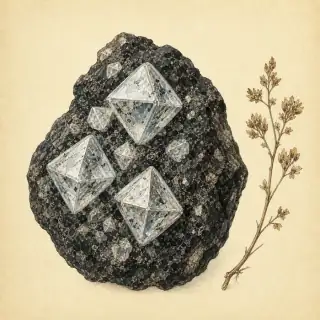
Diamond crystal meaning includes resolve, loyalty, and protective beliefs in the sources examined here. Kunz records a tradition that a bought diamond lost its talismanic virtue, while a gift retained it. That is a belief about exchange and friendship; it does not make self-purchased jewelry powerless or unlucky. This guide uses diamond as an optional symbol of commitment. The stone cannot force a turning point or tell you to make a choice today.
| Chakra | Crown (Sahasrara) |
| Element | Fire / Storm |
| Zodiac | Aries |
| Color | Colorless, Yellow, Brown, Blue, Pink, Green, Black |
Why Does Ancient Diamond Lore Defy Modern Myths?
Modern crystal blogs repeat claims without checking history. Almost every site asserts that diamond amplifies any stone it touches. No historical text supports that claim. The oldest accounts describe a demanding presence. Pliny the Elder, Book 37, chapter 15 of the Natural History, first century. The adamas beats fire and beats iron, and gives way to fresh warm goat's blood. He stopped to marvel at what research or accident led anyone to try that. Pliny also recorded that the stone is hostile to the magnet. Placed nearby, it refuses to let a lodestone hold iron, pulling the metal away. Keep your stone away from lodestone. In the fourteenth century, Sir John Mandeville wrote: "It happens often that the good diamond loses its virtue by sin and for incontinence of him who bears it." The Talmud records that a high priest's stone dimmed on the guilty and shone on the innocent. Live a double life and its power vanishes.
Cardano questioned the value of the fearlessness credited to diamond. Kunz records his point: prudence and fear can contribute to safety. The disagreement makes a useful subject for reflection. Before calling a decision brave, ask what preparation it needs. A diamond crystal can symbolize resolve while leaving room to reconsider. You do not need to suppress heartbreak or make a dramatic decision to match a stone's reputation.
Zodiac Connection
Kunz's comparison includes sapphire in seven April lists and diamond in two of the eight lists overall. The 1912 American trade list standardized diamond for April; diamond already appeared in some earlier calendars. This site's Aries pairing is a modern symbolic reading of resolve. It does not establish that diamond makes an Aries fearless or that everyone with the sign has the same temperament. Cardano's caution about fearlessness remains a useful counterpoint to the charm stories.
Diamond's symbolic meanings below are inherited belief. No laboratory finding backs any of it.
What Can Diamond Represent in a Personal Commitment?
Physical Healing
Diamond's hardness makes a memorable metaphor for resolve, but a mineral property does not create authority in meetings. If you wear a diamond to mark a professional milestone, write down the work that brought you there. Before a demanding day, choose one commitment you can realistically keep. The object may carry that personal meaning without changing colleagues, attracting leaders, or reorganizing your schedule.
Emotional & Spiritual Healing
When a project ends badly, the diamond crystal can mark a question about commitment: what remains worth your effort? Write the answer in your own words and allow it to change as you learn more. A jewel does not expose your motives or remove chronic worry. Avoid using its reputation for hardness as a demand to be hard on yourself or other people.
Chakra Association
This site's Crown Chakra pairing places diamond within modern crystal symbolism. Readers may use the crown image to represent perspective or a pause before a decision. Kunz also prints a different system, the nine-gem arrangement assigning diamond to Venus east of the central ruby. That layout is an astrological tradition, separate from a chakra diagram. These maps do not establish an effect on the body or tell you which decision is correct.
This is tradition and practice, not medical, financial, or life advice.
How Do You Use Diamond Day to Day?
Wearing Diamond
Kunz records Marbodus's belief that a diamond set in gold on the left arm drove away night spectres. Read it as a medieval charm instruction. It is not a reason to rely on jewelry against fear or danger. Wear your diamond on the side that suits its setting and your routine. There is no need to keep it away from magnets because of Pliny's old claim about diamond opposing lodestone.
Diamond in Your Home
If you want a display inspired by the nine-gem arrangement Kunz reproduces, you can put diamond east of a central ruby. Identify it as a decorative adaptation of that layout. A desk placement can instead mark a personal commitment. It does not discourage gossip or create discipline in a room. Choose a secure place where the jewelry will not be lost or knocked onto the floor.
Meditation with Diamond
Hold the diamond in your palm while considering a decision. Ask what you know, what is still uncertain, and who else could offer useful information. A white-light visualization is optional imagery. No answer has to arrive immediately, and no decision has to be carried out before sunset. Put the stone down when you need time to think.
Cleansing & Charging
For a symbolic reset, clean the display space and revisit the intention you associate with your diamond. You can ask a friend to share a good wish if you both enjoy that custom. Kunz records a belief that bought diamonds lost their talismanic virtue. That belief does not mean a self-purchased stone needs a restoration ceremony. Physical cleaning depends on the stone, treatments, and setting; an imagined residue does not require smoke or soaking.
Crystal Combinations
Diamond pairs well with these crystals for complementary energy in crystal healing practice:
- Clear Quartz for Symbolic pairing: shared clarity and amplification themes in crystal reflection practice
- Amethyst for Symbolic pairing: pairing Crown Chakra work with calming spiritual imagery
- Moonstone for Symbolic pairing: combining diamond's clarity with moonstone's intuition in crystal reflection tradition
- Ruby for Symbolic pairing: combining clarity and amplification with passion and vitality
European jewelers into the eighteenth century priced amethyst level with diamond, ruby and emerald, and the February birthstone page follows what became of that ranking once new supply reached the market a century later.
Caring for Diamond
Cleaning: Warm soapy water and a soft brush, or hand the piece to a jeweler once a year.
Avoid: Take the ring off before anything heavy. One bad angle on an exposed corner and a diamond splits clean in two, which no jeweler can undo.
Your crystal profile
Is Diamond Your Birthstone?
Month
Day
Diamond is linked to Aries and the month of April. Enter your birthday above to see if it matches your sign.
Pairs well with
Diamond at a glance
- Also known as
- April's modern birthstone, once linked to Aries in astrological gem lists
- Tradition
- A second-century verse treats it as an Evil Eye ward; Kunz's 1913 survey found it on only 2 of 8 historical month lists.
- Chakra / element
- Crown chakra, Fire and Storm
- In one line
- A stone credited with unbending resolve and, in some old texts, moral scorekeeping.
- Try this first
- Wear it into one hard conversation you've been avoiding, as a personal cue to stay direct.
- Do not
- Do not hammer-test a diamond to prove it's real. It only proves it can shatter.
Kunz 1913, pp. 72, 73, 248
Real moments where diamond lore actually applies
Three specific situations, not generic reassurance.
You're about to hammer-test a diamond someone is selling you
Put the hammer down. The anvil trick these sellers demonstrate proves nothing except that the stone shatters, which any diamond does under a direct blow. Ask for a proper hardness or refractive index test instead, or get the stone checked by a lab. Kunz documented this false test in 1913, and it has been wrecking real stones, emeralds included, for over a century.
You feel like someone has it out for you before a big meeting
Traditionally believed protection here traces to a second-century verse promising the Evil Eye no power over the wearer. Slip a diamond on before you walk in, not as insurance against a bad outcome, but as a way to walk in steady. Practitioners treat it as a mental anchor, not a shield against actual danger.
You're comparing diamond colors and wondering if shade means anything
In crystal practice, some readers still nod to Buddhabhatta's old color-by-caste system, treating white stones as the purest grade and brown ones as lesser. Leave that framework where it started. It sorted people, not gem quality. Modern clarity and color grading exists for a reason, and none of it has to do with who is allowed to wear which shade.
Two diamonds, two incompatible traditions
Two accounts, two different diamonds, one stone. Diamond crystal lore never agreed with itself.
The anvil myth that broke real gems
You've probably heard someone claim you can drop a diamond on an anvil and hit it with a hammer to prove it's real. Kunz called this out directly in 1913: a genuine diamond does not survive a hammer blow, it shatters like any other crystal under a direct strike. The claim didn't just embarrass a few jewelers. People who trusted it went looking for something to smash and grabbed emeralds off nearby trays, certain any tough looking green stone would pass the same test. A diamond's value sits in its resistance to scratching, not its ability to survive being struck.
Protection charm or class marker
The oldest diamond blessing on record comes from a second-century Orphic poem, promising that the Evil Eye shall have no power to harm the one who wears the stone. That reads like a charm anyone could use. Centuries later, the writer Buddhabhatta sorted diamonds by the caste of the owner. Kunz recorded his scheme: white stones for Brahmins, brown ones the color of a hare's eye for Kshatriyas, and separate grades further down the social order. One tradition hands the stone to whoever needs shielding. The other decides in advance who is even allowed to hold it.
Frequently Asked Questions
What does a diamond crystal really mean?
Diamond crystal meaning in modern practice leans on unyielding clarity and hard-won resolve, but the oldest written accounts describe something closer to a demanding presence than a passive good-luck charm. Pliny the Elder, writing in Book 37, chapter 15 of his first-century Natural History, said the adamas beats fire and beats iron, yet gives way to fresh warm goat's blood, a claim he found strange enough to marvel at whatever accident or research led anyone to test it. He also recorded that diamond is hostile to the magnet, refusing to let a lodestone hold iron placed near it. Modern crystal blogs commonly claim diamond amplifies any stone it touches; no historical text quoted on this site supports that specific claim.
What tarot card connects to the diamond?
This guide follows the Crown correspondence in Crowley's 777: diamond appears at Kether, row 1 of Column XL, associated with the four Aces. That is an occult table's relationship between symbols. It does not make a diamond produce new beginnings or identify the right course of action.
Why is diamond considered the April birthstone?
The diamond crystal's link to April is about a hundred years old, not ancient. Across the eight historical birthstone lists Kunz gathered for his 1913 research, seven give April to sapphire, and diamond appeared in only two lists total. Kunz found no diamond birthstone assignment anywhere before the nineteenth century, and argued in print that jewelers should drop diamond from the calendar entirely, using small diamonds only as decorative borders around the actual birthstones. The switch happened at a trade meeting in Kansas City in August 1912, where the jewelers' association handed April to diamond. Kunz recorded the vote and published the adopted table in 1913, warning in the same pages against letting commercial interests dictate what people believed was ancient lore.
What happens if you buy a diamond for yourself?
Buying a diamond for yourself, outside of any engagement or gift tradition, is treated in crystal practice as an act of self-declared commitment, not romance: a way of marking that you are the one keeping the promise, not someone else making it. There is no historical source cited on this site for that specific framing; it draws on the stone's older reputation for demanding integrity from whoever carries it. Sir John Mandeville wrote in the fourteenth century that a diamond crystal loses its virtue through the sin or infidelity of its bearer, and the Talmud records a similar belief that a high priest's stone dimmed on the guilty and shone on the innocent. Read together, the tradition treats diamond as a stone that reflects the wearer's own conduct, not one that grants favors regardless of it.
Which chakra is linked to diamond?
This site's Crown Chakra pairing places diamond within modern crystal symbolism. Readers may use the crown image to represent perspective or a pause before a decision. Kunz also prints a different system, the nine-gem arrangement assigning diamond to Venus east of the central ruby. That layout is an astrological tradition, separate from a chakra diagram. These maps do not establish an effect on the body or tell you which decision is correct.
Which zodiac sign belongs to diamond?
Kunz's comparison includes sapphire in seven April lists and diamond in two of the eight lists overall. The 1912 American trade list standardized diamond for April; diamond already appeared in some earlier calendars. This site's Aries pairing is a modern symbolic reading of resolve. It does not establish that diamond makes an Aries fearless or that everyone with the sign has the same temperament. Cardano's caution about fearlessness remains a useful counterpoint to the charm stories.
How were diamonds worn as protection?
Kunz records Marbodus's belief that a diamond set in gold on the left arm drove away night spectres. Read it as a medieval charm instruction. It is not a reason to rely on jewelry against fear or danger. Wear your diamond on the side that suits its setting and your routine. There is no need to keep it away from magnets because of Pliny's old claim about diamond opposing lodestone.
Can you pair diamond with any crystal?
Yes, diamond can be paired with other crystals in practice, and this site pairs it specifically with amethyst, a combination meant to add clarity and light to amethyst's calming, boundary-setting reputation not to amplify it in any measurable sense. That framing is deliberate: modern crystal blogs commonly claim diamond amplifies whatever stone sits near it, and no historical text cited on this site supports that broad a claim. The Sanskrit Nararatnaparikshaa, reproduced by Kunz in 1913, places diamond specifically beside a central ruby in a nine-gem setting not beside an arbitrary stone, which is closer to how this site treats pairing: a deliberate, named combination with a reason behind it, not diamond as a universal booster for anything you set beside it.
The primary sources behind this page
Each diamond crystal claim above, traced back to the page it came from.
- A second-century poem promises the diamond wards off the Evil Eye
Kunz 1913, p. 72
The Orphic verse states "the Evil Eye shall have no power to harm" the wearer. - Buddhabhatta sorted diamonds by caste and color
Kunz 1913, p. 73
White stones went to Brahmins, hare's-eye brown stones to Kshatriyas, and further grades below them. - The anvil-and-hammer diamond test is false and destroyed real stones, emeralds included
Kunz 1913, p. 248
Kunz records the anvil claim as untrue and notes real gems were smashed by people acting on it.
References
- Diamond, Gemological Institute of America (GIA)
- Diamond, International Gem Society
- perseus.tufts.edu/hopper/text?doc=Perseus:text:1999.02.0137:book=37:chapter=15
- gutenberg.org/files/57978/57978-h/57978-h.htm
“The safest cleaning methods are also the easiest.”

 ?
?