 BirthstoneMeaning
 Aries Birthstone
 Taurus Birthstone
 Gemini Birthstone
 Cancer Birthstone
 Leo Birthstone
 Virgo Birthstone
 Libra Birthstone
 Scorpio Birthstone
 Sagittarius Birthstone
 Capricorn Birthstone
 Aquarius Birthstone
 Pisces Birthstone
 Garnet Meaning
 Aquamarine Meaning
 Diamond Meaning
 Emerald Meaning
 Pearl Meaning
 Ruby Meaning
 Blue Sapphire Meaning
 Opal Meaning
 Topaz Meaning
 Turquoise Meaning
 Moonstone Meaning
 Tourmaline Meaning
 Citrine Meaning
 Tanzanite Meaning
 Alexandrite Meaning
 Spinel Meaning
 Sardonyx Meaning
 Zircon Meaning
 Lapis Lazuli Meaning
 Rose Quartz Meaning
 Onyx Meaning
 Labradorite Meaning
 Malachite Meaning
 Jade Meaning
 Agate Meaning
 Carnelian Meaning
 Clear Quartz Meaning
 Black Tourmaline Meaning
 Smoky Quartz Meaning
 Sodalite Meaning
 Obsidian Meaning
 Fluorite Meaning
 Selenite Meaning
 Hematite Meaning
 Howlite Meaning
 September Birthstone
February Birthstone Meaning: Amethyst, Once a Cardinal Gem
Ask what the February birthstone meaning is and the answer is amethyst, tied in old writing to restraint, a settled mind and protection from excess. No revision has ever offered the month a second gem. The stone's standing is another matter. European jewelers once priced amethyst level with diamond, ruby, sapphire and emerald.
- Level head
- Temperance
- Inner quiet
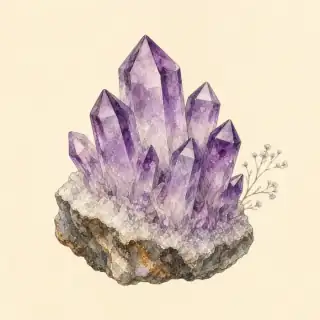
The Sobriety Amethyst Was Supposed to Guarantee
Every February birthstone meaning on this page reached us through writing and none of it through a laboratory. No part of what follows has ever been tested, and it is here anyway, because what people wanted a stone to do for them is itself part of the record.
Amethyst
Sobriety runs through every layer of the lore. Classical writers held that a cup of the right purple stone would keep a drinker clear-headed, and the idea widened over the centuries into a general association with self-command. Medieval European courts read the color as a mark of restraint and spiritual seriousness. Crystal healing practice today extends the older reading toward calm sleep, quieted anxiety and freedom from compulsive habits of any kind. These are traditional beliefs with a long paper trail behind them and no experimental support whatsoever.
| Chakra | Crown (Sahasrara) |
| Element | Air |
| Zodiac | Aquarius, Pisces |
| Colors | Purple, Violet, Lilac, Deep purple |
When the Older Sources Say to Wear It
Classical and medieval writers tied amethyst to specific moments of self-command, not to a general good mood. These are the situations they actually named.
A dinner or an evening where staying clear-headed matters
Classical writers associated amethyst with sobriety. That story offers no way to stay sober: wearing it or drinking from it cannot prevent intoxication. You can choose it as a symbol of restraint without treating the old claim as a drinking strategy.
A decision you don't want to make on impulse
Medieval courts read the colour as a mark of restraint and seriousness, and crystal practice keeps that reading for the stretch between an urge and an action. Wear it in the hours before you sign, answer or reply.
A habit you're trying to break
Modern crystal practice borrows amethyst’s restraint symbolism for changing a habit. You might use it as a visual reminder of a choice you have already made. The stone has no established role in treating addiction.
The night before something that unsettles you
Older lore links amethyst’s calm-headed reputation with nighttime rest. Keeping it on a bedside shelf is an optional symbolic custom, with no established effect on sleep or anxiety.
Can You Wear February’s Stones Every Day?
Amethyst survives almost everything except light. Charge it on a sunny windowsill the way half the internet tells you to and you get back a paler stone every month, until the purple has gone entirely. The ritual is the thing that kills it, and no jeweler can put the color back.
- Charge it under the moon and store it in the dark. Sun fades amethyst slowly enough that you never catch it happening, and a deeply colored stone holds out longer than a pale one.
- Take a ring off before a beach day or a long drive with your hand up in the light. An ordinary indoor day costs nothing. A whole summer of direct sun does.
- Tell any jeweler the stone is amethyst before a torch goes near the setting. Heat during a resize turns the purple yellow for good, and the stone should come out of the mount first.
- Warm water, a drop of hand soap, a soft brush. Skip anything that buzzes or steams unless you know exactly what has already been done to the piece.
- A sharp knock on an exposed edge will chip it, so a bezel or a lower setting is the sensible answer for a stone you plan to wear every day.
Where February's Old Agreement Splits in Two
Amethyst is one of the few months the historical tables barely argue over. Split the month by zodiac sign, not by calendar date, and a real disagreement turns up, one sitting inside February itself and not between February and its neighbours.
Eight tables, and only two small departures
Amethyst appears on all eight of the historical lists Kunz set side by side. Two of the eight also carry a second name for the month: one adds hyacinth, another adds pearl, each appearing exactly once. Only a handful of months on that page come anywhere close to that kind of agreement, and February is one of them.
Kunz's zodiac table sent Aquarius to garnet, not amethyst
The same 1913 book has a separate zodiacal chapter, and it hands Aquarius, whose span in that chapter reaches to February 21, a different stone entirely: garnet. A reader born in the first three weeks of February gets amethyst from the month table and garnet from the zodiac table, a full stone apart, from one author writing two chapters of the same book. Our January page carries the four-line verse behind that Aquarius line; February inherits the contradiction without inheriting the quote.
Pisces is where the two old tables actually land on the same stone
Kunz's zodiacal chapter gives amethyst to Pisces as well, covering February 21 through March 21, and that is the one point in this whole calendar where the month table and the zodiac table agree outright. The verse attached to the sign reads: “From passion and from care kept free Shall Pisces’ children ever be Who wear so all the world may see The amethyst.” Nowhere else in February does an old zodiac assignment simply confirm what the calendar already says.
Was Amethyst Always February's Stone?
On the American chart it has been, from the first version onward. The 1912 standardization gave February to amethyst by itself, later revisions that reshuffled other months never touched it, and no committee has proposed a companion since. That makes it one of the calendar's quiet slots, along with April and September. Older European and Polish lists made the same choice independently, so the month has an unusually consistent record across traditions that otherwise disagree constantly.
Consistency at the top of the list hides a collapse in status underneath it. Through the eighteenth century European jewelers ranked amethyst among five cardinal gems, level with diamond, ruby, sapphire and emerald, and priced it that way. New supply reached the market in the nineteenth century, overwhelmed a demand built on scarcity, and dropped the stone into the affordable tier where it has stayed. February is the only month whose gem carries that history of a price crash, and a buyer today gets a saturated, well-cut stone for a sum that would have bought nothing two centuries ago.
Which Zodiac Signs Cover February Birthdays?
February is split unevenly between two signs, and the break comes on the 19th. Aquarius covers birthdays through February 18, then Pisces takes the last week and a half and continues into March. An Aquarius birthday collects amethyst from both directions, since the sign's modern zodiac stone is amethyst as well, and the calendar agrees. A February 25 birthday sits differently. The month says amethyst, Pisces answers aquamarine in the modern zodiac scheme, and aquamarine belongs to March on the calendar chart. Amethyst then reappears as the traditional Pisces stone, so the two systems overlap for that reader without matching. Different traditions, different purposes, never reconciled.
February Birthstone Questions People Ask
Is there a second February birthstone?
No official chart lists a second. Amethyst has held February alone since 1912, and none of the revisions that expanded other months proposed a partner for it. Some retailers offer purple sapphire or iolite as harder alternatives for daily rings, and those are shopping suggestions with no place on the list.
How long does sunlight take to fade an amethyst?
Longer than a walk and shorter than you would like. The change is gradual and cumulative, so months of direct exposure on a windowsill or a dashboard produce a visible loss while normal wear indoors produces none. Deeper stones hold their color better, and once the purple has gone it does not return on its own.
Is a very dark amethyst better than a pale one?
Up to a point. The premium goes to a rich purple that still returns light through the stone, often with red or blue flashes, and color that reads almost black in average lighting loses value because the gem stops looking lively. Even distribution matters as much as depth, since natural zoning leaves many crystals darker at one end.
Is synthetic amethyst common?
It is, and it has been since the 1970s, when laboratories learned to grow it. Lab-grown amethyst looks the same to the eye and usually the same under a loupe, so telling the two apart is a job for a laboratory. On a gem this affordable, an honest listing matters more than the price does.
What is amethyst traditionally used for in crystal practice?
Practitioners describe it as a stone for calm, clear thought and restful sleep, and they extend the old sobriety association to breaking compulsive patterns generally. It is traditionally placed at the crown in energy work. None of this has been demonstrated in any study, and it should never take the place of medical care.
Is February the least argued month on the chart?
It is among them. All eight of the historical tables Kunz compared name amethyst for February, with hyacinth and pearl each appearing once as a second name. The disagreement for this month sits in the zodiac tables, not the calendar ones.
Why is amethyst so much cheaper than other February gifts?
Supply. Enormous finds reached the market in the nineteenth century and ended the scarcity that had kept amethyst among the cardinal gems. The upside for a buyer is that deep color and a large clean stone are both within reach, which is rarely true anywhere else on the chart.
Citations for every measurable claim sit below, and the February birthstone meaning stays inside the section built to hold it. That leaves the practical part. The February birthstone is hard enough to wear daily, cheap enough to buy well, and easier to spoil than anything else on the calendar, because the thing that makes it purple is a defect that light erases. Keep it out of the sun, and warn your jeweler before a torch comes near it.
February also has a flower on the calendar, the violet. The birth flower chart tracks it alongside every month's birthstone.
February's Claims and the Pages Behind Them
Each claim below points at a text you can open yourself. The book is out of copyright, so nothing here asks you to take our word for it.
- February's near-unanimous place on the historical tables
Kunz 1913, p.316
Kunz's eight-table comparison credits amethyst against every one of the eight, with hyacinth and pearl each turning up once as a second name for the month. - The Aquarius zodiac assignment that contradicts the month table
Kunz 1913, p.345-347, "Zodiacal Gems"
The chapter gives Aquarius garnet and prints a four-line verse with it, a full stone away from the amethyst the month table assigns the very same weeks. Our January guide carries that entry verbatim. - The Pisces zodiac assignment that matches the month table
Kunz 1913, p.345-347, "Zodiacal Gems"
“From passion and from care kept free Shall Pisces’ children ever be Who wear so all the world may see The amethyst.”
References
- Amethyst, Gemological Institute of America (GIA)
- Amethyst, International Gem Society
- perseus.tufts.edu/hopper/text?doc=Perseus:text:1999.02.0137:book=37:chapter=40
- gutenberg.org/files/57978/57978-h/57978-h.htm
“The safest cleaning methods are also the easiest.”

 ?
?