 BirthstoneMeaning
 Aries Birthstone
 Taurus Birthstone
 Gemini Birthstone
 Cancer Birthstone
 Leo Birthstone
 Virgo Birthstone
 Libra Birthstone
 Scorpio Birthstone
 Sagittarius Birthstone
 Capricorn Birthstone
 Aquarius Birthstone
 Pisces Birthstone
 Peridot Meaning
 Garnet Meaning
 Amethyst Meaning
 Aquamarine Meaning
 Diamond Meaning
 Emerald Meaning
 Pearl Meaning
 Ruby Meaning
 Blue Sapphire Meaning
 Opal Meaning
 Topaz Meaning
 Turquoise Meaning
 Moonstone Meaning
 Tourmaline Meaning
 Citrine Meaning
 Tanzanite Meaning
 Alexandrite Meaning
 Spinel Meaning
 Sardonyx Meaning
 Zircon Meaning
 Lapis Lazuli Meaning
 Rose Quartz Meaning
 Onyx Meaning
 Labradorite Meaning
 Malachite Meaning
 Jade Meaning
 Agate Meaning
 Carnelian Meaning
 Clear Quartz Meaning
 Black Tourmaline Meaning
 Smoky Quartz Meaning
 Sodalite Meaning
 Obsidian Meaning
 Fluorite Meaning
 Selenite Meaning
 Hematite Meaning
 Howlite Meaning
 September Birthstone
Carnelian Meaning and Healing Properties Explained
The core carnelian meaning centers on courage, motivation, and bold speech. Crystal practitioners connect this warm orange-red stone to confidence and the willingness to act without hesitating. Historical rulers, physicians, and religious authorities all attributed different powers to carnelian across centuries of documented tradition.
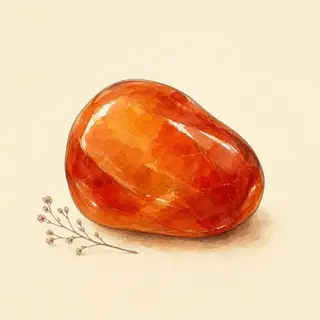
| Chakra | Sacral (Svadhisthana) |
| Element | Fire |
| Zodiac | Aries |
| Color | Orange, Reddish-orange, Deep red, Brownish-red |
What Is the Spiritual Carnelian Meaning?
Folklore across several traditions shapes the carnelian meaning around a stone that pushes its wearer toward action. The thirteenth-century Lapidario, a gem guide commissioned by King Alfonso X of Castile, recommends carnelian to people with a weak voice or timid manner, for the warm-colored stone was said to lend them the courage to speak both boldly and well. In parts of the Islamic world, engravers carved carnelian seals with Arabic prayers asking for protection from envy and misfortune, and craftsmen sold entire verses of Ottoman-era poetry describing the stone as a talisman that drives away evil and brings luck to its owner. Among Mohammedan peoples, the stone's popularity is said to trace back to the Prophet himself, who reportedly wore a silver ring set with an engraved carnelian seal on the little finger of his right hand. One of the most famous Shia imams, Jafar, lent his religious authority to carnelian's reputation, declaring that every desire of a man who wore the stone would be granted. That sweeping promise sits beside a very different, secular use of the same gem: the carnelian seal carried by Napoleon I, later worn by Napoleon III and finally by the Prince Imperial, who kept it on a cord around his neck at his father's request. Napoleon I picked up the octagonal seal himself during his Egyptian campaign, and it disappeared during the Prince Imperial's death in the Zulu War of 1879, never to be recovered. Folklore separately credited carnelian with protecting its wearer from injury in a collapsed building, with one seventeenth-century writer claiming no man who wore the stone was ever found beneath a fallen wall.
You can use this stone as a physical prompt to speak up in moments that would normally call for silence. Its warm, sun-toned color offers an immediate visual reminder to push past hesitation before a difficult conversation. Many people hold a smooth piece in a closed fist for a few seconds before raising a concern they would normally avoid. The stone also serves as an anchor during periods of low motivation. Practitioners suggest that its deep orange tone mirrors the color of a flame, and holding it can help focus scattered attention on a single, immediate task. People who feel stuck on a project sometimes keep a piece next to their keyboard to prompt the first small step. Crystal healers describe this as a way of externalizing willpower into an object you can see and touch, without depending on mood alone to get started. Beyond individual motivation, some practitioners use carnelian to support difficult family conversations, drawing on its long association with courage in speech. Keeping the stone in a pocket during a tense visit is said to provide a quiet reminder to state your position plainly without deferring just to keep the peace.
Zodiac Connection
Carnelian pairs naturally with Aries because the stone's traditional link to courage and bold speech mirrors this fire sign's own direct, initiating energy.
All claims about carnelian's spiritual and emotional effects reflect traditional crystal folklore and historical belief, passed down through centuries, not verified scientific or medical findings.
How Do Practitioners Use Carnelian for Healing?
Physical Healing
Crystal practitioners incorporate carnelian into routines meant to support physical stamina and a sense of momentum. People often hold a warm-toned piece before exercise, using its color as a visual cue to raise their energy before a workout. Some keep a tumbled stone in a gym bag or on a desk during long afternoons when energy typically dips. A seventeenth-century source recorded by Kunz names carnelian, along with hematite and jasper, among stones once applied directly to the body in the belief that they could check bleeding from small wounds. Modern practitioners no longer use the stone this way, and no scientific evidence supports using crystals to treat any physical condition. These older applications survive only as a historical curiosity, not as guidance for how anyone should use the stone today. Some users hold a piece while doing slow, deliberate breathing exercises before a physically demanding task, treating the stone's weight and warmth as a grounding point, not a remedy.
Emotional & Spiritual Healing
Tradition holds that carnelian steadies emotional courage during moments that call for a direct response. Users often hold the stone before a confrontation they have been avoiding, using its warm surface as a prompt to stop rehearsing the conversation and simply begin it. Many people report that focusing on the stone's color for a few breaths interrupts a spiral of overthinking before a hard conversation. Crystal healers also connect the stone to recovering motivation after a setback. Practitioners suggest that carnelian's fire-toned color pairs naturally with a fresh start, and some keep a piece visible on a desk after a rejection or a missed opportunity as a reminder to try again and not give up. This use has no clinical basis and works, if at all, purely as a personal ritual and visual cue. Others use the stone to support honest self-expression in group settings, drawing on its long folkloric association with a confident speaking voice.
Chakra Association
Modern crystal healers associate carnelian with the Sacral chakra, located a few inches below the navel. Practitioners typically hold or place a piece against the lower abdomen during meditation, believing this placement supports creativity, motivation, and a healthy sense of personal desire. The stone's orange color is the traditional hue assigned to this specific energy center in most modern chakra systems. When working with this chakra, some practitioners visualize a warm orange light expanding outward from the stone through the hips and lower torso. This visualization is meant to loosen a sense of stuck or blocked creative energy. Others pair slow abdominal breathing with holding the stone, treating the physical warmth of the gem as a focal point, not a treatment. This chakra-based reading of the carnelian meaning remains a matter of symbolic tradition. It offers a structured meditation focus, not a verified physical effect on the body.
This is tradition and practice, not medical, financial, or life advice.
How Do You Use Carnelian Day to Day?
Wearing Carnelian
Jewelers commonly set this Mohs 6.5 to 7 chalcedony into rings, pendants and beaded bracelets because it withstands ordinary daily wear well. A carnelian ring worn on the dominant hand gives you something to glance at right before you need to speak up in a meeting. Many people prefer a simple bezel setting that keeps the stone's warm color fully visible and not tucked away, staying close to the everyday carnelian meaning of confidence on display. You can rotate a carnelian ring with your thumb as a quiet, private cue to steady your nerves before an unscheduled conversation. Avoid extended exposure to strong household bleach or chlorine, which can dull the stone's surface over years of contact.
Carnelian in Your Home
Many people place a carnelian cluster or tumbled stones near a home office desk to mark the spot where they do focused, deadline-driven work. A common practice involves keeping a piece near the front door as a reminder to greet visitors with confidence, not reserve. You can arrange several polished stones in a bowl on a kitchen counter, where the warm color adds visual energy to a space used early in the morning. Placing a piece near a reading chair gives you something to hold before making a difficult phone call from home. Kept in a visible spot, the stone works as a standing reminder of the carnelian meaning: act now, do not delay.
Meditation with Carnelian
You can hold a smooth, palm-sized carnelian in both hands while seated, letting its weight settle before you begin. Focus on the warmth building between your palms as a physical anchor for attention, the same way practitioners have used warm-colored stones for centuries. Some people visualize a small flame at the center of the lower abdomen, matching the stone's traditional Sacral chakra placement, and let that image grow steadier with each breath. You might also rest the stone directly on your lower abdomen while lying down, aligning it with the chakra practitioners associate with motivation and creative drive. Five to ten minutes is usually enough to notice the grounding effect practitioners describe.
Cleansing & Charging
A soft-bristled brush with a touch of mild soap under warm running water safely removes everyday skin oils and dust from carnelian. Its solid chalcedony structure tolerates gentle ultrasonic cleaning reasonably well, though heavily included or fractured pieces are safer washed by hand. Avoid sudden temperature swings, such as moving the stone from hot water directly into a cold rinse, which can stress internal fractures over time. Extended direct sunlight can gradually shift the stone's color, so store pieces you are not wearing in a drawer or pouch. For symbolic cleansing, some practitioners set the stone in indirect morning light for an hour, treating the daylight as a way of refreshing its traditional association with renewed energy.
Crystal Combinations
Carnelian pairs well with these crystals for complementary energy in crystal healing practice:
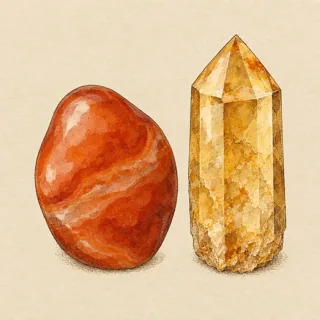
- Citrine for Practitioners often pair carnelian with citrine to combine bold motivation with a steadier sense of personal confidence.
- Garnet for Crystal healers use garnet alongside carnelian to strengthen the traditional link between both stones and sustained physical stamina.
Caring for Carnelian
Cleaning: Warm soapy water and a soft brush; ultrasonic cleaning is generally safe.
Avoid: Avoid prolonged direct sunlight and extreme heat which can alter color.
Your crystal profile
Is Carnelian Your Birthstone?
Month
Day
Carnelian is linked to Aries. Enter your birthday above to see if it matches your sign.
Carnelian at a glance
- Also known as
- Sard, Sunset Stone
- Tradition
- Courage, motivation and bold speech
- Chakra / element
- Sacral / Fire
- In one line
- A warm orange-red chalcedony long associated with courage, motivation and confident speech.
- Try this first
- Hold it for a moment before a conversation you have been avoiding.
- Do not
- Prolonged direct sunlight and sudden temperature changes.
Kunz, The Curious Lore of Precious Stones, 1913, p.64
When to Reach for Carnelian in Daily Life
These situations show where practitioners actually keep the stone close at hand.
At your desk on a Wednesday afternoon before a hard email
You can set a carnelian stone beside your keyboard while you draft a message you have been putting off for days. Hold the stone for a moment before you start typing, letting its warmth remind you of the traditional link between carnelian and bold, direct speech. Write the difficult sentence first; do not bury it near the end of the message. Send the email while the stone is still in your hand, without waiting for a better moment that may not come.
In your car in the parking lot before a job interview
Keep a small tumbled carnelian in your coat pocket as you review your notes one last time. Press your thumb against the smooth surface while you run through your opening answer out loud. Crystal tradition ties this stone to overcoming a weak or timid voice, so use the moment to practice speaking at your normal volume, not a nervous half-whisper. Leave the stone in your pocket during the interview itself as a quiet physical anchor you can feel without anyone noticing.
Getting dressed in your bedroom on a Monday morning before a big meeting
Hold a carnelian stone for a moment while you decide what to wear for the day ahead. Set it on your dresser where you will see it again while you tie your shoes. Crystal practitioners connect the stone's fire-toned color to overcoming inertia, so use it as a prompt to name the one task you have been avoiding all week. Slip the stone into your bag before you leave so it stays with you until that task is done.
How Far Does Carnelian's Power Reach?
Two historical sources placed very different limits on what carnelian could actually do for the people who wore it.
Jafar's Boundless Promise
According to George Frederick Kunz, one of the most famous Shia imams, Jafar, lent the full weight of his religious authority to carnelian, declaring that every desire of a man who wore the stone would be granted. This claim traveled with an account that the Prophet himself wore a silver ring set with a carnelian seal on the little finger of his right hand, and in Persia engravers frequently cut the name of one of the twelve imams directly onto the stone. The promise carried no limit and no condition beyond simply wearing the gem.
The Lapidario's Narrow Prescription
A different, far narrower claim appears in the Lapidario, a gem guide compiled for King Alfonso X of Castile in the thirteenth century. Kunz records that this text recommends carnelian specifically to people with a weak voice or a timid manner, promising only that the warm-colored stone would give them the courage to speak boldly and well. The Lapidario makes no claim about wealth, safety or general desire, tying the stone's power to one narrow, practical effect, not an unlimited one. The two traditions never reconciled; they simply describe the same gem at opposite ends of how far its promised power was said to reach.
Frequently Asked Questions
What is the traditional carnelian meaning in crystal practice?
The traditional carnelian meaning centers on courage, motivation and confident speech. Crystal practitioners associate this warm orange-red chalcedony with the willingness to act without hesitating. A thirteenth-century Spanish text, the Lapidario, recommended it specifically for people with a weak or timid voice. The stone registers 6.5 to 7 on the Mohs hardness scale, making it durable for daily wear. Historical sources also connect carnelian to a well-documented family heirloom: a carnelian seal carried by Napoleon I, Napoleon III and the Prince Imperial. These applications come from folklore and symbolic tradition, and no scientific evidence supports crystals having a measurable effect on courage or speech.
What is the story behind the Napoleon carnelian seal?
Napoleon I picked up an octagonal carnelian seal during his campaign in Egypt and carried it with him afterward. His nephew, Napoleon III, later wore the same seal on his watch-chain and gave it to his son, the Prince Imperial, describing it as a talisman to keep. The Prince Imperial wore it on a cord around his neck and died in 1879 during the Zulu War, where Zulu fighters stripped his body of his belongings. The seal was never recovered. Antiquarian Rev. C. W. King documented the object's engraved Arabic inscription and its passage through three generations of the Bonaparte family.
How should you clean and care for carnelian jewelry?
Wash carnelian gently with a soft brush, a drop of dish soap, and lukewarm tap water to lift everyday oils and dust. The stone tolerates gentle ultrasonic cleaning in most cases, though older or heavily fractured pieces are safer washed by hand. Avoid sudden temperature changes, such as rinsing a warm stone under cold water, since this can stress internal fractures over time. Extended direct sunlight can gradually shift the stone's natural color, so store pieces in a drawer or pouch when you are not wearing them. Wiping the surface with a soft cloth restores its natural glassy shine.
Where does carnelian come from and how is its color produced?
Carnelian is a variety of chalcedony, a microcrystalline form of quartz, colored orange to reddish brown by iron oxide impurities, mainly hematite. Major sources include India, Brazil, Uruguay and Madagascar. Much of the material sold commercially has been heat-treated, either naturally through sun exposure over long periods or deliberately by cutters, to deepen a pale stone's color. The gem has been worked since antiquity, carved into seals and beads in ancient Egypt and Mesopotamia and later favored by Roman signet-ring cutters because hot sealing wax does not stick to its surface.
Why do crystal healers associate carnelian with the Sacral chakra?
Modern crystal healers link carnelian to the Sacral chakra largely because of its warm orange color, which matches the hue most chakra systems assign to that energy center. Practitioners typically hold or place the stone against the lower abdomen during meditation, believing this supports creativity, motivation and a healthy sense of personal desire. This association draws on the stone's long folkloric reputation for encouraging bold action and confident speech. The practice remains entirely symbolic, with no verified physical effect on the body.
Does the carnelian meaning change between cultures?
The core carnelian meaning of courage and bold speech appears across several unrelated traditions, though the details differ. Islamic sources tied the stone to the Prophet's own seal ring and to sweeping promises from religious authorities. A thirteenth-century Spanish text narrowed the claim to curing a weak or timid voice. European folklore separately credited the stone with protecting its wearer from injury in a collapsed building. Modern crystal practice keeps the courage and confidence themes while dropping the older claims about physical protection or unlimited desire fulfillment.
Who should wear carnelian?
Speakers, performers, and leaders frequently utilize this warm orange-red chalcedony. In crystal healing practice, it is traditionally believed to inspire bold speech and high motivation. Folklore suggests its fire element energy empowers individuals who need extra courage. Practitioners often associate its sacral chakra connection with taking decisive action and overcoming hesitation.
What zodiac sign is carnelian for?
Aries matches perfectly with this fiery chalcedony in astrological traditions. Individuals belonging to this sign are naturally driven and action-oriented. Practitioners associate the warm fire element of the mineral with their innate bravery. Crystal folklore holds that its sacral chakra energy amplifies their motivation while encouraging them to speak boldly and confidently.
A Seal Carried by Three Generations of an Empire
One artifact connects a royal military campaign, a private family message, and a death on a distant battlefield. Read together, they show how differently people across history have understood the carnelian meaning.
- Napoleon I, Napoleon III and the Prince Imperial each personally carried the same carnelian seal across three generations.
Kunz 1913, p.64
The Reverend C. W. King, a recognized writer on antique gems, described this octagonal carnelian seal, engraved with the Arabic legend "The slave Abraham relying upon the Merciful (God)." Napoleon I picked it up during his Egyptian campaign and carried it afterward. Napoleon III wore it on his watch-chain and later gave it to his son with the instruction to keep it as a talisman. The Prince Imperial wore it on a cord around his neck and lost it in 1879 during the Zulu War, when Zulu fighters stripped his body after his death; it has never been recovered. - A thirteenth-century Spanish court text recommended carnelian specifically for people with a weak or timid speaking voice.
Kunz 1913, p.63
The Lapidario, a gem guide compiled for King Alfonso X of Castile, recommends carnelian to people with a weak voice or a timid manner, stating that the warm-colored stone would give them the courage to speak both boldly and well. - A seventeenth-century court physician listed carnelian among stones once believed to check bleeding when applied to the body.
Kunz 1913, p.6
Writing in 1609, Anselmus De Boot, court physician to Emperor Rudolph II, argued that many supposed virtues of gems were false, but held that carnelian, hematite and jasper had real, observable effects when applied to the body, specifically that they checked hemorrhage.
References
“The safest cleaning methods are also the easiest.”