 BirthstoneMeaning
 Aries Birthstone
 Taurus Birthstone
 Gemini Birthstone
 Cancer Birthstone
 Leo Birthstone
 Virgo Birthstone
 Libra Birthstone
 Scorpio Birthstone
 Sagittarius Birthstone
 Capricorn Birthstone
 Aquarius Birthstone
 Pisces Birthstone
 Peridot Meaning
 Garnet Meaning
 Amethyst Meaning
 Aquamarine Meaning
 Diamond Meaning
 Emerald Meaning
 Pearl Meaning
 Ruby Meaning
 Blue Sapphire Meaning
 Opal Meaning
 Topaz Meaning
 Turquoise Meaning
 Moonstone Meaning
 Tourmaline Meaning
 Citrine Meaning
 Tanzanite Meaning
 Alexandrite Meaning
 Spinel Meaning
 Sardonyx Meaning
 Zircon Meaning
 Lapis Lazuli Meaning
 Rose Quartz Meaning
 Onyx Meaning
 Labradorite Meaning
 Malachite Meaning
 Jade Meaning
 Agate Meaning
 Carnelian Meaning
 Clear Quartz Meaning
 Black Tourmaline Meaning
 Smoky Quartz Meaning
 Sodalite Meaning
 Obsidian Meaning
 Fluorite Meaning
 Selenite Meaning
 Hematite Meaning
 Howlite Meaning
 September Birthstone
Find Your Tarot Birth Card
This is tradition and practice, not medical, financial, or life advice.
Your tarot birth card is the Major Arcana card tied to your birthday through a numerology method: add every digit in your birth date and reduce the total to a number from 0 to 22. This tarot birth card calculator runs that reduction for you and shows its paired stone and zodiac sign.
Calculate Your Tarot Birth Card



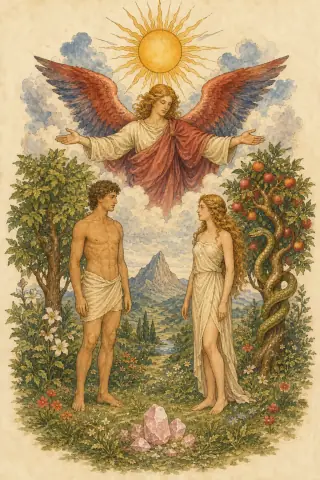
6. The Lovers
Stone: Rose Quartz · Sign: Gemini
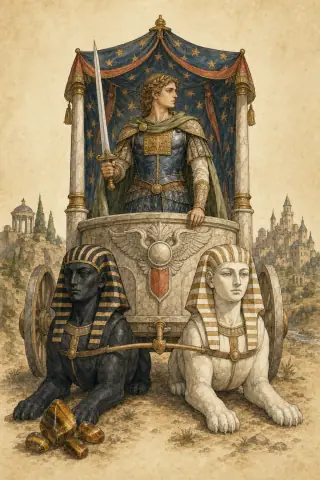
7. The Chariot
Stone: Tiger Eye · Sign: Cancer


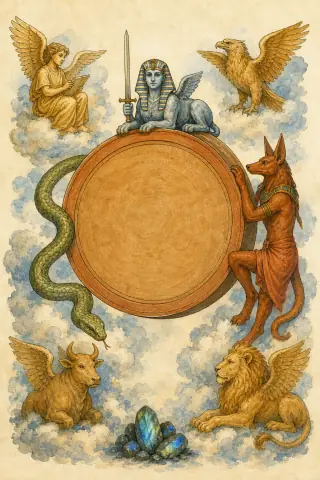
10. Wheel of Fortune
Stone: Amethyst · Sign: Sagittarius


12. The Hanged Man
Stone: Aquamarine · Sign: Pisces


14. Temperance
Stone: Labradorite · Sign: Sagittarius

15. The Devil
Stone: Black Tourmaline · Sign: Capricorn


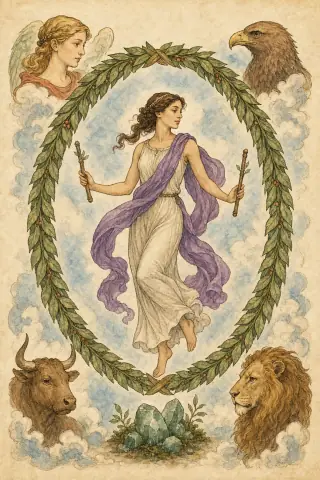
17. The Star
Stone: Celestite · Sign: Aquarius



Where This Method Comes From
Tarot readers have used a birth card system since at least the 1980s, most commonly traced to Mary K. Greer's 1984 book Tarot for Your Self, which paired every birth date with a Major Arcana card through digit addition. Secondary accounts of Greer's own acknowledgments say she credited tarot teacher Angeles Arrien with teaching her the underlying technique in workshops starting in 1977, though we could not confirm that detail against a primary quote from the book itself. What every source we checked agrees on is the arithmetic itself.
How to Calculate Your Birth Card
Write out your birth date and add every individual digit: the digits of the month, the digits of the day, and all four digits of the year. If that total is 21 or lower, it is your primary birth card, matched directly to the Major Arcana card of that number. If the total is exactly 22, your primary card is The Fool, card 0 — a special case explained below. If the total is 23 or higher, add its own digits together and check the result against these same rules, repeating until you land on a number 22 or lower. This is the same method the tarot birth card calculator above runs automatically, so you can check its output by hand.
A Worked Example
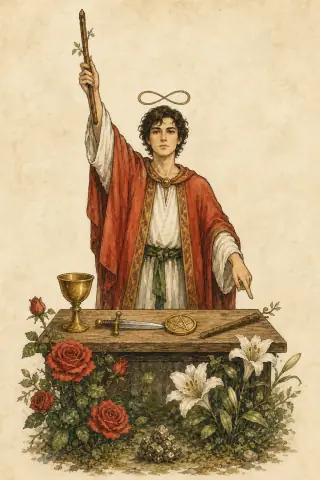
Take a sample birthday, November 3, 1985. The month contributes 1 + 1 = 2. The day contributes 0 + 3 = 3. The year contributes 1 + 9 + 8 + 5 = 23. Add those three subtotals: 2 + 3 + 23 = 28. Since 28 is over 21, add its digits: 2 + 8 = 10. Ten falls between 10 and 21, so the primary birth card for this date is card 10, the Wheel of Fortune, the card this site already pairs with amethyst and Sagittarius.
Your Companion Card
Most birth-card sources describe a second step for anyone whose primary card lands in the 10 to 21 range: reduce that two-digit number one more time and read the result as a companion card. Continuing the November 3, 1985 example, 10 reduces to 1 + 0 = 1, giving a companion card of card 1, The Magician, the card this site pairs with opal and Gemini. If your first reduction already lands on a single digit, 0 through 9, you do not get a separate companion card. Your birth card and your companion card are the same number. The Fool works the same way: a primary card of The Fool, from a total of exactly 22, has no separate companion card either. One starting total produces a rarer third step. A sum of 19 reduces to 1 + 9 = 10, and 10 is itself a two-digit card that still needs one more reduction. Someone whose full birth-date digits add up to 19 ends up with three connected cards: 19 (The Sun), 10 (Wheel of Fortune), and 1 (The Magician). That is the only starting total where the chain runs three cards deep, not two.
The Sum-of-22 Case: The Fool
Digit reduction on its own can never land on exactly 0 — there is no positive digit total that reduces straight to zero. Two live tarot birth-card calculators we checked, TheAstroScope and Xuan Seal, handle that gap the same way: they stop reducing at 22 and assign that total to The Fool, card 0, without taking the extra step to 2 + 2 = 4. We follow that same rule here. A worked example: November 29, 2016. The month contributes 1 + 1 = 2. The day contributes 2 + 9 = 11. The year contributes 2 + 0 + 1 + 6 = 9. Adding those, 2 + 11 + 9 = 22 exactly, so this birth date's primary card is The Fool, with no separate companion card. Not every tarot teacher accepts this convention. The Tarot School's Ruth Ann and Wald Amberstone reject it outright: 'Since no sum of positive numbers ever equals 0, we do not consider The Fool as part of a Birth Card pair. Likewise, we do not accept the sometimes-used convention of assigning the number 22 to The Fool.' Their method would reduce a sum of 22 to card 4, The Emperor, the same as any other total over 21. We are naming that disagreement openly, not hiding it, and this calculator follows the convention the working calculators use: 22 is The Fool.
Bonus: Your Tarot Card for 2026
Alongside the main tarot birth card calculator above, a related, lower-effort convention gives you a card for the current year, not for your whole life. It uses only your birth month and day, added to the current calendar year, not your birth year, so it changes every January 1 and is the same starting point for everyone born on that date regardless of how old they are.
Add the digits of your birth month and day together, then add the digits of the current year, then reduce the same way as above. Using the November 3 birthday again for 2026: month and day give 2 + 3 = 5. The digits of 2026 give 2 + 0 + 2 + 6 = 10. Add those: 5 + 10 = 15. Fifteen falls in the 10 to 21 range, so the personal year card for that birthday in 2026 is card 15, The Devil, the card this site pairs with black tourmaline and Capricorn.
We checked this method against several independent calculator sites (Angelorum, Tarot.com, The Mystica, Shadow Bear Tarot) and they describe the same birth-month-plus-birth-day-plus-current-year formula, though some of them add the day and month as whole numbers before summing digits, not splitting every digit first. We recommend implementing this bonus section with the same digit-by-digit method used for the main birth card above, for consistency on one page. Call out that choice explicitly in the implementation spec, and don't silently mix two reduction styles.
A Tradition, Not a Calculation
This tarot birth card calculator uses a numerology convention from tarot practice, not a scientific method or an astrological calculation. It reduces the digits in your birth date to a Major Arcana number using arithmetic that has no connection to your natal chart, your moon sign, or any planetary position. Two people born on very different dates can land on the same card, because the method only cares about the digit total, not the date itself. Read your result as a reflection prompt drawn from a decades-old teaching tradition, not a prediction, a diagnosis, or a claim about your personality that any test has measured.
Frequently Asked Questions
- What if my birthdate reduces to a two-digit number over 21?
- Keep going. Add the digits of that number together and check the result again. Repeat until you land on a number from 0 to 21. Most birth dates only need one or two reduction passes to get there.
- Can I have two birth cards?
- Yes, and it is the more common outcome. Anyone whose first reduction lands on a two-digit number from 10 to 21 gets a primary card plus a companion card from one more reduction step. Only birth dates that reduce straight to a single digit, 0 through 9, end up with just one card.
- Is this the same as astrology?
- No. This is a numerology method built on digit addition, not a chart calculated from your birth time and location. The zodiac sign shown next to your card comes from this site's existing tarot-to-zodiac pairing for that specific card, the same pairing used on our individual card pages, not from any astrological calculation done on your birthday.
- Does the year card use my birth year or the current year?
- Your main birth card always uses your full birth date, month, day, and birth year. The bonus year-card section further down this page works differently: it uses your birth month and day together with whatever the current calendar year is, so it produces a different card every year.
- When do I get The Fool as my birth card?
- When your birth date's digits add up to exactly 22. That is the one total where we stop reducing and assign the card directly, without continuing on to 2 + 2 = 4 (The Emperor). Not every tarot teacher accepts this convention, but it's how the live tarot birth-card calculators we checked handle this specific total, and it's the rule this calculator follows.
- Who created the birth card method?
- It is most often credited to Mary K. Greer, who published it in her 1984 book Tarot for Your Self. Secondary accounts of Greer's own acknowledgments say she credited tarot teacher Angeles Arrien with teaching her the technique in workshops from 1977, though we could not confirm that detail against a primary quote from the book itself.
Sources
- Mary K. Greer, Archetypal Tarot / Tarot Birth and Year Cards (author's own course page). Confirms Greer authored Tarot for Your Self and Archetypal Tarot and taught both a birth-card and a year-card system; does not spell out the full digit formula on this page.
- Biddytarot, 'Reveal Your Inner Self with Tarot Birth Cards'. Attributes the Personality/Soul Card naming to Mary Greer and describes the general digit-reduction method; a chief-editor re-check of this page found an example pairing '22/0' with 4 but no unambiguous statement of the sum-of-22 rule, so TheAstroScope and Xuan Seal below are the sources this page actually relies on for that specific rule.
- Angelorum, 'How to Calculate Your Tarot Birth Cards'. Worked example (April 13, 1975) using block addition, not per-digit summing; used here only to cross-check the disagreement between block and per-digit methods, not as the algorithm this spec recommends.
- Thalira, 'Tarot Birth Cards: How to Calculate Yours and What They Mean'. Describes the exact per-digit-sum algorithm this page uses, with a worked example (November 3, 1985) matching the one reused above, and a two-step companion-card reduction (28 to 10 to 1).
- Trini Idealist does Tarot, 'Personality, Soul and Hidden Factor Cards'. Source for the sum-of-19 triple-card case, the sum-of-22 Fool/Emperor special-case disagreement, and the secondary claim that Greer credited Angeles Arrien (1977) as the technique's source.
- Angelorum, 'How to Calculate Your Tarot Year Card'. Direct quote and worked example (March 1, 2025 and 2026) confirming the personal year card uses birth month plus birth day plus the current calendar year, recalculated every year.
- TheAstroScope, 'Free Arcana Calculator — Birth Arcana by Date'. Live calculator: reduces every digit of the birth date until the total is 22 or less, and states '22 counts as 0, The Fool.' Primary source for this page's sum-of-22 rule.
- Xuan Seal, 'Free Arcana Calculator — Find Your Major Arcana Birth Cards'. Second independent live calculator confirming the same rule: reduce until the total is 22 or less, '22 standing for The Fool in Rider-Waite numbering.'
- The Tarot School (Ruth Ann & Wald Amberstone), 'Determining Your Birth Cards'. Dissenting view, quoted directly in the sum-of-22 section: explicitly rejects assigning 22 to The Fool and treats only 1-21 as valid birth-card numbers. Included for honesty about a real disagreement, not adopted as this page's rule.
Explore More Tarot
Sources & Editorial Basis
Month assignments follow the Jewelers of America birthstone list. Care guidance is checked against the Gemological Institute of America. Everything else here is folklore, astrology and crystal practice. We label each claim as tradition and name the text or the period we traced it to wherever one exists.
“The safest cleaning methods are also the easiest.”