 BirthstoneMeaning
 Aries Birthstone
 Taurus Birthstone
 Gemini Birthstone
 Cancer Birthstone
 Leo Birthstone
 Virgo Birthstone
 Libra Birthstone
 Scorpio Birthstone
 Sagittarius Birthstone
 Capricorn Birthstone
 Aquarius Birthstone
 Pisces Birthstone
 Peridot Meaning
 Garnet Meaning
 Amethyst Meaning
 Aquamarine Meaning
 Diamond Meaning
 Emerald Meaning
 Ruby Meaning
 Blue Sapphire Meaning
 Opal Meaning
 Topaz Meaning
 Moonstone Meaning
 Tourmaline Meaning
 Citrine Meaning
 Tanzanite Meaning
 Alexandrite Meaning
 Spinel Meaning
 Sardonyx Meaning
 Zircon Meaning
 Rose Quartz Meaning
 Onyx Meaning
 Labradorite Meaning
 Malachite Meaning
 Jade Meaning
 Agate Meaning
 Carnelian Meaning
 Clear Quartz Meaning
 Black Tourmaline Meaning
 Smoky Quartz Meaning
 Obsidian Meaning
 Fluorite Meaning
 Selenite Meaning
 Hematite Meaning
 Howlite Meaning
 September Birthstone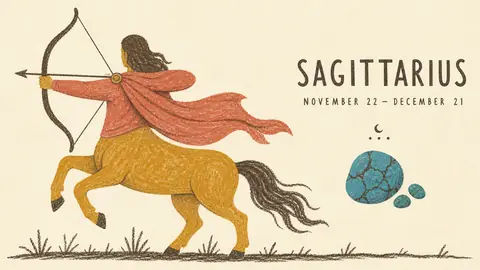
Sagittarius Birthstone: Turquoise, the Traveler's Talisman
The Sagittarius birthstone is turquoise in the modern list, with topaz as the older traditional choice. Turquoise has been the traveler's charm for over 5,000 years, carried along the Silk Road and through the Southwest. Topaz, the philosopher's stone, sharpens the mind for the journey.
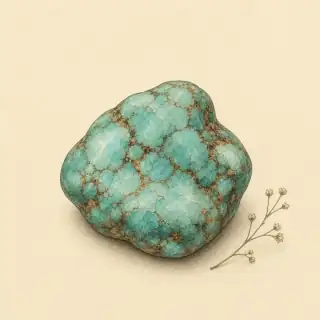
How Does the Archer End Up With Turquoise?
Jupiter rules Sagittarius in the astrology this guide uses, and turquoise's protective reputation is paired with that rulership by tradition, not by evidence about personality or about turquoise's effect.
Sagittarius is mutable fire, ruled by Jupiter, and permanently half packed. The Archer runs on optimism, big questions and the need to see the next place, whether that place is a country, an idea or a belief system. Turquoise fits because it has been the traveler's stone for thousands of years, carried by Native American warriors, Persian kings, Tibetan monks and Silk Road merchants who all reached the same conclusion separately. Its sky blue is the color of the thing a Sagittarius keeps walking toward. The traditional stone, topaz, supplies the thinking half. Where turquoise opens the road, topaz was the stone of philosophers, credited with clear judgment and with protection against your own foolishness. Sagittarius wants to think as far as it travels, and the pair covers both.
Where Does the Sagittarius Birthstone Come From?
History and Lore
Turquoise is one of the oldest known gemstones. Egyptian pharaohs wore turquoise jewelry at least 5,500 years ago, and Tutankhamun's burial mask features prominent turquoise inlay. In the American Southwest, Native peoples have mined and worked turquoise for over 2,000 years, and it remains central to Navajo, Zuni, and Pueblo jewelry traditions.
- Ancient Egyptians mined turquoise in the Sinai Peninsula as early as 3200 BCE; King Tutankhamun's burial mask features extensive turquoise inlay.
- The word 'turquoise' comes from the French 'pierre turquoise' (Turkish stone), as the gems reached Europe via Turkish trade routes.
Correspondences
Crystal practice files turquoise under these correspondences, a traditional association. Use it to decide where you keep turquoise and which intention you set with it.
| Chakra | Throat (Vishuddha) |
| Element | Earth |
| Zodiac | Sagittarius, Capricorn |
| Colors | Sky blue, Robin's egg blue, Green-blue, Blue with brown matrix |
Traditional Meanings
- Traditionally believed to protect travelers, promote honest communication, and attract good fortune.
- In Native American tradition, turquoise is a sacred stone connecting earth and sky, used in healing ceremonies and jewelry for centuries.
Turquoise has carried these meanings across cultures for centuries, on the strength of tradition alone, not proof.
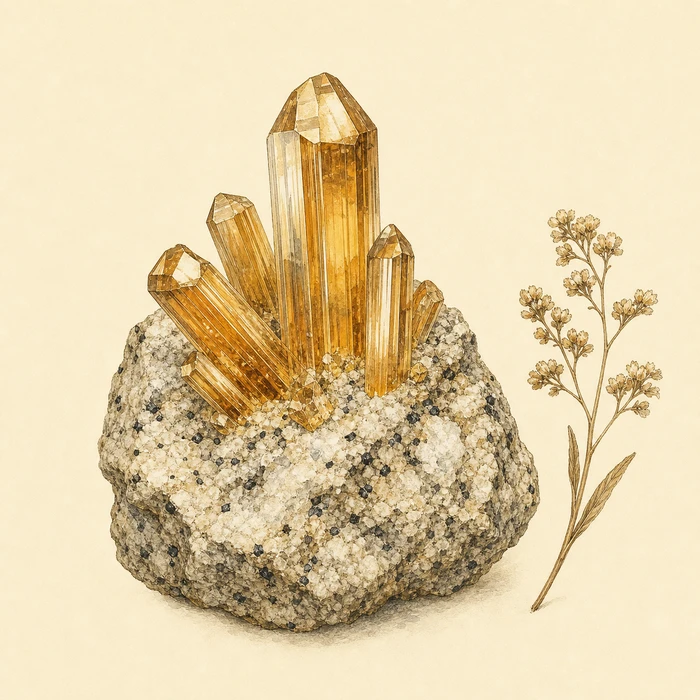
Topaz: The Traditional Sagittarius Birthstone
This guide uses Turquoise as the modern Sagittarius stone because most of the sign falls in December, whose standardized monthly list includes Turquoise. Topaz comes from a separate, older stream of zodiac-gem associations, which varied by place and period. Topaz's connection to Sagittarius is an older custom that predates 1912, a pairing the official vote has still never adopted. The stone that borrowed its name from an island nobody could find, and November's stone in every old list.
Kunz's 1913 Sagittarius verse names topaz. Turquoise enters our modern column through December's month list. One can mark a question you want to explore and the other a journey you want to remember. The travel-charm story belongs to folklore; carrying a stone does not provide safety, wisdom or an income.
Sagittarius answers to Jupiter, and topaz is the stone the old planetary tables hand to that same planet, which is why this sign carries the expansion stone twice over. The crystals for money puts that Jupiter filing next to the gold-setting rule and the corner of the room each money stone is meant to sit in.
- The stone Portugal's crown listed for generations as the Braganza Diamond turned out to be a colorless topaz.
- Ancient Egyptians tied topaz to the golden glow of the sun god Ra and wore it as a protector.
Interactive birthstone reading
Your Sagittarius Stone Pairing
This Sagittarius guide starts with its own zodiac result. Add a birthday to check another sign.
Sagittarius: Turquoise and Topaz
Modern month-derived pairing and older zodiac tradition
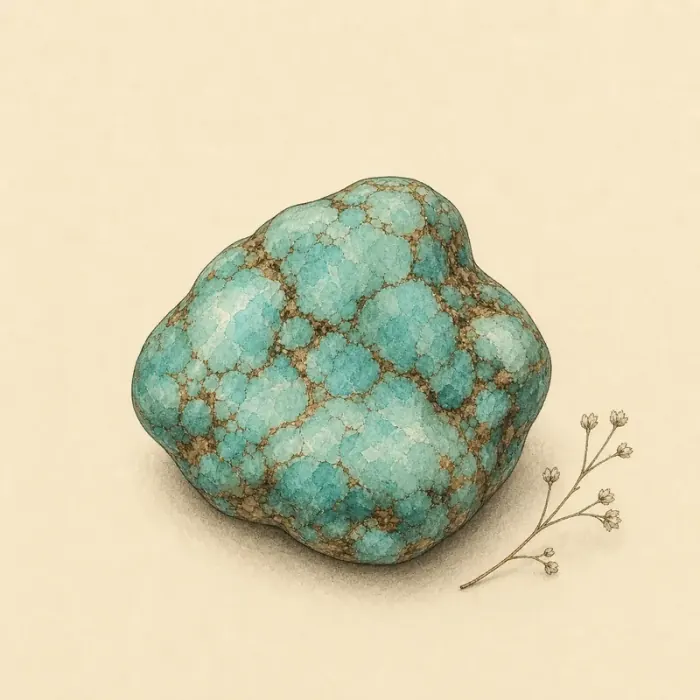
Modern stone
Turquoise
Traditional stone
Topaz
Turquoise is this guide's modern zodiac pairing, drawn from the month containing most Sagittarius dates. Topaz comes from older zodiac-gem traditions. Both Turquoise and Topaz are cultural conventions here, and a birthday cannot prove either one.
Try a birthday
Choose a month and day to recalculate the local zodiac result. No birth year, time, or location is needed for this date-range lookup.
Or use today's date from this device to see the current zodiac result.
Choose a symbolic focus
Pick a supporting stone to explore one tradition-based prompt for Sagittarius.
Should a Sagittarius Add Lapis Lazuli or Sodalite?
Beyond the primary and traditional birthstones, two additional gems have strong associations with Sagittarius in crystal healing practice. These are not standardized monthly birthstones, but they complement turquoise well in both color and traditional symbolism.

Lapis Lazuli
Lapis lazuli's deep blue color and historical association with philosophical wisdom resonate with Sagittarius' Jupiter-ruled quest for knowledge and higher meaning.

Sodalite
Sodalite's blue-and-white patterns make it a companion for a Sagittarius study ritual. Keep it beside a notebook as a marker for questions you want to explore.
Quick Reference
Sagittarius Birthstone
at a glance
Modern Stone
Turquoise
Traditional
Topaz
Chakra
Throat (Vishuddha)
Element
Earth
Colors
Sky blue, Robin's egg blue, Green-blue
Supporting
Lapis Lazuli, Sodalite
birthstonemeaning.com
Infographic · share with credit
How Should You Wear the Sagittarius Birthstone?
The best way to wear a birthstone is whatever way you will actually put it on every day. That said, some settings and combinations bring out turquoise’s best qualities better than others.
Chakra, planetary and energy notes in this section describe crystal-practice tradition, not a proven physical or medical effect.
- A turquoise pendant or bolo tie can mark the start of a journey. Enjoy the travel-charm symbolism as a story; jewelry does not protect you from accidents.
- Topaz can split when struck at the wrong angle. Choose a pendant for active days and remove a topaz ring before hands-on work.
- Layer a lapis lazuli bracelet with a sodalite bracelet for a Jupiter-energy wisdom stack during study, teaching, or philosophical exploration.
Learn more: Turquoise Crystal Meaning & Healing Properties →
Where the Sagittarius Birthstone Story Gets Complicated
The topaz answer for Sagittarius did not appear from nowhere. It comes from a named, dated source, and that source disagrees with today's charts on exactly where the sign begins.
The traditional stone column has an actual author
Every traditional stone on this site's zodiac pages, topaz for Sagittarius included, comes from George Frederick Kunz's zodiacal gems chapter, published in 1913. Kunz was Tiffany's own gem buyer, and he set his sign-by-sign list down with a short verse attached to each one. Most sites that print “traditional birthstone” never say where the tradition comes from. This one does, and the answer has a page number.
Kunz Starts Sagittarius One Day Earlier
Our Sagittarius range starts November 22; Kunz's starts November 21. Both end on December 21. November 21 is Scorpio in our lookup, with topaz in the modern column. In Kunz's table it is a shared Scorpio/Sagittarius boundary, carrying the family name quoted on our Scorpio page and topaz respectively. The table cannot settle an exact Sun-sign calculation.
The month chart hands the same birthday a third stone
November 22 to 30 falls within Sagittarius and has topaz or citrine by month. December 1 to 21 has December's turquoise, tanzanite or zircon. Our modern Sagittarius column keeps turquoise throughout, while Kunz's zodiac verse names topaz. The calendar switches stones on December 1, independently of the zodiac date range.
A note on the modern stone. It comes from December, the month this sign closes in, by the same arithmetic used for all twelve. Pavitt's 1914 chapters list turquoise as Taurus's second stone and give Sagittarius topaz and chrysolite. the complete 1914 comparison →
Sagittarius Birthstone: Frequently Asked Questions
These common questions cover the Sagittarius birthstone, its color, monthly overlap, and how people actually wear it. The sections above carry the lore and the correspondences behind the short answers.
What is the birthstone for Sagittarius?
The modern birthstone for Sagittarius (November 22 to December 21) is turquoise, an ancient sky-blue gem sacred to cultures worldwide. The traditional birthstone is topaz, a hard, brilliant gem associated with wisdom and strength.
Why is turquoise the birthstone for Sagittarius?
Turquoise has been a traveler's talisman for millennia, a match for Sagittarius' adventurous, globe-trotting spirit. Its sky-blue color symbolizes the open horizons that Jupiter-ruled Sagittarius constantly seeks.
Which stone should a Sagittarius pack for a trip?
Turquoise, and it is not close. The stone has been the traveler's charm from the Silk Road to the Southwest, worn by people who genuinely did not know whether they were coming back. Put it on before you leave and keep it on until you are home.
What is the difference between topaz and citrine?
They look alike in yellow and they carry very different reputations. Topaz is the older Sagittarius stone, the one tradition hands to philosophers and to anybody who wants a clear head. Citrine sits with money and confidence. Sellers called citrine topaz for a long time, and the confusion is still with us.
Is the Sagittarius birthstone the same as the December birthstone?
They overlap. Turquoise is a December monthly birthstone, along with tanzanite and zircon, and it is also the modern Sagittarius stone. Sagittarius runs November 22 to December 21, so late-November births fall under topaz by month, which is Sagittarius's traditional stone anyway.
What is Sagittarius's lucky stone?
Jupiter rules Sagittarius, and lapis lazuli and sodalite are the stones most often tied to the sign's love of wisdom and truth, alongside turquoise. These lucky-stone links are traditional beliefs, so choose the color and story that speak to you.
Can turquoise be worn every day?
Yes, with one rule. Turquoise drinks in whatever touches it, so lotion, perfume, sunscreen and sweat will shift the blue toward green over time and it never shifts back. Dress first, jewelry last, and reverse that at the end of the day. A dry cloth is the whole routine, and it should never be soaked.
A turquoise piece is the natural gift for a Sagittarius, a bolo, a pendant, a cuff, something with road history attached. Keep a topaz ring alongside it for the days the turquoise should stay home. Turquoise takes up whatever touches it, so it goes on last and it never gets soaked. The idea that it guards wanderers has crossed enough cultures to count as universal. Give it to somebody who is always about to leave.
Where This Page's Sagittarius Claims Come From
Every historical claim above traces to one book and one chapter. Here is the paper trail.
- Topaz as the traditional Sagittarius stone, with its own verse
Kunz 1913, p.345-347, ZODIACAL GEMS
“Who first comes to this world below Under Sagittarius should know That their true gem should ever show A topaz.” Kunz gives Sagittarius no other stone in this chapter. - How Kunz dated the sign
Kunz 1913, p.345-347, ZODIACAL GEMS
Kunz's table opens Sagittarius on November 21 and closes it on December 21, a day earlier than the November 22 start printed on most charts in circulation today.
References
- Turquoise, Gemological Institute of America (GIA)
- Turquoise, International Gem Society
- perseus.tufts.edu/hopper/text?doc=Perseus:text:1999.02.0137:book=37:chapter=33
- gutenberg.org/files/57978/57978-h/57978-h.htm
- Topaz, Gemological Institute of America (GIA)
- Topaz, International Gem Society
- perseus.tufts.edu/hopper/text?doc=Perseus:text:1999.02.0137:book=37:chapter=32
- gutenberg.org/files/57978/57978-h/57978-h.htm
“The safest cleaning methods are also the easiest.”

 ?
?