 BirthstoneMeaning
 Aries Birthstone
 Taurus Birthstone
 Gemini Birthstone
 Cancer Birthstone
 Leo Birthstone
 Virgo Birthstone
 Libra Birthstone
 Scorpio Birthstone
 Sagittarius Birthstone
 Capricorn Birthstone
 Aquarius Birthstone
 Pisces Birthstone
 Peridot Meaning
 Garnet Meaning
 Amethyst Meaning
 Aquamarine Meaning
 Diamond Meaning
 Emerald Meaning
 Pearl Meaning
 Ruby Meaning
 Blue Sapphire Meaning
 Opal Meaning
 Topaz Meaning
 Turquoise Meaning
 Moonstone Meaning
 Tourmaline Meaning
 Citrine Meaning
 Tanzanite Meaning
 Alexandrite Meaning
 Spinel Meaning
 Sardonyx Meaning
 Zircon Meaning
 Lapis Lazuli Meaning
 Rose Quartz Meaning
 Onyx Meaning
 Labradorite Meaning
 Malachite Meaning
 Jade Meaning
 Agate Meaning
 Carnelian Meaning
 Clear Quartz Meaning
 Black Tourmaline Meaning
 Smoky Quartz Meaning
 Sodalite Meaning
 Obsidian Meaning
 Fluorite Meaning
 Selenite Meaning
 Hematite Meaning
 Howlite Meaning
 September Birthstone
The Spiritual Meaning of Birthstones, Tradition by Tradition
This is tradition and practice, not medical, financial, or life advice.
The spiritual meaning of birthstones is a set of traditional associations, one per month, that folk practice and crystal healing assign to twelve gems. Each carries a chakra, an element, and a customary use. This page compares all twelve side by side. None of it is scientifically demonstrated.
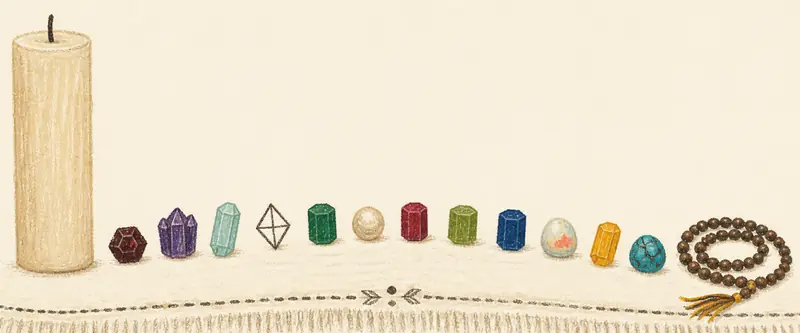
- Twelve traditions
- Chakra and element
- Belief, not science
Everything below is documented belief. Greek, Roman, medieval, Vedic, and modern crystal healing sources say these things about these stones; no controlled study has shown a gemstone to produce an energetic, emotional, or medical effect. Every claim here names the text, the century or the practice it came from. Where nobody can name one, we say so.
The Twelve Traditions at a Glance
Every stone below carries three inherited labels: a chakra seat, a classical element, and a one-word theme that crystal healing practice repeats most often. Reading them as a set shows patterns that no single stone guide can show.
| Month | Stone | Chakra | Element | Traditional Theme |
|---|---|---|---|---|
| January | Garnet | Root (Muladhara) | Fire | Grounding |
| February | Amethyst | Crown (Sahasrara) | Air | Restraint |
| March | Aquamarine | Throat (Vishuddha) | Water | Safe passage |
| April | Diamond | Crown (Sahasrara) | Fire / Storm | Amplification |
| May | Emerald | Heart (Anahata) | Earth | Steadiness |
| June | Pearl | Third Eye (Ajna) | Water | Receptivity |
| July | Ruby | Heart (Anahata) | Fire | Appetite |
| August | Peridot | Solar Plexus & Heart | Earth | Release |
| September | Sapphire | Third Eye (Ajna) | Air | Attention |
| October | Opal | Crown (Sahasrara) | Water | Amplified feeling |
| November | Topaz | Throat (Blue) / Solar Plexus (Golden) | Fire | Color-split |
| December | Turquoise | Throat (Vishuddha) | Earth | Protection |
Which Chakras Crowd, and Which Stand Alone
Crown and throat are the crowded seats, three stones apiece. Amethyst, diamond, and opal share the crown; aquamarine, turquoise, and blue topaz share the throat. Color drives most of that clustering, since every throat stone reads blue, and twentieth-century crystal healing practice matched blue to speech more or less on sight.
Heart belongs to emerald and ruby outright, with peridot claiming a partial seat. Third eye splits between pearl and sapphire. Root holds exactly one stone, garnet, which makes January the only month with no company at all in its own band. Sacral draws a complete blank. No birthstone sits there, and practitioners working that particular center have to reach outside these twelve entirely.
Elements skew the same lopsided way. Fire claims four stones, water and earth split three apiece, and air gets only two. Anyone hunting an air-element birthstone is choosing between amethyst and sapphire, and this traditional framework seats both of them at the two highest points on the body.
Month by Month: What Tradition Assigns Each Stone
Each entry below states where the tradition places the stone relative to the other eleven. For the full cultural record on any one of them, follow the link to its own guide.
January: Garnet
Root (Muladhara) · Fire
Root chakra placement gives garnet the lowest seat on this list, and garnet holds it completely alone. Crystal healing practice traditionally treats it as a grounding stone, meant to be worn low on the body. Its fire element makes that grounding an active push, not a passive settle, in the tradition's own terms.
February: Amethyst
Crown (Sahasrara) · Air
Sobriety is the oldest claim attached to any February stone on record. Greek and Roman writers traditionally believed the purple stone kept a drinker clear-headed, and later practice stretched that into restraint of every kind. It's one of three crown chakra stones on this list.
March: Aquamarine
Throat (Vishuddha) · Water
At sea is where this March gem earned its reputation. Roman sailors traditionally carried it for safe passage, and modern crystal healing practice shifted the emphasis onto speech, which is what puts aquamarine in the throat group today. Water stays its element under both readings.
April: Diamond
Crown (Sahasrara) · Fire / Storm
Permanence carries the entire argument for April's stone. Lapidary texts assigned diamond invincibility and truth because nothing known at the time could damage it, and the vow it sits on top of today inherited that exact reasoning intact. Crystal healing practice traditionally treats it as an amplifier for whatever stone sits beside it, and its sources can't agree on a chakra, so the single label above flattens a dispute that's still very much alive.
May: Emerald
Heart (Anahata) · Earth
The heart chakra holds a pair, and May is the calm half of it. Practitioners traditionally describe emerald as slow and steadying, an earth-element counterweight to July's fire. Egyptian and Roman writers had already tied it to love and renewal long before any of this chakra language existed.
June: Pearl
Third Eye (Ajna) · Water
Lunar cycles anchor the whole June tradition. Pearl is the one organic gem on this list, and Hindu and Chinese texts traditionally linked it to the Moon, to receptivity, and to patience. Crystal healing practice seats it at the third eye, one of two stones holding that position.
July: Ruby
Heart (Anahata) · Fire
Fire, the element assigned to July, does most of the actual work here. Ruby shares the heart chakra with emerald, and practitioners traditionally read that single seat in two different registers: courage and appetite on one side, patience on the other. No other pair on this list holds a chakra together while pulling in opposite directions.
August: Peridot
Solar Plexus & Heart · Earth
Two chakra seats get claimed at once for August's stone, the only simultaneous pairing on this list, since November's two seats depend entirely on which color specimen you're holding. Tradition gives peridot the solar plexus and the heart together, and Egyptian lore already knew it as a gem of the sun.
September: Sapphire
Third Eye (Ajna) · Air
Medieval clergy and modern study desks meet in September of all months. Blue sapphire was traditionally worn as a sign of heaven, and crystal healing practice now assigns it the third eye and the discipline of sustained attention. Air is its element.
October: Opal
Crown (Sahasrara) · Water
Amplifying whatever's already present is opal's traditional role, which leaves October the least prescriptive month on this entire list. Practitioners describe it as widening feeling in either direction, for better or worse. Romans ranked opal supreme among gems; a nineteenth-century novel handed it the opposite reputation entirely.
November: Topaz
Throat (Blue) / Solar Plexus (Golden) · Fire
Color decides which chakra November lands in, and no other stone here splits that particular way. A blue topaz and a golden topaz collect two different traditional labels, which is how one gem name ends up in two separate bands of the table above. Lapidary texts from the Middle Ages assigned it the power to break spells outright.
December: Turquoise
Throat (Vishuddha) · Earth
Seven thousand years of mining stand behind December's stone, longer than any other gem on this list can claim. Egyptian, Persian, and Southwestern Pueblo traditions each independently treated turquoise as protective, arriving at the same conclusion without contact with each other, and crystal healing practice now groups it with the throat stones. Earth is its element, unusual for that particular group.
Where the Twelve Traditions Contradict Each Other
Aggregating the spiritual meaning of birthstones into one list makes the disagreements visible. Two of them are worth knowing before anyone treats this set as a single coherent system.
Opal holds two opposite European reputations
Roman writers put opal at the very top of their entire gem hierarchy. Nineteenth-century Britain reversed that verdict after Sir Walter Scott published Anne of Geierstein in 1829, and for decades afterward the gem was said to be unlucky, a piece of folklore that outlived the novel, until the jewelry trade spent years arguing it back into favor. One stone, one continent, two completely opposite readings a few generations apart.
Diamond's chakra is unsettled
Practitioners reach for diamond at the crown in one strand of crystal healing. Others describe it engaging all seven centers simultaneously, which would make it the only stone on this entire list with no fixed position at all.
Birthstone spiritual meaning at a glance
- Also known as
- Zodiac stones, chakra stones, crystal healing correspondences
- Tradition
- Twelve overlapping traditions: Greek and Roman lapidary lore, Vedic and Hindu texts, medieval European writers, and 20th-century Western crystal healing
- Chakra / element
- Chakra assignments date from 20th-century Western practice, mostly matched to color, not from any single ancient source
- In one line
- Opal's luck and diamond's chakra both change depending on which century you ask, and the lore never settled either one.
- Try this first
- Read your month's entry for the specific claim and century behind it, past the one-word theme.
- Do not
- Don't treat the chakra or element column as older than about a hundred years.
Pavitt 1914; Kunz 1915; Jones 1877
How Practitioners Actually Use One Tradition
This lore was never meant to sit flat in a comparison table. Here's how four of these traditions play out in an actual day.
You are comparing the bodily powers old authors attributed to a stone
Pavitt's 1914 catalog records the Gnostics wearing bloodstone as an amulet meant to prolong life, grant courage and wealth, strengthen digestion, and lift melancholy, four claims from one religious sect, page 139. Egyptians, Greeks, Romans, and medieval farmers each layered their own stated purpose onto the same stone afterward. Picking bloodstone off a modern list borrows from at least five separate traditions stacked on top of each other, whether the label admits it or not. These are historical attributions, not evidence of medical benefit or a reason to select bloodstone for a health problem.
You've heard the Cleopatra pearl story and you're about to repeat it as fact
Pavitt's own 1914 book tells the famous version, a pearl dissolved in vinegar to win a wager, then flatly says it 'cannot be believed, unless the Pearl was first ground to powder,' on page 184, because any acid strong enough to dissolve a whole pearl would kill the person drinking it. A writer from more than a century ago is the one doing the fact-checking here, not a modern skeptic.
You're wondering why opal has an unlucky reputation at all
Pavitt traces that reputation to one specific source: the misfortunes of a fictional character, Anne of Geierstein, in Sir Walter Scott's 1829 novel of the same name, whose main jewel was a large opal, page 219. Pavitt argues outright that opal is no unluckier than any other stone once you trace the superstition back to a novel published in 1829, not to ancient belief.
You want proof that lodestone lore once had genuinely serious stakes
Pavitt credits the architect Dinocrates, working for Ptolemy Philadelphus, with designing a temple roofed entirely in lodestone so a statue of Queen Arsinoe would hang suspended by magnetism alone, page 233. Both architect and patron died before the roof was finished, and the temple was never built. Lodestone folklore here isn't background decoration. It was an actual engineering plan with a named architect and a named patron attached to it.
Which Two Stones Cannot Keep One Story Straight?
Compare this site's modern zodiac stones against Pavitt's 1914 chapters and one pair comes out swapped.
Opal holds two opposite European reputations
Roman writers put opal at the very top of their entire gem hierarchy. Nineteenth-century Britain reversed that verdict after Sir Walter Scott published Anne of Geierstein in 1829, and for decades afterward the gem was said to be unlucky, a piece of folklore that outlived the novel, until the jewelry trade spent years arguing it back into favor. One stone, one continent, two completely opposite readings a few generations apart.
Diamond's chakra is unsettled
Practitioners reach for diamond at the crown in one strand of crystal healing. Others describe it engaging all seven centers simultaneously, which would make it the only stone on this entire list with no fixed position at all.
Questions Readers Ask About the Spiritual Meaning of Birthstones
Does the tradition require sticking to your own birth month?
No. The month-to-stone list is a twentieth-century retail convention, while crystal healing practice selects stones by intent. Practitioners routinely pick for the quality they want and treat the birth month as one starting point.
How is a stone's spiritual meaning different from its healing properties?
Spiritual meaning covers what a culture said the stone stood for: protection, wisdom, constancy, love. Healing properties cover what modern practitioners claim it does to a body or a mood. The first is documented cultural history. The second is a contemporary belief system with no clinical support.
Where do birthstone chakra assignments come from?
Chakras originate in South Asian tantric and yogic texts, where they describe centers in a subtle body and have nothing to do with gemstones. Pairing them with specific gems is a twentieth-century Western addition matched mostly on color. Blue stones cluster at the throat for that reason alone.
Do zodiac birthstones carry the same meanings as month birthstones?
Often no, because the two systems name different stones. Aries takes diamond from April's month list and bloodstone from the older zodiac list. The traditional associations belong to the stone itself, so a date that points at two stones points at two sets of lore.
Do you have to wear your birthstone for it to work?
No, the folklore treats wearing as one custom among several. In these traditions you can also place a stone where you spend your day: a desk, a nightstand, a meditation corner. Practitioners hold that attention and intent do the work, so a stone in your pocket counts as much as one on your hand.
When a month lists several stones, which one carries the meaning?
Each stone keeps its own lore, so a month with three options carries three separate traditions to read. Crystal healing writers often suggest handling every candidate and keeping the one you reach for again; in that practice the pull you feel is the tiebreaker. The custom reads any pick as fully yours.
The Three Books Behind This Comparison
Every claim on this page points at a named author, a year, and a page number you can check yourself.
- Galen recorded that Egypt's King Nechepsus wore a green jasper amulet, carved as a dragon, specifically to strengthen his digestion.
Jones 1877, p.148
Jones cites Galen's account of a green jasper cut in the shape of a dragon surrounded by rays, worn by the 7th-century-BCE king for a stated physical purpose, not generic luck, one of the earliest named examples of a gemstone assigned to a specific bodily complaint. - Princess Henrietta Anne, dying in 1670, had an emerald ring made in advance and asked for it to reach Bishop Bossuet after her death, as a personal memorial.
Jones 1877, p.360
Drawn from Agnes Strickland's biography, the episode shows a specific gemstone assigned deliberate memorial meaning by the person who chose it, not inherited from any wider folk tradition. - Pavitt records the Gnostics wearing bloodstone as an amulet meant to prolong life, grant courage and wealth, strengthen the stomach, and dispel melancholy.
Pavitt 1914, p.139
This sits in Pavitt's Aries chapter, describing bloodstone's use as a talisman across Egyptians, Gnostics, Greeks, Romans, and medieval farmers, each with a separate stated purpose, not one flattened 'ancient meaning.'
Follow any stone above for the cultural record behind its entry, or start from your own month and work outward through the table.
Sources & Editorial Basis
Month assignments follow the Jewelers of America birthstone list. Care guidance is checked against the Gemological Institute of America. Everything else here is folklore, astrology and crystal practice. We label each claim as tradition and name the text or the period we traced it to wherever one exists.
“The safest cleaning methods are also the easiest.”