 BirthstoneMeaning
 Aries Birthstone
 Taurus Birthstone
 Gemini Birthstone
 Cancer Birthstone
 Leo Birthstone
 Virgo Birthstone
 Libra Birthstone
 Scorpio Birthstone
 Sagittarius Birthstone
 Capricorn Birthstone
 Aquarius Birthstone
 Pisces Birthstone
 Peridot Meaning
 Garnet Meaning
 Amethyst Meaning
 Aquamarine Meaning
 Diamond Meaning
 Emerald Meaning
 Pearl Meaning
 Ruby Meaning
 Blue Sapphire Meaning
 Opal Meaning
 Topaz Meaning
 Turquoise Meaning
 Moonstone Meaning
 Tourmaline Meaning
 Citrine Meaning
 Tanzanite Meaning
 Alexandrite Meaning
 Spinel Meaning
 Sardonyx Meaning
 Zircon Meaning
 Lapis Lazuli Meaning
 Rose Quartz Meaning
 Onyx Meaning
 Labradorite Meaning
 Malachite Meaning
 Jade Meaning
 Agate Meaning
 Carnelian Meaning
 Clear Quartz Meaning
 Black Tourmaline Meaning
 Smoky Quartz Meaning
 Sodalite Meaning
 Obsidian Meaning
 Fluorite Meaning
 Selenite Meaning
 Hematite Meaning
 Howlite Meaning
 September Birthstone
Fluorite Meaning and Healing Properties Explained
The fluorite meaning in modern crystal practice centers on mental clarity, focus, and energetic organization. Practitioners call this highly colorful calcium fluoride mineral the "Genius Stone." They believe it clears mental fog, stabilizes chaotic environments, and helps you process complex information when you need to make difficult choices.
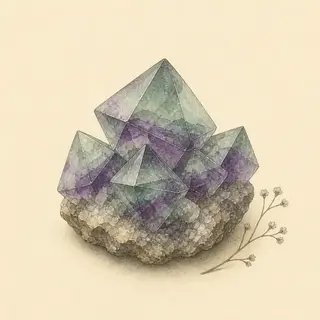
| Chakra | Third Eye (Ajna) |
| Element | Air |
| Zodiac | Pisces |
| Color | Purple, Green, Blue, Yellow, Pink, Colorless, Rainbow |
What Is the Traditional Spiritual Fluorite Meaning?
In 1913, gemologist George Frederick Kunz documented a strange 19th-century medical experiment involving fluorite. He described tests performed on a clairvoyant subject named Frederike Hauffe, born in 1801 and known as the "Seeress of Prevorst." When researchers placed ordinary granite or flint in Hauffe's hand, she showed no reaction. Kunz noted that holding fine qualities of fluorspar (the old common name for the mineral) produced a "marked action, relaxing the muscles" and sometimes inducing a "somnambulistic state" (Kunz 1913, p.9). Beyond these early psychological tests, scientists marveled at the stone's physical properties. Kunz personally tested roughly 13,000 mineral specimens for luminescence. In the same chapter, right after quoting Crookes on diamond phosphorescence, Kunz resumes his own narration and writes that "the luminescence produced by heat is wonderfully marked in the case of chlorophane, a variety of fluorite" (Kunz 1913, p.172). Kunz then conducted his own direct testing on chlorophane specimens sourced from Amelia Court House, Virginia. He found these stones exhibited strong triboluminescence, emitting light simply from the friction of rubbing against another hard substance (Kunz 1913, p.173).
In modern crystal healing traditions, the fluorite meaning shifts from 19th-century somnambulism to sharp mental focus. Practitioners commonly call it the "Genius Stone," relying on it as a tool for intense study and complex problem-solving. Where the 1800s experiments on Frederike Hauffe suggested the stone had a marked action that relaxed the body into a trance state, today's practitioners believe it has a highly active, organizing effect on the mind. Crystal healers say holding the stone sweeps away mental clutter and helps you synthesize new information. They recommend keeping a piece on your desk when you face overwhelming tasks. In this belief system, the mineral acts as a mental anchor, stopping spiraling thoughts and bringing order to chaos. You use it to find objectivity when emotions cloud your judgment. Modern guides teach that the stone absorbs environmental negativity, requiring you to cleanse it frequently. You must remember that these focus and clarity claims remain entirely part of spiritual tradition, sharing no connection to the early, unscientific trance experiments Kunz recorded in 1913.
Zodiac Connection
Modern crystal astrologers primarily pair this mineral with Pisces. In this tradition, the stone provides grounding energy for a highly intuitive, emotionally absorptive water sign. Practitioners believe it helps Pisces filter out other people's emotional baggage and maintain clear personal boundaries. Because the mineral forms in so many shades, crystal guides occasionally assign specific color variants to other signs, matching purple stones with Aquarius or green stones with Taurus. Pisces remains the most widely cited primary zodiac connection overall.
Fluorite's modern association with mental clarity and focus is entirely a matter of crystal healing tradition, and the early 1800s claims regarding its severe physical effects on Frederike Hauffe were never validated by medical science.
How Do Practitioners Use Fluorite in Healing Traditions?
Physical Healing
In traditional crystal healing practice, believers connect the physical fluorite meaning with bodily coordination, mobility, and cellular repair. Practitioners often place the stone on joints to ease stiffness or use it during recovery from viral illnesses, claiming it supports the immune system and respiratory tract. Some alternative healers suggest the mineral fortifies teeth and bone structure, a belief likely drawn from the stone's calcium content. You must remember that these physical healing claims belong strictly to alternative spiritual traditions and are never a substitute for professional medical care. From a strictly factual, mineralogical standpoint, you must handle this stone with significant care. As the defining reference mineral for a hardness of 4 on the Mohs scale, it remains quite soft compared to typical gemstones. It possesses perfect octahedral cleavage. This means the crystal structure has flat planes of weakness, and the stone can easily split or chip if you knock it against a hard surface. You should never clean it in an ultrasonic cleaner, and you must protect it from extreme temperature changes that could cause it to fracture.
Emotional & Spiritual Healing
Emotional healing traditions treat this crystal as a highly effective stabilizing force. Practitioners believe the stone neutralizes emotional trauma and panic, replacing internal chaos with calm rationale. When you feel overwhelmed by conflicting feelings, healers suggest holding this stone to step back and view your situation objectively. The core emotional fluorite meaning centers on breaking free from rigid thinking patterns and adopting a more fluid, adaptable mindset. Guides strongly recommend using it when you must make difficult life decisions. In this practice, the mineral helps you separate your own true desires from external pressures or the expectations of others. Practitioners say it dissolves illusions, allowing you to see the reality of a relationship or career path clearly. They claim it boosts self-confidence by helping you trust your own intellect and intuition. If you struggle with anxiety that manifests as scattered, racing thoughts, crystal healers advise meditating with the stone to anchor your mind and bring your emotional state back into a manageable, organized alignment.
Chakra Association
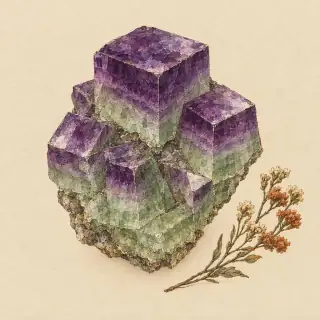
In contemporary chakra practice, healers primarily link this mineral to the Third Eye (Ajna) chakra. Located in the center of the forehead, this energy center traditionally governs intuition, perception, and mental clarity. Practitioners believe that placing the stone on the Third Eye clears energetic blockages, allowing you to process information more effectively and access deeper spiritual insight. They use it to stimulate conscious thought and expand awareness during meditation. Because the mineral forms in a massive spectrum of colors, crystal guides often adjust their chakra assignments based on the specific hue of the stone. Purple specimens remain most tightly bound to the Third Eye and Crown chakras. Practitioners generally associate green variants with the Heart chakra, using them to heal emotional wounds and clear negative energy from relationships. They link blue stones to the Throat chakra, utilizing them to improve clear communication and honest self-expression. Despite these color-based nuances, general crystal healing texts overwhelmingly cite the Third Eye as the primary target for the stone's organizing, clarifying energy.
This is tradition and practice, not medical, financial, or life advice.
How Do You Use Fluorite Day to Day?
Wearing Fluorite
If you choose to wear this stone, you must prioritize protective settings. Fluorite's Mohs hardness is only 4, and it has perfect octahedral cleavage, so the stone scratches easily and can split along flat planes upon impact. It makes a very poor choice for daily-wear rings or bracelets, which frequently knock against desks or doors. Crystal enthusiasts recommend a pendant or earrings instead, where daily bumps are far less likely. This placement also keeps the crystal physically close to the Throat and Third Eye chakras, aligning with traditional energetic practices.
Fluorite in Your Home
The home-use side of the fluorite meaning treats this mineral as an essential addition to any home office or study space. They traditionally place pieces near computers or on desks to absorb chaotic environmental energy and promote deep concentration during work hours. You can also place an octahedral crystal in a living room to encourage clear, harmonious communication among family members. Because direct sunlight can cause the stone's brilliant colors to fade over time, you should keep it away from bright, south-facing windows. Many enthusiasts prefer keeping it in shaded spaces or using it specifically as an evening meditation tool.
Meditation with Fluorite
During meditation, practitioners use this stone to quiet a distracted mind. If you struggle with racing thoughts when you sit down to meditate, healers suggest holding a piece in your non-dominant hand to act as a mental anchor. You can also lie flat and rest a smooth piece against your forehead to stimulate the Third Eye chakra. In traditional practice, you visualize the crystal's cubic structure absorbing your scattered thoughts, helping you transition from a state of stress into a focused, organized meditative state.
Cleansing & Charging
Due to its soft Mohs 4 rating and perfect cleavage, you must avoid harsh cleansing methods. Never use boiling water, salt scrubs, or ultrasonic cleaners on this mineral. Gently rinse the stone in lukewarm water and pat it dry with a soft microfiber cloth. Because spiritual practitioners believe the stone absorbs a heavy amount of negative energy during use, they recommend frequent energetic cleansing. You can safely clear it by resting it on a bed of clear quartz, passing it through sage smoke, or leaving it under the light of a full moon.
Crystal Combinations
Fluorite pairs well with these crystals for complementary energy in crystal healing practice:
- Clear Quartz for Practitioners pair these together to amplify mental clarity, believing quartz boosts the organizing energy of the Genius Stone.
- Amethyst for Crystal healers combine these to deepen Third Eye chakra meditation, traditionally using amethyst to enhance spiritual intuition while maintaining focus.
Caring for Fluorite
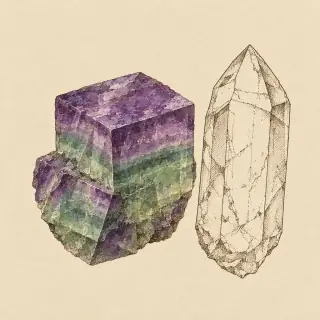
Cleaning: Rinse gently with lukewarm water and pat dry; avoid ultrasonic cleaners.
Avoid: Very soft and prone to splitting along flat internal planes. Avoid any impact, scratching, or thermal shock. Not suitable for rings.
Your crystal profile
Is Fluorite Your Birthstone?
Month
Day
Fluorite is linked to Pisces. Enter your birthday above to see if it matches your sign.
Pairs well with
Fluorite at a glance
- Also known as
- Fluorspar, Blue John, Chlorophane
- Tradition
- Mental clarity and focus, per the fluorite meaning in modern practice
- Chakra / element
- Third Eye (Ajna) / Air
- In one line
- Fluorite is a colorful calcium fluoride mineral famous for its cubic crystals and modern reputation as the "Genius Stone".
- Try this first
- Keep a fluorite crystal on your desk to visually anchor your attention during intense study sessions.
- Do not
- Avoid wearing fluorite in daily rings, as its Mohs 4 hardness and perfect cleavage make it highly vulnerable to scratches and splitting.
Kunz, The Curious Lore of Precious Stones, 1913, p.9
Working With Fluorite Today
Modern crystal healing practice utilizes this mineral primarily for mental clarity and analytical focus.
Tuesday morning at a cluttered study desk
You face a massive stack of research papers and a looming deadline. In crystal healing practice, the fluorite meaning earns it the nickname "Genius Stone" for its association with mental organization. You place a purple fluorite octahedron directly next to your notebook. Practitioners believe this stone clears mental fog and supports the Third Eye chakra, helping you process complex information. You hold the cool, geometric crystal for three minutes, take a deep breath, and reset your attention span before beginning your intensive reading session.
Friday afternoon during a tense strategic planning meeting
Three different department heads are arguing about the fourth-quarter budget allocations. You need to make a firm, unbiased decision. Modern tradition connects fluorite with objective thinking and emotional detachment. You keep a polished green fluorite palm stone in your pocket. As the debate escalates, you quietly trace the smooth surface of the mineral with your thumb. Crystal practitioners recommend this grounding action to filter out chaotic external energies and maintain a steady, analytical mindset while navigating stressful corporate environments.
Sunday evening in a dedicated meditation space
You want to end the weekend with a clear head before the new work week begins. You lie on your back and place a small piece of blue fluorite directly on your brow. Many modern crystal traditions link the blue varieties to clear communication and calm mental processing. Practitioners suggest this placement aligns your energy centers and quiets racing thoughts. You leave the stone resting there for ten minutes, focusing entirely on the weight of the calcium fluoride crystal against your skin.
Historical Contradictions in Fluorite Record
George Frederick Kunz documented two completely different ways nineteenth-century minds approached this specific mineral.
Tested Biological Substance vs. Decorative Acrostic Symbol
In the early 1800s, an investigation treated fluorspar—the common historic name for fluorite—as an active biological agent. Kunz documents an experiment involving Frederike Hauffe, a clairvoyant subject known as the "Seeress of Prevorst." Observers tested the physical effects of placing different minerals directly in her hands. Granite and flint produced no reaction. Fluorspar reportedly triggered a severe physical response, relaxing her muscles, causing a sour taste in her mouth, and occasionally inducing a somnambulistic state (Kunz 1913, p.9). Investigators treated the mineral as a measurable physical catalyst with profound bodily effects. Decades later, a completely different tradition emerged across Europe. People began choosing gems based purely on the first letter of a given name. Fluorite appeared on popular acrostic lists for the names Florence and Frederick (Kunz 1913, pp.47, 49). In this widespread practice, the mineral held no physical power. It functioned entirely as a decorative, symbolic placeholder matching a specific alphabet letter. One era weighed its biological impact on a human subject, while another valued it simply because it started with the letter F.
Rigorous Scientist vs. Passive Collector of Folklore
Kunz usually maintained strict scientific rigor in his own work. He personally tested over 13,000 specimens of various minerals to document their luminescent properties. He specifically acquired chlorophane, a luminescent variety of fluorite, from Amelia Court House, Virginia. He conducted hands-on tests and confirmed the specimens exhibited strong triboluminescence—emitting light when rubbed against another hard substance (Kunz 1913, p.173). He carefully defined his terms, noting the exact scientific boundary between fluorescence and phosphorescence. Yet in the exact same book, Kunz reports the unscientific 1800s claims about Frederike Hauffe's physical reactions to fluorspar. He shares the dramatic details about her muscle relaxation and somnambulism without endorsing them. He shifts abruptly from a rigorous experimenter testing chlorophane friction in a laboratory to a passive historian recording decades-old folklore about a clairvoyant subject. He presents his own highly verifiable mineralogical data on page 173 right alongside the undocumented, pseudo-scientific medical claims from page 9. He leaves the reader to navigate the vast gap between hard physical science and historical superstition.
Frequently Asked Questions
Who should wear fluorite?
The fluorite meaning, in crystal healing traditions, points to anyone seeking mental clarity, focus, and protection from chaotic energy as the ideal wearer. Practitioners highly recommend it for students preparing for exams or professionals facing complex, high-stakes decisions. Traditional guides suggest it benefits individuals who feel overwhelmed by mental fog and need an energetic tool to organize their thoughts. Because it requires careful handling due to its Mohs 4 softness, you should opt for protective jewelry like pendants. You must avoid wearing the stone in rings if you plan to wear it regularly.
What zodiac sign is fluorite for?
Modern crystal astrologers primarily associate this mineral with Pisces. In this spiritual tradition, the stone provides necessary grounding and mental organization for a highly intuitive, emotionally sensitive water sign. Practitioners believe it helps Pisces filter out external negativity and maintain clear personal boundaries. Pisces remains the dominant pairing, though crystal guides sometimes match specific colored variants with other signs. For example, they may recommend purple stones for Aquarius or green variants for Taurus. The Pisces connection remains the most frequently cited overall in modern astrology.
Why is fluorite called the "Genius Stone"?
The "Genius Stone" nickname stems entirely from modern crystal healing traditions. It holds no connection to any scientific or cognitive claim. Practitioners gave it this title because they believe the mineral emits an energy that promotes intense mental clarity, focus, and logical thinking. In alternative healing circles, you use the stone to clear mental fog, synthesize complex new information, and solve difficult problems. Enthusiasts claim it acts as an energetic organizer for a chaotic mind, earning it a reputation as the perfect study companion in spiritual lore.
What is the difference between fluorite and quartz?
These two minerals differ significantly in their basic chemistry and physical structure. Fluorite is calcium fluoride, while quartz is silicon dioxide. You can easily tell them apart by their hardness. Quartz sits at a durable 7 on the Mohs scale, whereas calcium fluoride defines a Mohs hardness of 4. Furthermore, calcium fluoride features perfect octahedral cleavage, meaning it splits along flat, predictable planes if struck. Quartz has no cleavage at all. It breaks with an uneven, glass-like fracture.
Is fluorite safe to wear every day?
From a strictly physical perspective, it is a poor choice for everyday wear in rings or bracelets. Its hardness sits at just 4 on the Mohs scale, well below typical jewelry stones such as quartz or sapphire. It possesses perfect octahedral cleavage, meaning a sharp knock against a desk or doorframe can easily cause the stone to chip or split along flat planes. If you want to wear it regularly, you should choose protected settings like pendants or earrings to minimize impact risks.
What Kunz Actually Documented About Fluorite
Kunz's coverage of fluorite is notably thinner than his chapters on harder gemstones, focusing primarily on short list entries and his own tests regarding mineral luminescence.
- Fluorspar reportedly caused severe physical reactions in a clairvoyant subject.
Kunz 1913, p.9
Kunz details an early nineteenth-century investigation involving Frederike Hauffe, famously known as the "Seeress of Prevorst." Observers tested her physical responses to holding various natural minerals. While granite and flint caused no reaction, fluorspar (the old common name for fluorite) reportedly triggered a severe biological response. Kunz states the mineral "had a marked action, relaxing the muscles, causing diarrhœa, and producing a sour taste in the mouth." He adds that the stone occasionally induced a somnambulistic state. He records this pseudo-scientific medical claim strictly as a historical account of early experiments on a clairvoyant subject. This passage remains one of the few places in his book detailing acute, measurable illness attributed directly to holding a mineral. - Chlorophane, a variety of fluorite, exhibits strong triboluminescence when subjected to friction.
Kunz 1913, pp.172-173
Kunz personally researched the glowing properties of minerals, stating he tested over 13,000 individual specimens. This sentence belongs to Kunz’s own narration, appearing right after Crookes’s quoted passage on diamonds ends. Kunz states that luminescence from heat is "wonderfully marked in the case of chlorophane, a variety of fluorite." On page 173, Kunz reports his own direct laboratory testing. He acquired chlorophane specimens specifically from Amelia Court House, Virginia. He confirmed they exhibited strong triboluminescence—a phenomenon he strictly defines as "the emission of light as a result of friction." Kunz observed this glow when the stones made contact with each other or with any other hard substance. He provides precise technical definitions for fluorescence and phosphorescence to separate temporary luminescence from persistent glowing.
References
“The safest cleaning methods are also the easiest.”