 BirthstoneMeaning
 Aries Birthstone
 Taurus Birthstone
 Gemini Birthstone
 Cancer Birthstone
 Leo Birthstone
 Virgo Birthstone
 Libra Birthstone
 Scorpio Birthstone
 Sagittarius Birthstone
 Capricorn Birthstone
 Aquarius Birthstone
 Pisces Birthstone
 Peridot Meaning
 Garnet Meaning
 Amethyst Meaning
 Aquamarine Meaning
 Diamond Meaning
 Emerald Meaning
 Pearl Meaning
 Ruby Meaning
 Blue Sapphire Meaning
 Opal Meaning
 Topaz Meaning
 Turquoise Meaning
 Moonstone Meaning
 Tourmaline Meaning
 Citrine Meaning
 Tanzanite Meaning
 Alexandrite Meaning
 Spinel Meaning
 Sardonyx Meaning
 Zircon Meaning
 Lapis Lazuli Meaning
 Rose Quartz Meaning
 Onyx Meaning
 Labradorite Meaning
 Malachite Meaning
 Jade Meaning
 Agate Meaning
 Carnelian Meaning
 Clear Quartz Meaning
 Black Tourmaline Meaning
 Smoky Quartz Meaning
 Sodalite Meaning
 Obsidian Meaning
 Fluorite Meaning
 Selenite Meaning
 Hematite Meaning
 Howlite Meaning
 September Birthstone
Yes or No Tarot Reading, One Card at a Time
This is tradition and practice, not medical, financial, or life advice.
A yes or no tarot draw takes one card and reads its traditional meaning as a verdict: yes, no, or a conditional maybe. This page draws from the 22 Major Arcana, shows the reasoning behind each verdict, and names the crystal and zodiac sign that tradition pairs with the card you pull.
Ask, Then Draw
Hold a question that can take a yes or a no. Vague questions get vague cards. Then draw. You can flip the card to its reversed position to see how the answer changes.
When your question is set, pick one card.
- yes or no tarot
- one card draw
- major arcana
- crystal pairing
Tarot is a tradition of symbolic interpretation, not a method of prediction. Treat every answer here as a prompt for reflection. Nothing on this page is medical, legal, or financial advice.
All 22 Cards and the Answer Each One Gives
Every card in the deck used here, with its verdict upright, the crystal we pair it with, and the sign it maps to. The pairings are explained further down.
| Card | Upright | Crystal | Sign |
|---|---|---|---|
| 0. The Fool | Yes | Topaz | Aquarius |
| 1. The Magician | Yes | Opal | Gemini |
| 2. The High Priestess | No | Moonstone | Cancer |
| 3. The Empress | Yes | Emerald | Taurus |
| 4. The Emperor | Yes, with conditions | Ruby | Aries |
| 5. The Hierophant | Yes, with conditions | Topaz | Taurus |
| 6. The Lovers | Yes | Rose Quartz | Gemini |
| 7. The Chariot | Yes | Tiger Eye | Cancer |
| 8. Strength | Yes | Carnelian | Leo |
| 9. The Hermit | No | Peridot | Virgo |
| 10. Wheel of Fortune | Yes, with conditions | Amethyst | Sagittarius |
| 11. Justice | Yes, with conditions | Emerald | Libra |
| 12. The Hanged Man | No | Aquamarine | Pisces |
| 13. Death | No | Obsidian | Scorpio |
| 14. Temperance | Yes, with conditions | Labradorite | Sagittarius |
| 15. The Devil | No | Black Tourmaline | Capricorn |
| 16. The Tower | No | Ruby | Aries |
| 17. The Star | Yes | Celestite | Aquarius |
| 18. The Moon | No | Pearl | Pisces |
| 19. The Sun | Yes | Peridot | Leo |
| 20. Judgement | Yes, with conditions | Malachite | Scorpio |
| 21. The World | Yes | Jade | Capricorn |
The quoted keywords under each card are the divinatory meanings A. E. Waite published in The Pictorial Key to the Tarot (1911), the companion book to the deck most readers use today. His wording is reproduced verbatim; the verdicts and readings are ours.
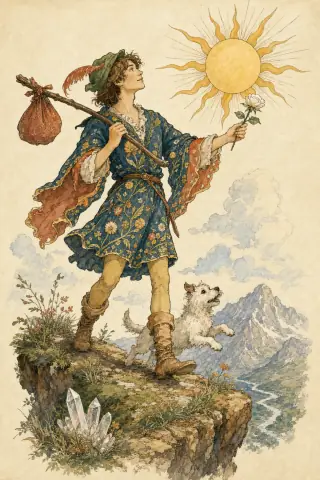
0. The Fool
Step off the cliff edge and the card backs you. The Fool answers yes to anything new, unproven, or slightly reckless, as long as you accept that you are starting without a map.
Reversed: Reversed, the leap turns careless. The answer becomes no while you are ignoring real risk, skipping preparation, or calling avoidance freedom. Deal with the details you keep sliding past, then ask again.
Waite (1911): “Folly, mania, extravagance, intoxication, delirium, frenzy, bewrayment.” Reversed: “Negligence, absence, distribution, carelessness, apathy, nullity, vanity.”
Aleister Crowley assigned topaz to The Fool at row 11 of Column XL in 777 (1909). A clear or golden stone for a card that starts out certain of nothing.
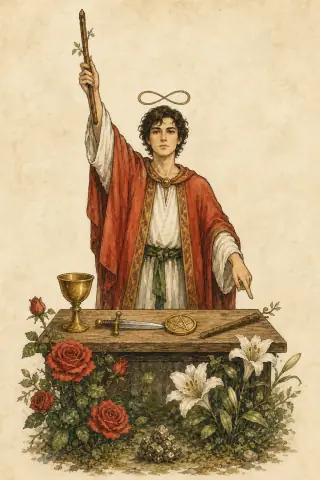
1. The Magician
Every tool you need is already on the table. The Magician answers yes when the question is whether you can pull this off, because skill, timing, and resources line up in your favor.
Reversed: Reversed, the trick misfires. Expect a no while someone is overselling, including you. Check whether the promised skills and resources actually exist before you commit anything you cannot get back.
Waite (1911): “Skill, diplomacy, address, subtlety; sickness, pain, loss, disaster, snares of enemies; self-confidence, will; the Querent, if male.” Reversed: “Physician, Magus, mental disease, disgrace, disquiet.”
Aleister Crowley's 777 assigns opal to The Magician's path, row 12 of Column XL, printed 1909. Opal holds every color inside one stone, the way this card holds every tool at once.
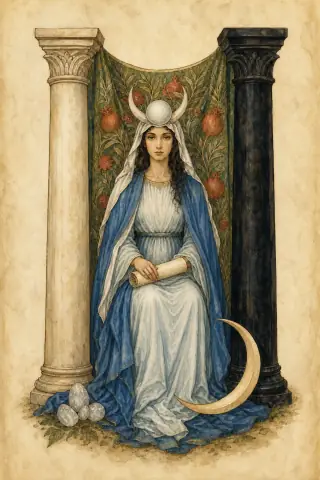
2. The High Priestess
Something stays hidden here, so the honest answer is no for now. The High Priestess points to information you have not been given. Wait for the missing piece to surface before you act.
Reversed: Reversed, the secret leaks. What looked closed opens up, and the answer shifts toward yes once you stop second-guessing an instinct you have already had three separate times.
Waite (1911): “Secrets, mystery, the future as yet unrevealed; the woman who interests the Querent, if male; the Querent herself, if female; silence, tenacity; mystery, wisdom, science.” Reversed: “Passion, moral or physical ardour, conceit, surface knowledge.”
Moonstone hides a blue white glow that only shows at certain angles, easy to miss unless you turn it toward the light. The High Priestess keeps her knowledge the same way, visible only from the right side.
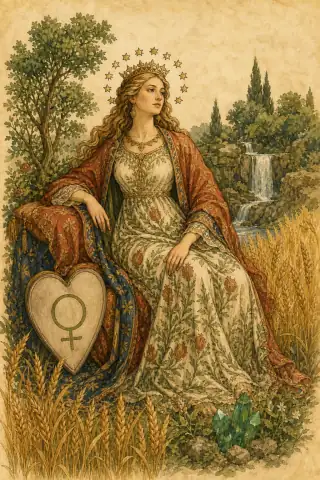
3. The Empress
Growth is already underway. The Empress answers yes to anything you want to nurture: a relationship, a project, a body of work. Give it time and material support and it produces.
Reversed: Reversed, the yield stalls. The answer turns to no while the thing is starved, smothered, or growing on someone else's schedule. Fix the conditions and the card changes its mind.
Waite (1911): “Fruitfulness, action, initiative, length of days; the unknown, clandestine; also difficulty, doubt, ignorance.” Reversed: “Light, truth, the unravelling of involved matters, public rejoicings; according to another reading, vacillation.”
Crowley's 777 puts emerald and turquoise on row 14 of Column XL, printed 1909, the path Venus rules for this card. The pairing is one of the few here with a date on it.
4. The Emperor
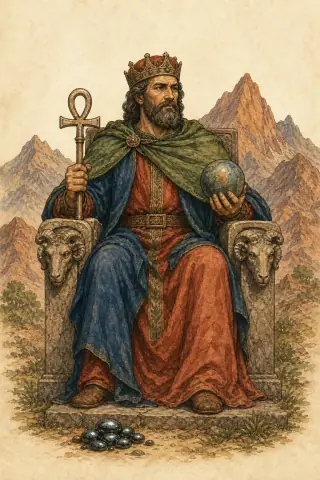
Yes arrives with conditions attached. The Emperor grants what you asked for once the structure, the paperwork, and the person in charge are all satisfied. Skip the process and the answer collapses.
Reversed: Reversed, the authority is shaky. Read this as no while a rigid rule, an absent decision-maker, or your own control habit is running the situation straight into the ground.
Waite (1911): “Stability, power, protection, realization; a great person; aid, reason, conviction; also authority and will.” Reversed: “Benevolence, compassion, credit; also confusion to enemies, obstruction, immaturity.”
The Emperor's path carries ruby in 777, row 15 of Column XL, the table Crowley printed in 1909. Rubies crowned kings for centuries, a hard red stone for a card built on rule.
5. The Hierophant
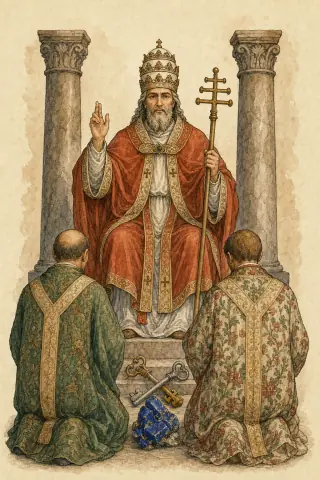
Institutions, mentors, and rules decide this one. The Hierophant answers yes through official channels and no when you improvise. Ask what the established route looks like, then judge whether you want it.
Reversed: Reversed, the rulebook loses authority. Going your own way becomes the workable answer, though you carry the cost of the guidance and the group approval you gave up.
Waite (1911): “Marriage, alliance, captivity, servitude; by another account, mercy and goodness; inspiration; the man to whom the Querent has recourse.” Reversed: “Society, good understanding, concord, over-kindness, weakness.”
Topaz also lands on The Hierophant's path, row 16 of Column XL in 777, printed 1909, one of two cards sharing this stone. Topaz taught doctrine long before it taught fashion.
6. The Lovers
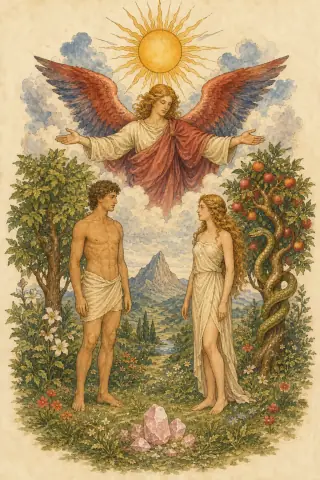
A clear choice sits in front of you, and the card says the aligned option wins. The Lovers answer yes to relationships, partnerships, and any decision you can make wholeheartedly.
Reversed: Reversed, the alignment breaks. The answer is no while values clash, one side stays half-committed, or you are deciding by default. Name what you actually want, then look again.
Waite (1911): “Attraction, love, beauty, trials overcome.” Reversed: “Failure, foolish designs. Another account speaks of marriage frustrated and contrarieties of all kinds.”
Rose quartz is the pink stone everyone already associates with love, and crystal lore has tied it to reconciliation for generations. The Lovers ask you to choose with your whole chest.
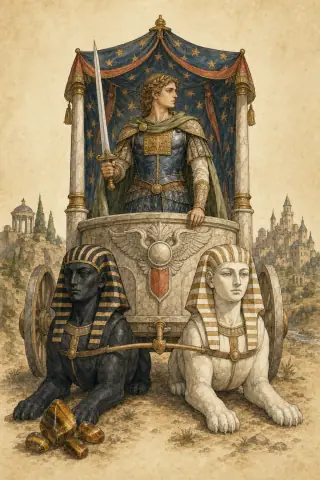
7. The Chariot
Momentum favors you. The Chariot answers yes when the question involves travel, competition, or pushing a plan through opposition. Hold the reins tight, because the forces pulling you forward disagree with each other.
Reversed: Reversed, the wheels come off. Read it as no while you are scattered, overcommitted, or driving on someone else's fuel. Regain control of the direction before you spend more energy.
Waite (1911): “Succour, providence; also war, triumph, presumption, vengeance, trouble.” Reversed: “Riot, quarrel, dispute, litigation, defeat.”
Turn tiger eye and a band of light slides across the gold, so the stone never sits still. This card is motion under control, and readers pair the two for exactly that.
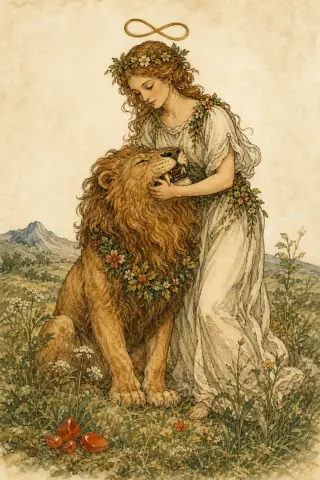
8. Strength
Patience beats force here. Strength answers yes when you can stay calm, keep showing up, and handle the situation with a light hand. Aggression is the one route that loses.
Reversed: Reversed, the nerve fails. The answer slides to no while self-doubt, a short temper, or plain exhaustion is steering. Rest first, then approach the same question with a softer grip.
Waite (1911): “Power, energy, action, courage, magnanimity; also complete success and honours.” Reversed: “Despotism, abuse of power, weakness, discord, sometimes even disgrace.”
Carnelian was cut into Mesopotamian signet rings thousands of years ago, worn by people who had to hold their nerve in public. Its warm orange has long stood for steady courage.
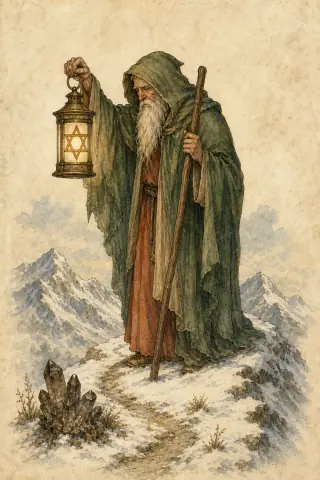
9. The Hermit
Withdraw first. The Hermit reads as no to anything asking for a fast public move. Take the question somewhere quiet, work it through alone, and the right timing shows itself later.
Reversed: Reversed, the retreat has run too long. Isolation stops paying off, so re-enter the situation, take the call, answer the message. Motion becomes the better option now.
Waite (1911): “Prudence, circumspection; also and especially treason, dissimulation, roguery, corruption.” Reversed: “Concealment, disguise, policy, fear, unreasoned caution.”
Peridot sits on row 20 of Column XL in Crowley's 777, printed 1909, The Hermit's own path. Peridot forms in olivine deep underground, pulled from the dark to catch the light.
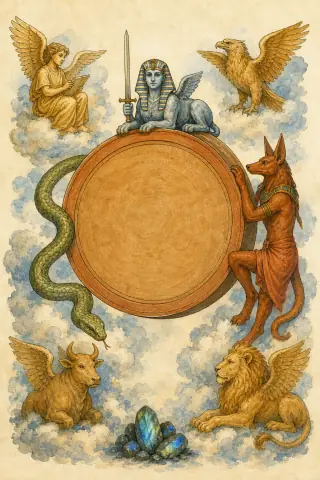
10. Wheel of Fortune
Timing runs the show. The Wheel of Fortune gives a conditional answer, because the situation is turning on factors outside your control. Watch the next few weeks and ask again.
Reversed: Reversed, the turn goes against you. Expect delay, a run of bad luck, or a cycle repeating for the third time. Break the pattern yourself, since fortune is busy elsewhere.
Waite (1911): “Destiny, fortune, success, elevation, luck, felicity.” Reversed: “Increase, abundance, superfluity.”
Aleister Crowley put amethyst on row 21 of Column XL in 777, printed 1909, and row 21 is this card's own path. It is the only dated, named source pairing any stone with this card.
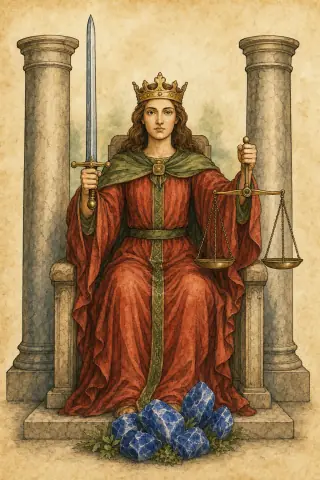
11. Justice
The answer tracks your evidence. Justice returns yes when the facts support you and no when they do not, with no sentiment applied. Look honestly at what you have documented.
Reversed: Reversed, the scales tilt. Expect an unfair outcome, a biased decision, or a consequence you have been dodging. Something in the account has been left off the record.
Waite (1911): “Equity, rightness, probity, executive; triumph of the deserving side in law.” Reversed: “Law in all its departments, legal complications, bigotry, bias, excessive severity.”
The Empress and Justice both draw emerald from Crowley's 777, printed 1909. The Empress sits at row 14, Justice eight rows later at row 22, and two very different cards sharing one stone in his table is itself worth noting.
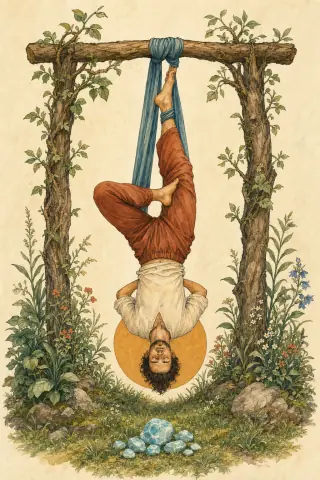
12. The Hanged Man
Nothing moves yet. The Hanged Man answers no to any question about timing, because the situation is suspended and your job is to see it from a new angle.
Reversed: Reversed, the pause ends. Either the stall breaks and things move, or you finally stop sacrificing for something that never paid you back. Either way, the waiting is over.
Waite (1911): “Wisdom, circumspection, discernment, trials, sacrifice, intuition, divination, prophecy.” Reversed: “Selfishness, the crowd, body politic.”
Column XL, row 23 of Crowley's 777, printed 1909, ties aquamarine to The Hanged Man's path. Named for seawater, it is the stillest blue stone here, fit for a card that asks you to wait.
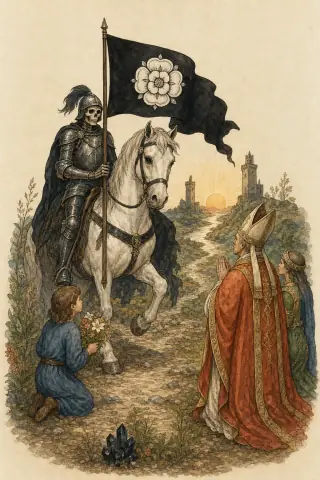
13. Death
An ending is doing the answering. Death says no to keeping things as they are, because this chapter is already closing. What you asked about will not survive in its current form.
Reversed: Reversed, you are holding the door shut. The change stalls, so the answer stays no until you release whatever you keep reviving. Resistance is the only thing still running.
Waite (1911): “End, mortality, destruction, corruption; also, for a man, the loss of a benefactor; for a woman, many contrarieties; for a maid, failure of marriage projects.” Reversed: “Inertia, sleep, lethargy, petrifaction, somnambulism; hope destroyed.”
Aztec smiths worked obsidian into blades and into the black mirrors their priests scried in. A stone this dark and this sharp sits well on the card that closes a chapter.
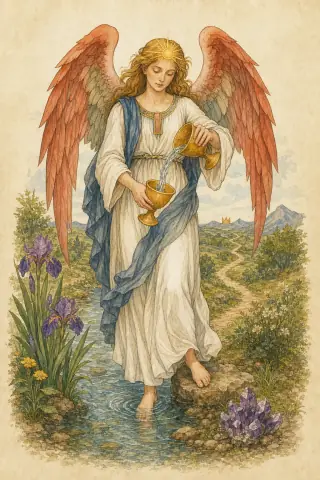
14. Temperance
Half measures win here. Temperance gives a qualified answer: yes at a slower pace, in a smaller dose, with two things blended carefully. Force the pace and you lose the result.
Reversed: Reversed, the mix goes wrong. Excess, impatience, or two elements that refuse to combine push the answer to no. Cut one ingredient and see what the question looks like.
Waite (1911): “Economy, moderation, frugality, management, accommodation.” Reversed: “Things connected with churches, religions, sects, the priesthood, sometimes even the priest who will marry the Querent; also disunion, unfortunate combinations, competing interests.”
Labradorite flips from gray to blue to gold depending on how you hold it, so readers treat it as the stone of two things blending. Temperance asks for that mix, in a smaller dose.
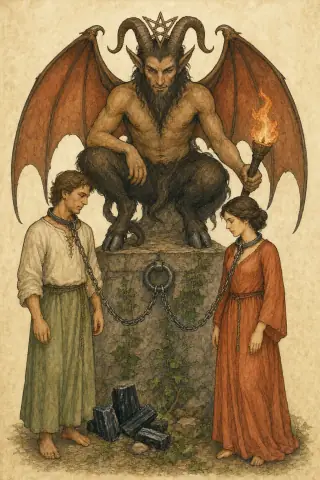
15. The Devil
Attachment is running this question. The Devil answers no while a contract, a habit, or a person still has a hold on you. The chain in the image is loose enough to lift off.
Reversed: Reversed, the chain comes off. You see the arrangement clearly and walk, which flips the answer toward yes for anyone ready to take the exit and absorb the short-term cost.
Waite (1911): “Ravage, violence, vehemence, extraordinary efforts, force, fatality; that which is predestined but is not for this reason evil.” Reversed: “Evil fatality, weakness, pettiness, blindness.”
Black tourmaline is flat black with no shine to distract you, and crystal healing practice has long treated it as the stone that guards a doorway. The Devil is about what still holds you.
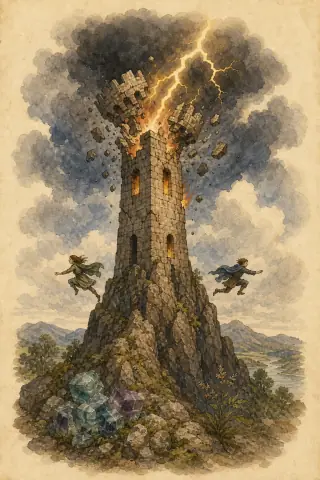
16. The Tower
The structure collapses. The Tower is a firm no to anything you hoped would stay stable, because the foundation was already cracked. What falls this week was built wrong from the start.
Reversed: Reversed, the collapse is delayed or survived. You get a near miss, a slow leak, or a controlled demolition you run yourself. The answer is still no, on gentler terms.
Waite (1911): “Misery, distress, indigence, adversity, calamity, disgrace, deception, ruin. It is a card in particular of unforeseen catastrophe.” Reversed: “According to one account, the same in a lesser degree; also oppression, imprisonment, tyranny.”
Ruby crowns two paths in Crowley's 777, printed 1909, at row 15 for The Emperor and row 27 for The Tower, both in Column XL. Both paths break open what looked permanent.
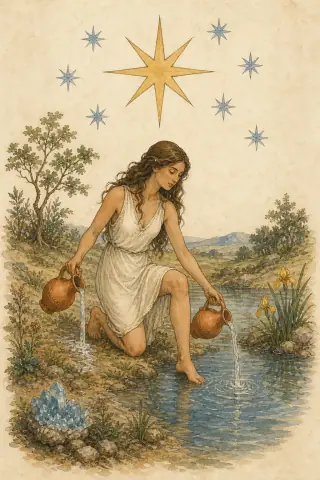
17. The Star
After the wreckage comes clear water. The Star answers yes, though the payoff arrives on a long timeline. Keep the faith you have left and the situation refills quietly.
Reversed: Reversed, hope runs dry. The answer weakens to no while discouragement, comparison, or a lost sense of purpose is in charge. Restock your own reserves before deciding anything.
Waite (1911): “Loss, theft, privation, abandonment; another reading says hope and bright prospects” Reversed: “Arrogance, haughtiness, impotence.”
Celestite takes its name from caelestis, the Latin word for heavenly, and its blue is the color of a sky after rain. Handle it gently. The Star promises a slow refill.
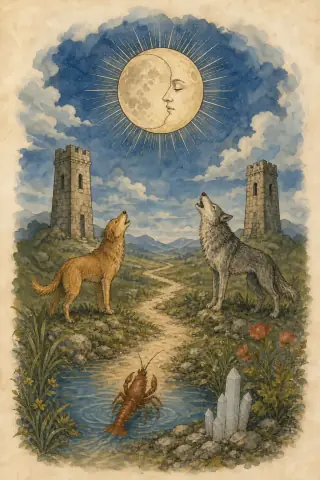
18. The Moon
You are working with bad information. The Moon answers no for now, because fear, projection, and half-truths shape the picture. Wait for daylight before acting on what you think you see.
Reversed: Reversed, the fog clears. A truth surfaces, an anxiety turns out to be groundless, and the question becomes answerable. Confusion lifts fast once one solid fact lands.
Waite (1911): “Hidden enemies, danger, calumny, darkness, terror, deception, occult forces, error.” Reversed: “Instability, inconstancy, silence, lesser degrees of deception and error.”
Pearl belongs to The Moon's path on row 29 of Column XL in 777, the table Crowley printed in 1909. A pearl forms slowly in the dark, the way this card asks you to sit out confusion.
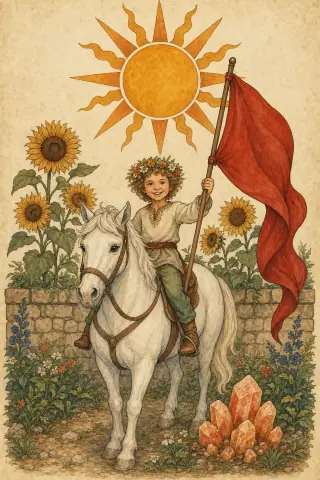
19. The Sun
Full daylight, nothing hidden. The Sun is the clearest yes in the deck, covering success, health, travel, and getting the news you wanted. Enjoy it without waiting for a catch.
Reversed: Reversed, the light dims. The yes still holds, though it comes late, smaller than expected, or with your own doubt taking the shine off. Delay is the usual reading.
Waite (1911): “Material happiness, fortunate marriage, contentment.” Reversed: “The same in a lesser sense.”
Peridot marks two rows in Crowley's 777 (1909), row 20 of Column XL for The Hermit and row 30 for The Sun. Peridot flashes gold green in direct light, plain as this card.
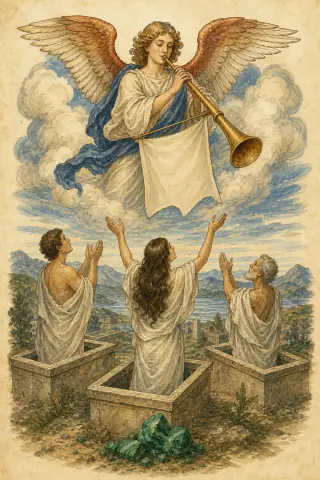
20. Judgement
A verdict is coming from outside you. Judgement answers conditionally: yes once you are ready to be honest about your own part, and no while you keep the old story intact.
Reversed: Reversed, the call goes unanswered. Self-doubt or a refusal to look back keeps the matter open, so the answer stays stuck until you make the review you keep postponing.
Waite (1911): “Change of position, renewal, outcome. Another account specifies total loss though lawsuit.” Reversed: “Weakness, pusillanimity, simplicity; also deliberation, decision, sentence.”
Egyptians ground malachite into green eye paint, and Russian tsars sheathed a whole room of the Winter Palace in it. Its banding records a past that already ran its course, which Judgement makes you face.
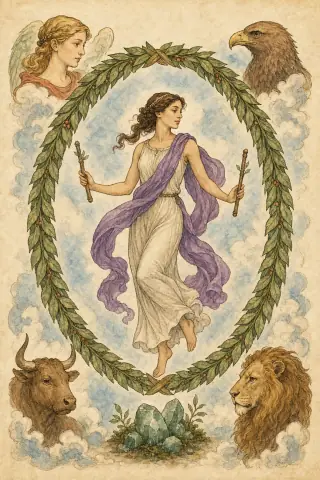
21. The World
The circle closes. The World answers yes and marks completion: the trip happens, the degree finishes, the deal signs. Whatever you asked about reaches its natural end in good order.
Reversed: Reversed, the finish line moves. One requirement is still outstanding, so the answer becomes almost. Find the loose end you have been treating as finished and close it properly.
Waite (1911): “Assured success, recompense, voyage, route, emigration, flight, change of place.” Reversed: “Inertia, fixity, stagnation, permanence.”
Jade was carved into burial suits in Han China and into Maori hei-tiki on the other side of the planet. Cultures that never met called it the stone of heaven. The World closes that circle.
How to Read a Maybe in a Yes or No Tarot Draw
Six of the 22 cards answer with conditions attached. The deck is still answering.
- A conditional card usually points at something you control. The Emperor grants the request once structure exists; the Hierophant defers to an institution or a mentor you have not consulted yet.
- When you draw a conditional card twice for the same question, the question is the problem. Split it into two smaller questions and draw for each.
- Reversals flip emphasis more often than they flip the verdict. A reversed yes tends to mean yes with a delay, and a reversed no tends to mean the obstacle is internal.
Why Each Card Carries a Crystal
Most tarot sites stop at the card. We pair each of the 22 with one stone from our guides, so the answer connects to something you can hold and look up.
- Twelve of the twenty-two pairings trace to a dated, named source. Aleister Crowley's 777, printed in 1909, is that source, and the stone's own reasoning names it in the text below the card. The other ten follow the card's traditional theme, matched by lore alone with no table behind them. Every stone links to its own guide with its chakra, its element and the tradition behind the reading.
- Belief stays labelled as belief on those guides. Where a claim traces to a named text and a century, we say which one.
- Some pairing stones are delicate. Water destroys selenite and a fingernail marks it, so it lives on a shelf and never in a pocket with keys.
How the Zodiac Links Are Derived
Twelve Major Arcana carry a direct zodiac attribution in the Golden Dawn system. The remaining ten carry a planet instead, so we map those to the sign that planet traditionally rules and say so on every card.
The Fool, The Hanged Man, and Judgement are attributed to Uranus, Neptune, and Pluto, all discovered after the original tables were written. We label those three as modern attributions.
Yes or no tarot at a glance
- Also known as
- The nearest historical name is istikhárah, Arabic for seeking guidance, as Edward Lane documented the practice in Cairo in the 1830s. It has nothing to do with tarot.
- Tradition
- Islamic folk divination, recorded by a European observer in the 1830s. Lane was watching from outside, and his account is one man's report.
- Chakra / element
- Each card here carries a crystal from this site's own tables, which is a modern pairing and not part of anything Lane described.
- In one line
- Asking a yes or no question and reading a single random outcome is a practice Lane was already writing down in 1830s Cairo, long before anyone dealt tarot for it.
- Try this first
- Write the question down before you draw. A vague question produces a verdict you can read any way you like.
- Do not
- Do not draw twice on the same question. The whole point of the older practice was that you accepted the first answer.
Lane, An Account of the Manners and Customs of the Modern Egyptians, 1836 (Project Gutenberg 70796)
The 1830s Practice a Yes or No Draw Resembles
Three passages from Edward Lane's Cairo notebooks, describing methods that resolve a doubt with one reading.
- Resolving a doubt by a single random outcome was a named practice in 1830s Cairo
Lane 1836, p.239
Lane, writing about customs he observed in Egypt in the 1830s, records that people had several practices reserved for settling a doubt, and lists them as a recognised group with their own names. - One method was to let a book fall open and read the tenor of the page
Lane 1836, p.240
Lane describes istikhárah as Cairo practised it: set prayers three times over, then the book allowed to fall open at random, and the general tenor of the passage read as favourable or unfavourable. One reading, one answer.
Questions People Ask About Yes or No Tarot
- Can a single tarot card really answer yes or no?
- A single card gives a clear reading of one symbol, which is why the format works for closed questions. It cannot account for context the way a multi-card spread does. Use it for quick reflection and switch to a fuller spread when the situation has moving parts.
- Why does this reading use only the Major Arcana?
- Major-only draws are a long-standing practice for yes or no work. Twenty-two cards give clearer verdicts than seventy-eight, because each Major Arcana card carries a single strong theme. We are adding the Minor Arcana in stages.
- What does a reversed card mean in a yes or no reading?
- Reversal usually shifts the timing or the source of an obstacle, and leaves the verdict standing. Each card on this page states its reversed reading separately, so you can see where the emphasis moves.
- Should I keep drawing until I get the answer I want?
- Repeated draws on one question stop being informative fast. If the same conditional card keeps appearing, the useful move is to rewrite the question.
- Do I need a crystal to do a yes or no tarot reading?
- No. The pairings are a way into the stone side of the site, and a way to give each card something concrete attached to it. The reading works on its own.
Draw again tomorrow and the deck will give you a different card. That is the point of the format: it is a way of turning a question over, not a forecast.
Where to Go Next
Sources & Editorial Basis
Month assignments follow the Jewelers of America birthstone list. Care guidance is checked against the Gemological Institute of America. Everything else here is folklore, astrology and crystal practice. We label each claim as tradition and name the text or the period we traced it to wherever one exists.
“The safest cleaning methods are also the easiest.”