 BirthstoneMeaning
 Aries Birthstone
 Taurus Birthstone
 Gemini Birthstone
 Cancer Birthstone
 Leo Birthstone
 Virgo Birthstone
 Libra Birthstone
 Scorpio Birthstone
 Sagittarius Birthstone
 Capricorn Birthstone
 Aquarius Birthstone
 Pisces Birthstone
 Peridot Meaning
 Amethyst Meaning
 Aquamarine Meaning
 Diamond Meaning
 Emerald Meaning
 Pearl Meaning
 Blue Sapphire Meaning
 Opal Meaning
 Topaz Meaning
 Turquoise Meaning
 Moonstone Meaning
 Tourmaline Meaning
 Citrine Meaning
 Tanzanite Meaning
 Alexandrite Meaning
 Spinel Meaning
 Sardonyx Meaning
 Zircon Meaning
 Lapis Lazuli Meaning
 Rose Quartz Meaning
 Onyx Meaning
 Labradorite Meaning
 Malachite Meaning
 Jade Meaning
 Agate Meaning
 Carnelian Meaning
 Clear Quartz Meaning
 Black Tourmaline Meaning
 Sodalite Meaning
 Obsidian Meaning
 Fluorite Meaning
 Selenite Meaning
 Howlite Meaning
 September Birthstone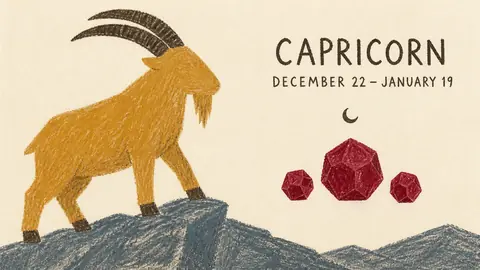
Capricorn Birthstone: Garnet, Ruby and the December Split
The Capricorn birthstone here is garnet, drawn from January's month list. Ruby is the zodiac stone in Kunz's 1913 table. If your birthday is in December, your month stones are turquoise, tanzanite and zircon instead. For a personal ritual, garnet can symbolize steady effort and ruby a milestone worth celebrating.
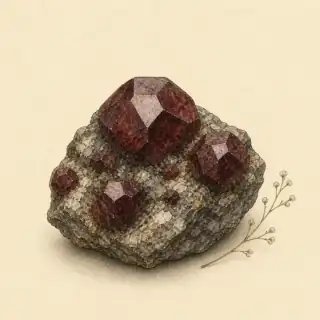
Why Garnet for a Saturn-Ruled Climber?
Saturn governs Capricorn here, and garnet's grounding reputation is matched to that rulership by long-standing convention. No test confirms a personality link, and none confirms garnet's claimed effect.
Capricorn's Saturn symbolism centers on structure, patience and work that takes time. In a crystal ritual, red garnet can stand for the commitment you return to after the excitement wears off. Put it beside a notebook and write one small step toward a larger goal. Ruby can mark a different moment: finishing the course, keeping a promise, or reaching a milestone. These are interpretations you give the stones, not effects they exert on your career. The source behind ruby is concrete: Kunz names it in his 1913 Capricorn verse. Garnet enters this site's chart through January, so the two choices tell different stories with separate sources.
Does Capricorn Have More Than One Birthstone?
History and Lore
Garnet has been in jewelry since the Bronze Age and it never left. Roman signet rings carried carved garnet intaglios across the empire. In the eighteenth and nineteenth centuries the Bohemian workshops turned deep red garnet into a European fashion craze that ran for a hundred years.
- Garnet beads have been found in Egyptian jewelry dating to 3100 BCE, and in Sumerian artifacts from 2300 BCE.
- The Sutton Hoo burial goods, laid down in early seventh-century England, set thin slices of garnet over gold foil on the shoulder clasps and the sword fittings.
Correspondences
Crystal practice files garnet under these correspondences, a traditional association. Use it to decide where you keep garnet and which intention you set with it.
| Chakra | Root (Muladhara) |
| Element | Fire |
| Zodiac | Capricorn |
| Colors | Red, Orange, Green, Purple, Brown, Black |
Traditional Meanings
- Traditionally believed to inspire devotion, restore drive, and stimulate passion.
- In medieval lore, garnet was carried by travelers as a protective talisman against accidents and nightmares.
Garnet's associations above are inherited belief, not a scientific finding about the stone.
Ruby: The Traditional Capricorn Birthstone
This guide uses Garnet as the modern Capricorn stone because most of the sign falls in January, whose standardized monthly list includes Garnet. Ruby comes from a separate, older stream of zodiac-gem associations, which varied by place and period. Ruby's tie to Capricorn is a historical convention, not something the 1912 committee adopted. The red stone Sanskrit called the king of gems, and December's stone until a trade vote moved it to July.
Kunz's Capricorn verse presents ruby as a charm against trouble. That promise belongs to folklore. Our suggested practice is more modest: let ruby mark an achievement you want to remember, and garnet the work you want to keep doing. You can choose either symbol without needing both stones or an expensive piece of jewelry.
Capricorn opens on December 22, which leaves the sign's first ten days inside a month whose own list reads turquoise, zircon and tanzanite. The December birthstone guide explains why the month chart and the zodiac chart part ways over those ten days.
- The Black Prince's Ruby in Britain's Imperial State Crown passed from Pedro the Cruel of Castile to Edward the Black Prince in 1367, and Henry V is said to have worn it at Agincourt in 1415.
- Marco Polo described a great red stone owned by the king of Ceylon in the thirteenth century, and reported that Kublai Khan offered a city for it and was turned down.
Interactive birthstone reading
Your Capricorn Stone Pairing
This Capricorn guide starts with its own zodiac result. Add a birthday to check another sign.
Capricorn: Garnet and Ruby
Modern month-derived pairing and older zodiac tradition
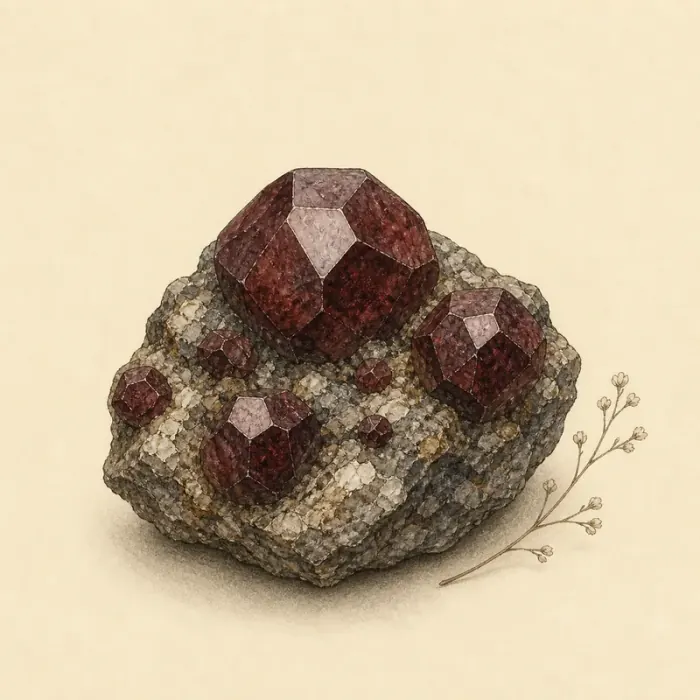
Modern stone
Garnet
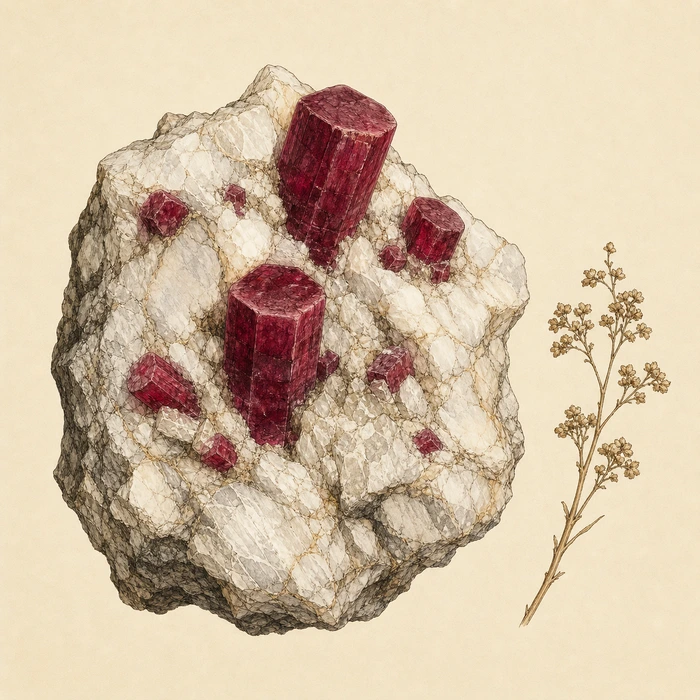
Traditional stone
Ruby
Garnet is this guide's modern zodiac pairing, drawn from the month containing most Capricorn dates. Ruby comes from older zodiac-gem traditions. Both Garnet and Ruby are cultural conventions here, and a birthday cannot prove either one.
Try a birthday
Choose a month and day to recalculate the local zodiac result. No birth year, time, or location is needed for this date-range lookup.
Or use today's date from this device to see the current zodiac result.
Choose a symbolic focus
Pick a supporting stone to explore one tradition-based prompt for Capricorn.
Do Smoky Quartz and Hematite Suit Capricorn?
Beyond the primary and traditional birthstones, two additional gems have strong associations with Capricorn in crystal healing practice. These are not standardized monthly birthstones, but they complement garnet well in both color and traditional symbolism.

Smoky Quartz
In crystal practice, smoky quartz represents grounding. For Capricorn's long-term goals, you might keep it beside a written checklist as a reminder to return to the next manageable step.

Hematite
Hematite sits heavy in the hand and takes a mirror polish. Crystal practice reads that weight as stamina, which is what a Capricorn wants from a stone partway up a long professional climb.
Quick Reference
Capricorn Birthstone
at a glance
Modern Stone
Garnet
Traditional
Ruby
Chakra
Root (Muladhara)
Element
Fire
Colors
Red, Orange, Green
Supporting
Smoky Quartz, Hematite
birthstonemeaning.com
Infographic · share with credit
How Should You Wear the Capricorn Birthstone?
The best way to wear a birthstone is whatever way you will actually put it on every day. That said, some settings and combinations bring out garnet’s best qualities better than others.
Chakra, planetary and energy notes in this section describe crystal-practice tradition, not a proven physical or medical effect.
- Choose a garnet pendant for a daily reminder of a long-term goal. If you prefer a ring, remove it for heavy work and ask a jeweler whether the stone and setting suit your routine.
- Choose smoky quartz cufflinks or a tie pin for a subtle, grounding touch in business environments that suits Capricorn's understated authority.
- Reserve a ruby piece you already own for a milestone, or mark the occasion with a red stone you enjoy. A ritual's meaning does not depend on rarity or price.
Learn more: Garnet Crystal Meaning & Healing Properties →
What the Capricorn Birthstone Chart Leaves Out
Ruby, the traditional stone paired with Capricorn's modern garnet, carries a source and a boundary dispute that most charts never mention.
The traditional stone traces to one dated source
Our ruby pairing follows the Capricorn entry in Kunz's 1913 Zodiacal Gems table. The rhyme presents ruby as a protective charm. Kunz also records competing lists, so this is a named historical tradition with no claim to cover every culture.
Kunz starts Capricorn one day earlier and ends it two days later
This site's lookup uses December 22 to January 19. Kunz prints December 21 to January 21: one extra day at the start and two at the end. January 20 is Aquarius in our lookup but Capricorn in that older table. Shared endpoints in the old table are another reason to treat it as historical lore; it does not calculate an exact horoscope.
A December Capricorn has a different month stone
Take December 28: the birthday month offers turquoise, tanzanite and zircon; our modern zodiac pairing gives garnet; Kunz's Capricorn verse names ruby. For January 10, garnet is also the month stone. Decide whether you are honoring the birth month or following a zodiac tradition before choosing the gem.
Where this attribution comes from. Capricorn crosses into January, so January's garnet fills the modern column here. Pavitt's 1914 system reads differently: garnet is Aquarius's stone there, and Capricorn carries ruby, spinel, malachite, black onyx and jet. where the older tables disagree →
Capricorn Birthstone: Frequently Asked Questions
These common questions cover the Capricorn birthstone, its color, monthly overlap, and how people actually wear it. The sections above carry the lore and the correspondences behind the short answers.
What is the birthstone for Capricorn?
Garnet is this chart's modern Capricorn pairing because Capricorn crosses into January. Ruby comes from Kunz's 1913 zodiac table. If you were born December 22 to 31, the month system gives turquoise, tanzanite and zircon. Pick the convention that fits the gift or ritual you have in mind.
Why is garnet the birthstone for Capricorn?
January's birthstone is garnet, and our modern zodiac column uses the later month of each sign. That is how Capricorn gets garnet here. The connection between red garnet and steady commitment is a symbolic interpretation, not proof that the gem affects ambition or improves with age.
What intention should a Capricorn set with garnet?
A long one. Crystal practice pairs garnet with goals that take years, and Capricorn is the sign that actually finishes those. Name the thing, keep the stone somewhere you will see it every working day, and check in on it at the winter solstice.
Can Capricorn wear garnet and ruby together?
Yes. Crystal tradition reads garnet and ruby together as ambition plus endurance, which is the Capricorn combination stated in stones. Wear garnet daily and keep ruby for the milestones worth marking.
Is the Capricorn birthstone the same as the January birthstone?
For January 1 to 19, this site's Capricorn pairing and the monthly list both give garnet. December 22 to 31 birthdays have turquoise, tanzanite and zircon by month, while our zodiac pairing remains garnet. Ruby belongs to the separate older zodiac tradition.
What is Capricorn's lucky stone and color?
Saturn rules Capricorn, and earthy, grounding stones like smoky quartz and black onyx are its traditional companions, with dark brown and charcoal as classic colors. These associations are cultural. They are not scientific, so use them as a starting point and nothing more.
Which garnet color is best for Capricorn?
Choose a garnet color you enjoy wearing. Red fits the devotion and endurance symbolism used on this page, but there is no color a Capricorn must buy. Gem quality, treatments and setting affect suitability and price; a green garnet is not automatically a better or more expensive choice.
For a January-born Capricorn, garnet joins the month tradition to this chart's zodiac pairing. A December-born Capricorn has another decision: follow the calendar month, or choose garnet or ruby for the zodiac story. Keep the gift simple, explain which tradition you chose, and attach an intention the person can make their own.
Where This Page's Capricorn Claims Come From
Ruby and the date dispute both trace back to the same 1913 chapter.
- Ruby as the traditional Capricorn stone
Kunz 1913, p.345-347, ZODIACAL GEMS
Kunz's Capricorn entry names ruby outright and closes with a short verse tying the stone to the sign; the verse itself is quoted in full on our December birthstone guide, and this page does not repeat it. - The span Kunz assigned to the sign
Kunz 1913, p.345-347, ZODIACAL GEMS
Kunz's table runs Capricorn from December 21 to January 21, a wider window than the December 22 to January 19 span printed on most modern charts.
References
- Garnet, Gemological Institute of America (GIA)
- Garnet, International Gem Society
- gutenberg.org/files/57978/57978-h/57978-h.htm
- Ruby, Gemological Institute of America (GIA)
- Ruby, International Gem Society
- gutenberg.org/files/57978/57978-h/57978-h.htm
“The safest cleaning methods are also the easiest.”

 ?
?