 BirthstoneMeaning
 Aries Birthstone
 Taurus Birthstone
 Gemini Birthstone
 Cancer Birthstone
 Leo Birthstone
 Virgo Birthstone
 Libra Birthstone
 Scorpio Birthstone
 Sagittarius Birthstone
 Capricorn Birthstone
 Aquarius Birthstone
 Pisces Birthstone
 Peridot Meaning
 Garnet Meaning
 Amethyst Meaning
 Aquamarine Meaning
 Diamond Meaning
 Pearl Meaning
 Ruby Meaning
 Blue Sapphire Meaning
 Opal Meaning
 Turquoise Meaning
 Moonstone Meaning
 Tourmaline Meaning
 Citrine Meaning
 Tanzanite Meaning
 Alexandrite Meaning
 Spinel Meaning
 Sardonyx Meaning
 Zircon Meaning
 Lapis Lazuli Meaning
 Rose Quartz Meaning
 Onyx Meaning
 Labradorite Meaning
 Malachite Meaning
 Jade Meaning
 Agate Meaning
 Carnelian Meaning
 Clear Quartz Meaning
 Black Tourmaline Meaning
 Smoky Quartz Meaning
 Sodalite Meaning
 Obsidian Meaning
 Fluorite Meaning
 Selenite Meaning
 Hematite Meaning
 Howlite Meaning
 September Birthstone
What Topaz Stone Means and How to Use It
You are holding a stone named after a fog bank. Topaz stone meaning in this guide uses the image of searching through uncertainty. That interpretation of the name story is ours. Holding the gem does not produce that effect. Its sources also connect topaz with royal favor, a theme of historical belief. The name carries confusion. In the first century, Pliny wrote in his Natural History, Book 37, chapter 32, quoting Juba, about a Red Sea island called Topazos. That island sat about three hundred stadia from the mainland, surrounded by fogs and often searched for by navigators. In the language of the Troglodytae, the word topazin meant "to seek", translated by Bostock and Riley in 1855. George Frederick Kunz gave another rendering in 1913, translating that root as "to conjecture", because sailors had to guess where land lay behind mist. That island stone was green. Kunz stated outright in 1913 that the topazius of ancient writers "usually signified our chrysolite, or peridot, not our topaz". The word arrived first. The golden stone we call topaz took the name later. You carry a talisman that entered history as a riddle for lost ships.
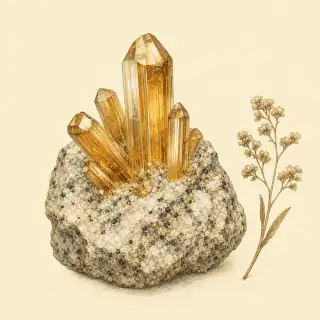
| Chakra | Throat (Blue) / Solar Plexus (Golden) |
| Element | Fire |
| Zodiac | Scorpio, Sagittarius |
| Color | Colorless, Blue, Yellow, Orange (Imperial), Pink |
Why Does Topaz Carry the Energy of Total Certainty?
The story of how this name reached royal palaces begins with stranded sailors. Pliny recorded that Troglodyte pirates, driven ashore by storm and hunger, dug for roots on that foggy island and found the stone. Philon, the king's prefect, brought them out and gave them to Queen Berenice, mother of the second Ptolemy, who was delighted. Later a statue four cubits high was cut from the stone in honor of Arsinoe, wife of Ptolemy Philadelphus, and set up in the Golden Temple. Most websites claim kings wore this golden jewel for thousands of years. They repeat that claim without checking what Pliny was describing. The ancient praise belonged to a green gem from a misty coast. Topaz holds an unshakable seat on the calendar. George Frederick Kunz set eight historical lists side by side in 1913. November is topaz on all eight of them. Only three attributions in that whole table are unanimous. The National Association of Jewelers, meeting at Kansas City in August 1912, kept November as topaz with no alternate. Kunz recorded that meeting first-hand and argued against most of the list, but not this. Nobody has ever tried to move it.
Kunz's collection includes a belief that a falcon engraved on topaz helped win the goodwill of rulers. It records a hope of influencing someone with power, not a demonstrated way to obtain agreement. Before a request, you can use a topaz stone to represent preparation: what are you asking, why, and what might the other person need to know? The falcon image does not give you control over their answer.
Zodiac Connection
Kunz's 1913 zodiac list assigns topaz to Sagittarius and prints a verse for that pairing. This site's Scorpio connection follows our modern November calendar interpretation. For a reflection exercise, Sagittarius can represent seeking a new perspective and Scorpio can represent examining an unanswered question. These pairings do not grant certainty or feed an actual energy field.
What follows about topaz is folklore and crystal-practice tradition, not a scientific finding.
How Can Topaz Symbolize a Search for Direction?
Physical Healing
Topaz can mark the place where you prepare proposals or review plans. Give the object a specific job as a reminder: check the figures, name the request, or ask about an unclear term. The stone does not accelerate an approval or make a money conversation productive. Its personal meaning can accompany careful work without becoming a prediction of success.
Emotional & Spiritual Healing
A topaz stone beside your notebook can stand for examining a question you keep revisiting. Write what happened and what you would like to understand. Leave room for an answer you have not considered. Topaz does not burn away self-doubt or expose how other people really feel. Its meaning here is a chosen image of looking for direction.
Chakra Association
Modern crystal guides often link blue topaz with the Throat Chakra and golden topaz with the Solar Plexus. This site uses those colors as symbols for expression and intention. You may prefer one color for a reflection exercise, but blue does not free the voice and gold does not command respect. These associations describe an esoteric practice, not a bodily mechanism.
This is tradition and practice, not medical, financial, or life advice.
How Do You Use Topaz Day to Day?
Wearing Topaz
A blue topaz pendant or a golden ring can remind you of a question you have prepared. Choose jewelry you enjoy and a setting suited to the stone's vulnerability to knocks. Before an important meeting, look at it and read your request once. No sunlight exposure or particular hand is needed to make that personal association meaningful.
Topaz in Your Home
The nine-gem layout printed by Kunz places topaz to the northeast under Jupiter. You can recall that historical arrangement in a display, while recognizing that older gem names need care. A topaz stone beside a proposal can mark the intention to check details. It does not attract wealth or expand a business. Use the display for reflection and the documents for your decisions.
Meditation with Topaz
Crowley's 1909 table places topaz on the paths associated with The Fool and The Hierophant. This guide uses their contrast as a prompt: what would a new start require, and which rules still matter? Hold the stone if you like, then write an answer to each question. The card correspondence belongs to one occult system. It does not transfer courage or authority from a card to you.
Cleansing & Charging
Sunday and Tuesday appear in the topaz weekday traditions recorded by Kunz. Choose either as a personal reminder to review an intention. The old table does not establish a charging effect. Set the stone on a soft cloth; skip salt and smoke. Some topaz colors can fade with light, so do not use prolonged sun exposure as a ritual. Follow the care guidance for physical cleaning.
Crystal Combinations
Topaz pairs well with these crystals for complementary energy in crystal healing practice:
- Turquoise for Symbolic pairing: pairing confident self-expression with honest, grounded communication
- Amethyst for Symbolic pairing: a calming and clarity combination often used together
- Clear Quartz for Symbolic pairing: traditionally believed to represent topaz's themes
- Sapphire for Symbolic pairing: combining confident self-expression with mental clarity and wisdom
Topaz shares November with citrine, and shops and printed lists have mistaken the two for each other across centuries. The November birthstone guide traces where that mix-up began and what people wore each stone for once they told them apart.
Caring for Topaz
Cleaning: Lukewarm soapy water and a soft brush, worked by hand. Never put topaz in a cleaning machine.
Avoid: One hard blow at the wrong angle splits topaz straight through. Keep it off a working knuckle and away from anything you swing, lift or drop.
Your crystal profile
Is Topaz Your Birthstone?
Month
Day
Topaz is linked to Scorpio and Sagittarius and the month of November. Enter your birthday above to see if it matches your sign.
Pairs well with
Topaz at a glance
- Also known as
- The "golden stone" name that once belonged, by ancient reckoning, to a green island gem now called peridot.
- Tradition
- Egyptians called yellow stone thehen; the golden topaz we wear didn't reach them until roughly 500 to 600 BCE.
- Chakra / element
- Throat and solar plexus chakras, fire element.
- In one line
- A borrowed name doing its own work now: confidence and clear sight through fog.
- Try this first
- Say your one clear ask out loud before you walk into a meeting that depends on someone else's yes.
- Do not
- Don't buy into "worn by ancient kings for millennia" marketing copy; that praise was for a different, green stone.
Kunz, The Curious Lore of Precious Stones, 1913, p. 297-298, 141.
When to actually reach for topaz
Three real situations, not general advice.
You've been putting off a decision for months because you can't picture how it ends.
The name comes from an island in the Red Sea that Pliny called Topazos, from topazein, to conjecture, because the place was so hard to find. The irony is that the ancient stone carrying that name was green, not yellow. Practitioners today use topaz the way the name suggests anyway, as a marker for a goal you can only guess your way toward. Keep it where you plan, not where you rest.
You're walking into a meeting where one person controls whether you get the yes: a loan officer, a judge, a hiring manager.
Kunz records a falcon-on-topaz charm said to win the goodwill of rulers. That is separate from his vine-and-ivy engraving passage. You can borrow the theme as a reminder to prepare one clear request before the meeting. The engraving and the stone do not control the response of a judge, lender, or employer.
You're shopping for a topaz online and a seller's description calls it an ancient royal gem worn for thousands of years.
Read that claim as marketing. The praise from antiquity that keeps getting recycled belonged to a green island stone the Greeks called topazion, which is peridot by today's naming, not the golden stone in the listing. Buy the topaz for what it actually is now, not for a borrowed royal résumé. Ask the seller for the treatment disclosure and skip the origin myth.
The identity mix-up baked into the name
Topaz carries someone else's history by accident, and the record shows exactly where the swap happened.
You're wearing a name that once belonged to a green stone
You inherited the reputation without inheriting the stone behind it. Ancient writers used the word topazion for a gem mined on an island in the Red Sea so hard to find that the name itself meant guesswork, and that stone was green. Kunz stated plainly in 1913 that the topazius of the ancients usually meant what we now call chrysolite, or peridot. Somewhere between Pliny's century and the modern gem trade, the labels crossed over. The green stone kept collecting praise under a name that drifted onto the golden one you know.
The lucky charm required carving; today's stones skip it
Kunz records a lapidary instruction for vine and ivy engraved on topaz. On the same page he separately cites Agricola on a topaz bearing an inscription. Those are two different examples; the vine-and-ivy rule should not be attributed to Agricola. The power, as they described it, lived in the carving itself, not in the raw mineral. Modern topaz jewelry almost never carries an engraving; dealers sell a polished, uncut stone and still attach the full old promise of luck and protection to it. The tradition demanded craftsmanship. The market kept the story and dropped the work that was supposed to make the story true.
Frequently Asked Questions
What is a topaz stone for?
Topaz stone meaning, as a symbol of protection and personal power, traces back to a specific, documented origin story that most sites get wrong. Pliny recorded that Troglodyte pirates, driven ashore by storm and hunger on a foggy island, dug for roots and found the stone; the king's prefect Philon brought them before Queen Berenice, mother of the second Ptolemy, who was delighted with the find. A four-cubit statue was later cut from the stone in honor of Arsinoe, wife of Ptolemy Philadelphus, and set up in the Golden Temple. Most crystal websites claim kings wore golden topaz for thousands of years without checking Pliny's actual text, the ancient praise he recorded belonged to a green gem from a misty coastal island, not the golden stone sold as topaz today.
Why is November associated with topaz?
The topaz stone holds one of the most stable seats on the entire birthstone calendar. Of the eight historical birthstone lists Kunz compared in his 1913 research, all eight assign November to topaz, one of only three attributions in his entire table with that level of unanimous agreement across every source he examined. The National Association of Jewelers, meeting at Kansas City in August 1912, kept November as topaz with no alternate stone offered, the standard practice for months where the trade voted to change or split an assignment. Kunz recorded that meeting firsthand and argued in print against most of the resulting calendar, but topaz for November was never among his objections; nobody in the historical record has seriously tried to move it.
Which tarot cards connect to topaz in esoteric tradition?
This guide pairs Topaz with The Fool, The Hierophant. Aleister Crowley assigned topaz to The Fool at row 11 of Column XL in 777 (1909). A clear or golden stone for a card that starts out certain of nothing. Topaz also lands on The Hierophant's path, row 16 of Column XL in 777, printed 1909, one of two cards sharing this stone. Topaz taught doctrine long before it taught fashion. These are correspondences within the named esoteric framework. They do not establish an effect on health or provide information about future events.
Is topaz a Sagittarius stone or a Scorpio stone?
Topaz has two homes in astrology, and only one comes with a documented birth certificate. Kunz's dated 1913 zodiac gem list assigns topaz to Sagittarius, printing a verse stating that those born under that sign should ever show a topaz, Sagittarius hunts truth across wide horizons, and topaz's traditional golden brightness feeds that expansive, fire-ruled energy. This site also pairs topaz with Scorpio, which is a modern convention not a historical claim: Scorpio rules the front half of November on the calendar, the same month topaz has held unanimously across all eight of Kunz's historical lists, and the sign's themes of shared secrets and hard turns of fate pair naturally with the stone's protective reputation. Sagittarius carries the dated historical verse; Scorpio holds the modern calendar-based connection.
What does a falcon carved on a topaz do?
Kunz's collection includes a belief that a falcon engraved on topaz helped win the goodwill of rulers. It records a hope of influencing someone with power, not a demonstrated way to obtain agreement. Before a request, you can use a topaz stone to represent preparation: what are you asking, why, and what might the other person need to know? The falcon image does not give you control over their answer.
Where should I place topaz in my home?
Placing a topaz stone in your home, in crystal practice, is generally suggested near an entryway or a home office not a bedroom, given the stone's traditional association with personal power and protection not calm or rest. The Golden Temple placement Pliny recorded for the ancient Arsinoe statue, a public, honored location not a private one, offers a loose model for this: topaz's older reputation is tied to visible status and protection not quiet, private reflection. Golden or yellow topaz specifically is associated in modern practice with the Solar Plexus Chakra, personal power and courage, which fits a placement near a workspace or front door where you want to project confidence not a bedroom where you want to wind down.
What days of the week are best for topaz rituals?
Sunday and Tuesday appear in the topaz weekday traditions recorded by Kunz. Choose either as a personal reminder to review an intention. The old table does not establish a charging effect. Set the stone on a soft cloth; skip salt and smoke. Some topaz colors can fade with light, so do not use prolonged sun exposure as a ritual. Follow the care guidance for physical cleaning.
Did ancient writers mean our modern topaz?
Ancient writers describing what they called topaz very likely did not mean the golden gem sold under that name today. Pliny's account of Troglodyte pirates finding the stone on a foggy island, later honored in a statue of Arsinoe at the Golden Temple, describes a green gem, not a yellow or golden one, most gem historians now believe ancient 'topaz' actually referred to what modern mineralogy calls peridot. This site states that identification plainly and does not repeat the common claim that kings wore golden topaz for thousands of years, which conflates two different stones separated by more than a millennium of naming drift. Modern topaz's own documented history, separate from the ancient green stone, is anchored instead by its unanimous November placement across all eight of Kunz's historical birthstone lists.
The paper trail behind the topaz name
These claims come from one 1913 public-domain source, checked to the page number.
- Ancient writers' topazius usually meant what we now call chrysolite or peridot, not today's topaz.
Kunz 1913, p. 297-298
Kunz wrote it "usually signified our chrysolite, or peridot, not our topaz." - Kunz records a topaz engraving instruction using vine and ivy.
Kunz 1913, p. 141
The vine-and-ivy instruction and the inscribed topaz Agricola describes are separate examples on this page.
References
- Topaz, Gemological Institute of America (GIA)
- Topaz, International Gem Society
- perseus.tufts.edu/hopper/text?doc=Perseus:text:1999.02.0137:book=37:chapter=32
- gutenberg.org/files/57978/57978-h/57978-h.htm
“The safest cleaning methods are also the easiest.”

 ?
?