 BirthstoneMeaning
 Aries Birthstone
 Taurus Birthstone
 Gemini Birthstone
 Cancer Birthstone
 Leo Birthstone
 Virgo Birthstone
 Libra Birthstone
 Scorpio Birthstone
 Sagittarius Birthstone
 Capricorn Birthstone
 Aquarius Birthstone
 Pisces Birthstone
 Peridot Meaning
 Garnet Meaning
 Amethyst Meaning
 Aquamarine Meaning
 Diamond Meaning
 Emerald Meaning
 Pearl Meaning
 Ruby Meaning
 Blue Sapphire Meaning
 Opal Meaning
 Topaz Meaning
 Turquoise Meaning
 Moonstone Meaning
 Tourmaline Meaning
 Citrine Meaning
 Tanzanite Meaning
 Alexandrite Meaning
 Spinel Meaning
 Sardonyx Meaning
 Zircon Meaning
 Lapis Lazuli Meaning
 Rose Quartz Meaning
 Onyx Meaning
 Labradorite Meaning
 Malachite Meaning
 Jade Meaning
 Agate Meaning
 Carnelian Meaning
 Clear Quartz Meaning
 Black Tourmaline Meaning
 Smoky Quartz Meaning
 Sodalite Meaning
 Obsidian Meaning
 Fluorite Meaning
 Selenite Meaning
 Hematite Meaning
 Howlite Meaning
 September Birthstone
What The Moon Means in Tarot, Upright and Reversed
This is tradition and practice, not medical, financial, or life advice.
Draw the Moon tarot card and you're being told to wait for more information, not to trust the first read of a confusing situation. Upright, the card warns about hidden threats, deception, and fear-driven decisions. Reversed, some of the fog lifts, though Waite's own words describe only "lesser degrees" of the same deception clearing, not full clarity.
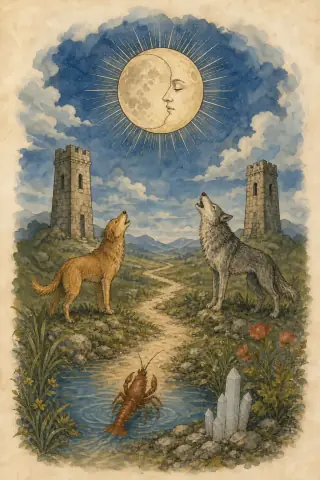
The Moon Tarot Meaning, Upright and Reversed
Card eighteen is one of the deck's least comfortable Major Arcana cards to receive, and Waite's own 1911 keywords explain why: "hidden enemies, danger, calumny, darkness, terror, deception, occult forces, error." Upright, this card says you're working from bad information right now, whether you know it or not. Someone isn't telling you the whole story, a fear is doing more steering than facts are, or a decision that looks clear from where you're standing is anything but. Waite's scene shows a dog and a wolf baying at the moon's sixteen rays while a creature drags itself out of a pool toward dry land. Nothing in that image has reached solid ground yet.
Reversed doesn't mean the fog lifts completely, whatever quick-reference lists imply. Waite's actual 1911 reversed keywords are "instability, inconstancy, silence, lesser degrees of deception and error," language about a smaller problem, not a solved one. Read literally, reversed Moon says the confusion is thinning, a lie is getting harder to maintain, or an anxious spiral is finally losing steam, but you're not fully in daylight yet. Treat this position as a downgrade from crisis to caution, not a clean resolution.
Where The Moon Tarot Traditions Disagree
- Waite's 1911 upright keywords for this card are unambiguously dark: hidden enemies, danger, calumny, terror, deception. A lot of contemporary tarot content softens that into "intuition, dreams, and the subconscious," treating the Moon as an invitation to trust your gut. That reframe isn't in Waite's own text. His Moon is a warning about being deceived, not an endorsement of intuition. The softer modern reading draws on the same moody, moonlit imagery, but it describes a different card than the one Waite actually wrote up in 1911.
- Not every deck agrees on the picture, either. The scene Waite describes uses a dog and a wolf baying beneath sixteen rays while a creature crawls out of the water. Crowley's Thoth deck, published decades later, reworks this card's imagery from the ground up, keeping the theme of illusion but changing almost everything else about the scene. "The Moon" names a theme more than one fixed picture.
The Moon in Real Situations
You're three days into a fight with your sister over something that started as a joke and now you can't agree on who escalated it first. The Moon upright names exactly this kind of fog: nobody here has the full story, and continuing to argue only adds more static. Table it until you both cool down.
A coworker keeps hinting that layoffs are coming, but nothing has been announced and HR says nothing's changed. The Moon warns against acting on rumor. Wait for something you can actually confirm before you update your resume out of a 2 a.m. panic.
You've reread the same three texts from someone you're dating so many times you've started inventing meanings that aren't there. That's the Moon's exact warning: fear filling in gaps that facts haven't filled yet. Ask the direct question. Stop running the scenario in your head for the fifth night running.
Reversed, a friend finally admits the real reason they canceled plans three times this month, and it has nothing to do with what you'd been assuming. The confusion doesn't fully clear the way a reversed pull might seem to promise. You get one solid fact, not the whole picture, and that's still worth having.
Stone & Sign Correspondence
Pearl. Pearl sits on row 29 of Column XL in Aleister Crowley's 777, published in 1909, the table's own row for The Moon. A pearl needs years in the dark, layered slowly inside a shell, before it's worth anything. Readers connect that patience to a card that asks you to sit with confusion, not force an answer out of it before it's ready.
Pisces. The Golden Dawn system assigns The Moon to Pisces directly, the zodiac's water sign associated with dreams, intuition, and edges that don't hold a fixed shape. The card's own landscape works the same way: nothing in Waite's scene, not the towers, not the creature in the water, sits on solid, settled ground.
What People Get Wrong About The Moon
Popular tarot content has softened this card into a gentle nudge toward intuition and dreaming, something close to a compliment. Waite's actual 1911 keywords don't support that read: hidden enemies, danger, calumny, darkness, terror, deception, occult forces, error. This is one of the more cautionary cards in the deck, not a permission slip to trust every gut feeling. A second misconception treats the reversed position as a full resolution, the fog completely lifted. Waite's reversed keywords describe "lesser degrees" of the same problem, smaller, not solved. Treat reversed Moon as improving, not as fixed.
The Moon Tarot Questions
- Does The Moon tarot card mean something bad is happening?
- It usually means you don't have the full picture yet, which is its own kind of caution. Waite's 1911 upright keywords are hidden enemies, danger, calumny, darkness, terror, deception, and occult forces. The card is asking you to wait for better information before acting.
- What does The Moon reversed mean?
- An improvement, not a resolution. Waite's reversed keywords describe "lesser degrees of deception and error," meaning the confusion is thinning, not gone. Treat it as progress, and keep checking your facts.
- Is The Moon always about intuition and dreams?
- That reading is common in modern content, but it isn't what Waite's original 1911 keywords say. His Moon is a warning about deception and hidden threats. The dreamier, gentler reading is a later, softer interpretation layered onto the same imagery.
- Why is pearl paired with The Moon?
- Aleister Crowley's 777, published in 1909, puts pearl on row 29 of Column XL, The Moon's own row in his correspondence table. It's one of the pairings on this site with a dated, named source behind it.
- Why is The Moon linked to Pisces?
- The Golden Dawn tradition assigns The Moon to Pisces directly. Both card and sign share the same theme: dreams, intuition, and boundaries that don't hold a fixed shape.
Primary Sources
- A. E. Waite, The Pictorial Key to the Tarot (Rider & Son, 1911). Public-domain upright and reversed keyword lists and the card's scene description, Part III, "The Greater Arcana and their Divinatory Meanings." Text as transcribed on Wikisource.
- Aleister Crowley, 777 and Other Qabalistic Writings (1909). Correspondence table, Column XL, row 29, pairing pearl with The Moon's path.
Explore More Tarot
Tarot is a tradition of symbolic interpretation, not a method of prediction. Treat every answer here as a prompt for reflection. Nothing on this page is medical, legal, or financial advice.
Sources & Editorial Basis
Month assignments follow the Jewelers of America birthstone list. Care guidance is checked against the Gemological Institute of America. Everything else here is folklore, astrology and crystal practice. We label each claim as tradition and name the text or the period we traced it to wherever one exists.
“The safest cleaning methods are also the easiest.”