 BirthstoneMeaning
 Aries Birthstone
 Taurus Birthstone
 Gemini Birthstone
 Cancer Birthstone
 Leo Birthstone
 Virgo Birthstone
 Libra Birthstone
 Scorpio Birthstone
 Sagittarius Birthstone
 Capricorn Birthstone
 Aquarius Birthstone
 Pisces Birthstone
 Peridot Meaning
 Garnet Meaning
 Amethyst Meaning
 Aquamarine Meaning
 Diamond Meaning
 Emerald Meaning
 Pearl Meaning
 Ruby Meaning
 Blue Sapphire Meaning
 Opal Meaning
 Topaz Meaning
 Turquoise Meaning
 Moonstone Meaning
 Tourmaline Meaning
 Citrine Meaning
 Tanzanite Meaning
 Alexandrite Meaning
 Spinel Meaning
 Sardonyx Meaning
 Zircon Meaning
 Lapis Lazuli Meaning
 Rose Quartz Meaning
 Onyx Meaning
 Labradorite Meaning
 Malachite Meaning
 Jade Meaning
 Agate Meaning
 Carnelian Meaning
 Clear Quartz Meaning
 Black Tourmaline Meaning
 Smoky Quartz Meaning
 Sodalite Meaning
 Obsidian Meaning
 Fluorite Meaning
 Selenite Meaning
 Hematite Meaning
 Howlite Meaning
 September Birthstone
Temperance in Tarot: What It Means Upright and Reversed
This is tradition and practice, not medical, financial, or life advice.
A temperance tarot draw calls for balance you build slowly, not balance you already have. Upright, it rewards patience: mixing two things carefully, taking the middle path, letting a process finish on its own time. Reversed, the mixture curdles: push too hard, rush the timing, or force together two things that won't blend.
At a Glance
- Card
- XIV (14). Temperance
- Upright
- Moderation, patience, a careful blend
- Reversed
- Excess, a mismatch that won't combine
- Zodiac Sign
- Sagittarius
- Verdict
- Maybe, a conditional yes
Temperance Tarot Meaning, Upright and Reversed
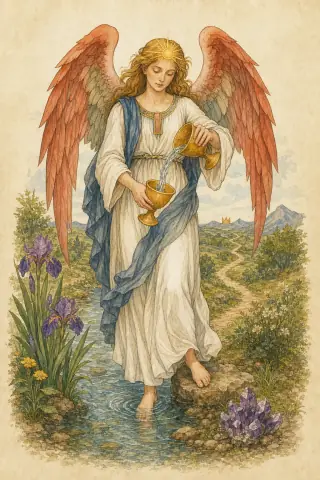
Card fourteen sits right after Death in the sequence, and that placement matters: Temperance is what comes after an ending, once two separate things have to become one new thing. A. E. Waite's 1911 keywords for this position are economy, moderation, frugality, management, and accommodation, a set of words about handling limited resources well, not about having unlimited ones. Upright, this card shows up when patience is the actual skill required: a diet, a budget, a slow reconciliation, a project that only works if you don't rush the last step. The card's traditional image shows an angel pouring liquid between two cups without spilling a drop. That's the whole instruction. Go slow enough that nothing spills.
Reversed Temperance surprises most readers, because Waite's own reversed keywords aren't about imbalance at all. He wrote "things connected with churches, religions, sects, the priesthood, sometimes even the priest who will marry the Querent," and separately, "disunion, unfortunate combinations, competing interests." Modern practice mostly keeps the second half and reads this position as excess or a bad mix: two people, plans, or habits that don't blend no matter how much you adjust them. Something that should combine into one working whole is instead staying two separate, competing pieces.
Where Temperance Tarot Traditions Disagree
- Waite's 1911 reversed meaning for Temperance names clergy and marriage officiants directly: "things connected with churches, religions, sects, the priesthood, sometimes even the priest who will marry the Querent." Almost no modern tarot content keeps that reading. Contemporary guides collapse the reversed card down to "imbalance" or "excess" and drop the church and marriage material completely. The "disunion, unfortunate combinations, competing interests" half of his sentence survived into modern practice. The clergy half quietly got edited out.
- Unlike the Wheel of Fortune's amethyst, Temperance's stone pairing has no dated table behind it. Labradorite is an editorial choice, matched to the card's blending theme because the stone visibly shifts color depending on the angle you hold it, not because a historical correspondence table names it. That's worth saying plainly: not every pairing on this site traces to a source, and this is one that doesn't.
Temperance in Real Situations
You're two years into a job that's fine, not great, and a recruiter just messaged you about something that sounds exciting. Temperance upright doesn't say stay or go. It says don't decide this week. Let the new option prove itself over a few real conversations before you quit anything.
You and a partner argue about money on a loop, not because either of you is wrong, but because you spend differently and both of you have dug in. Temperance names this directly: two systems that need blending, not a winner. A shared account with two separate discretionary lines solves more of these fights than a debate does.
You started a new routine on January 1st, went hard for nine days, and burned out by day ten. Reversed Temperance names that pattern directly: forcing the pace when the card was asking for a slower mix.
Your mother-in-law and your own mother run Thanksgiving dinner by two completely different rulebooks, and you're hosting this year. Upright Temperance is the card for exactly this: you don't need either family to win. You need one dinner that both traditions survive.
Stone & Sign Correspondence
Labradorite. Labradorite is one of this site's editorial pairings, chosen for a visible trait, not a written source: turn the stone in your hand and its color shifts from gray to blue to gold. Temperance is a card about blending two things into one, and readers reach for a stone that visibly does two things at once. Unlike the Wheel of Fortune's amethyst, no dated correspondence table names labradorite for this card.
Sagittarius. The Golden Dawn system assigns Temperance directly to Sagittarius. In the card's traditional image, the winged figure plants one boot on dry ground and dips the other into a pool, a split stance the Centaur-Archer echoes in its own two-part body, half horse, half human. Card and sign both put two different natures in one frame.
What People Get Wrong About Temperance
The name causes most of the confusion. English speakers have absorbed "temperance" mainly through the 19th and early 20th century Temperance Movement, the campaign against alcohol that led to Prohibition in the United States starting in 1920. New readers sometimes assume the card is specifically about sobriety or self-denial because of that shared word. It isn't. The tarot card predates that movement by centuries and covers any situation needing a careful mix, not drinking specifically: a budget, a diet, a relationship, a work-life split. Read Waite's actual 1911 keywords, economy, moderation, frugality, management, accommodation, and alcohol never comes up once.
Temperance Tarot Questions
- Is Temperance in tarot about the Temperance Movement or alcohol?
- No. That's a name coincidence, not a connection. The tarot card is centuries older than the 19th and 20th century Temperance Movement, and its meaning covers any situation that needs careful blending, not drinking specifically.
- What does Temperance reversed actually mean?
- Waite's 1911 keywords are surprising: "things connected with churches, religions, sects, the priesthood" on one side, and "disunion, unfortunate combinations, competing interests" on the other. Modern practice mostly reads this position as excess or a bad mix, two things that won't combine.
- Why is labradorite paired with Temperance?
- It's an editorial pairing, not a sourced one. Labradorite visibly shifts color between gray, blue, and gold depending on the angle, which readers connect to a card about blending two things into one. No historical correspondence table names this pairing the way Crowley's 777 names amethyst for the Wheel of Fortune.
- Why is Temperance linked to Sagittarius?
- The Golden Dawn tradition assigns Temperance directly to Sagittarius. The figure in the card keeps one boot dry and lets the other sink into a pool, an image that lines up with the Archer's own split nature, part horse, part human.
- Does Temperance mean yes or no?
- This site reads it as a conditional maybe. Upright, the answer favors patience and a slower pace over a fast one. Reversed, something is being rushed or mismatched, and the card is telling you to fix that before asking again.
Primary Sources
- A. E. Waite, The Pictorial Key to the Tarot (Rider & Son, 1911). Public-domain upright and reversed keyword lists and the card's scene description, Part III, "The Greater Arcana and their Divinatory Meanings." Text as transcribed on Wikisource.
Explore More Tarot
Tarot is a tradition of symbolic interpretation, not a method of prediction. Treat every answer here as a prompt for reflection. Nothing on this page is medical, legal, or financial advice.
Sources & Editorial Basis
Month assignments follow the Jewelers of America birthstone list. Care guidance is checked against the Gemological Institute of America. Everything else here is folklore, astrology and crystal practice. We label each claim as tradition and name the text or the period we traced it to wherever one exists.
“The safest cleaning methods are also the easiest.”