 BirthstoneMeaning
 Aries Birthstone
 Taurus Birthstone
 Gemini Birthstone
 Cancer Birthstone
 Leo Birthstone
 Virgo Birthstone
 Libra Birthstone
 Scorpio Birthstone
 Sagittarius Birthstone
 Capricorn Birthstone
 Aquarius Birthstone
 Pisces Birthstone
 Peridot Meaning
 Garnet Meaning
 Amethyst Meaning
 Aquamarine Meaning
 Diamond Meaning
 Emerald Meaning
 Pearl Meaning
 Ruby Meaning
 Blue Sapphire Meaning
 Opal Meaning
 Topaz Meaning
 Turquoise Meaning
 Moonstone Meaning
 Tourmaline Meaning
 Citrine Meaning
 Tanzanite Meaning
 Alexandrite Meaning
 Spinel Meaning
 Sardonyx Meaning
 Zircon Meaning
 Lapis Lazuli Meaning
 Rose Quartz Meaning
 Onyx Meaning
 Labradorite Meaning
 Malachite Meaning
 Jade Meaning
 Agate Meaning
 Carnelian Meaning
 Clear Quartz Meaning
 Black Tourmaline Meaning
 Smoky Quartz Meaning
 Sodalite Meaning
 Obsidian Meaning
 Fluorite Meaning
 Selenite Meaning
 Hematite Meaning
 Howlite Meaning
 September Birthstone
King of Pentacles Tarot Card Meaning
This is tradition and practice, not medical, financial, or life advice.
The King of Pentacles means material success, reliable competence, and the rewards of hard work. In a reading, this card represents a person or a phase of life characterized by financial stability. It signals that long-term effort is finally resulting in tangible, lasting wealth.
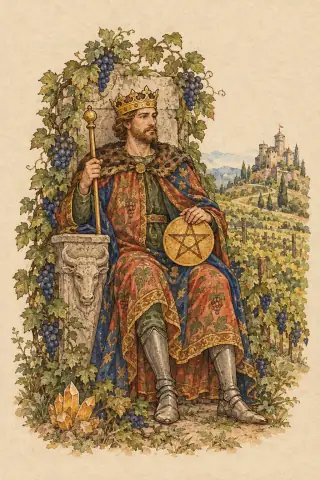
What Does the King of Pentacles Mean?
Arthur Edward Waite described the upright King as representing "valour, realizing intelligence, business and normal intellectual aptitude." He also noted "mathematical gifts" and ultimate "success in these paths." In a reading, this card signifies that you have reached a high level of practical mastery. You possess the required skills to generate wealth and create lasting security. Waite specifically cited mathematical attainments. In modern readings, this translates to balancing budgets, evaluating investments, and running the numbers on any new project before committing resources. You are acting as a provider or a steady hand in a turbulent situation. Younger court cards are still learning their trade. This figure has already built a stable empire. You can rely on proven methods and steady competence to secure your goals. The card confirms your practical efforts are sound. Acknowledging Waite's 1911 text, the emphasis falls heavily on realizing intelligence—the ability to turn abstract ideas into concrete, material reality. You are successfully building something durable.
Waite provided a remarkably harsh list of meanings for the reversed King: "vice, weakness, ugliness, perversity, corruption, peril." In modern readings, these 1911 keywords translate into the darker sides of wealth and material power. When this card appears reversed, it points to financial corruption, greed, or someone using money to exert unhealthy control over others. You might be dealing with a boss or partner who hoards resources, demands unreasonable compliance, or values social status above basic human connection. In your own life, this reversed card warns against becoming overly fixated on material accumulation. You might be compromising your ethics for a simple paycheck. It also highlights a severe lack of practical competence. You could face financial peril brought on by poor management, stubbornness, or sheer laziness. Waite's mention of weakness often manifests as an inability to follow through on basic financial commitments. To correct this energy, you must re-evaluate your relationship with money and authority, ensuring you build your security on honest ground and avoid exploitation completely.
Where Traditions Disagree
- Zodiac attributions for this court card vary among modern tarot practitioners. Some contemporary tarot writers pair this card with Capricorn. However, the most widespread system aligns the King with Taurus. This reasoning relies on a popular modern convention where RWS Kings represent the four fixed zodiac signs (Taurus, Leo, Scorpio, Aquarius) and the Pentacles suit represents the earth signs. Taurus is the only sign that is both fixed and earth. Furthermore, Arthur Edward Waite's own 1911 image description provides physical evidence for this alignment, instructing the reader to note "the bull's head... as a recurrent symbol on the throne."
- Crystal associations for the Minor Arcana lack the precise historical documentation found for the Major Arcana. Aleister Crowley's highly influential 1909 reference work 777 provides explicit stone pairings for the 22 Major Arcana paths, but offers zero documented stone correspondence for individual Minor Arcana court cards. Consequently, pairing this royal figure with a specific gemstone is purely a modern practitioner convention. Many contemporary crystal-and-tarot sites link this card to citrine. This modern pairing makes perfect thematic sense, as contemporary crystal practitioners heavily associate citrine with financial abundance, prosperity, and the exact material mastery depicted in the card.
King of Pentacles in Daily Life
You are three months into dating someone who insists on paying for every expensive dinner but rarely asks about your childhood or feelings. This card highlights a generous, financially stable partner who is emotionally guarded and prefers showing affection through material provision.
You are sitting in an annual review asking for a promotion to senior director. The King indicates you must demonstrate proven, steady competence and a track record of generating revenue. This is a moment for relying on hard data and past successes.
You are reviewing your investment portfolio after a sudden market dip. This court card advises against panic selling. Rely on the conservative, long-term financial strategies you put in place years ago, trusting that steady management yields the best security.
You are managing the estate and legal affairs for an aging parent. The card confirms you are stepping into a necessary role of practical authority. Your family needs your organizational skills, financial literacy, and calm reliability to handle these heavy material responsibilities.
Stone & Sign Correspondence
Citrine. There is no documented historical source linking specific gemstones to Minor Arcana court cards. Aleister Crowley's 777 only mapped stones to the Major Arcana. However, modern crystal practitioners commonly pair this figure with citrine. This is a thematic match based on contemporary crystal lore, where citrine is widely used to attract wealth, business success, and material prosperity—mirroring the King's mastery over money and resources.
Taurus. Many modern tarot readers associate this card with Taurus. This stems from a convention assigning Kings to the fixed zodiac signs and Pentacles to the earth element, leaving Taurus as the fixed-earth overlap. Arthur Edward Waite supported this specific association in his 1911 text by explicitly noting "the bull's head" as a recurrent physical symbol carved directly onto the King's throne in the Pamela Colman Smith artwork.
A Common Misconception
A frequent misreading assumes this is a card of sudden windfalls, lottery wins, or unearned luxury. People frequently see the lush, vine-covered imagery in the Pamela Colman Smith artwork and assume instant riches are on the way. In reality, this card represents wealth achieved through prolonged, deliberate effort. Waite explicitly tied this figure to business and normal intellectual aptitude, meaning practical intelligence applied systematically over time. The King sits on a throne built through sheer competence and discipline. When this card appears, it demands hard work, strict financial discipline, and a thorough understanding of the material world. It offers zero shortcuts to prosperity. It promises that methodical, grounded strategies will eventually produce absolute stability.
King of Pentacles FAQ
- What does the King of Pentacles mean in love?
- In a love reading, this card often represents a partner who is incredibly stable, generous, and focused on providing a comfortable life. This person demonstrates love through tangible actions. They pay bills, fix things around the house, and ensure absolute physical security for their family. However, they can be incredibly slow to open up emotionally or discuss vulnerable feelings. If you are single, this card suggests a developing relationship has genuine long-term potential, provided you value dependability above dramatic romance. The core focus remains on building a shared financial empire and a highly secure household together, prioritizing comfort and safety.
- What does the King reversed mean?
- Reversed, this archetype points to the dark side of material wealth. Waite associated this reversed card with corruption, vice, and peril. In practical terms, this often looks like someone using money to exert absolute control, acting extremely stubbornly, or hoarding resources during times of plenty. It can represent a boss who exploits workers for higher margins, or a partner who believes financial provision excuses deep emotional unavailability. It also serves as a stark warning about poor financial management. You might be facing a severe crisis born from greed, unethical business practices, or a complete lack of practical discipline regarding your savings.
- Is the King a yes or no card?
- Upright, this card is a definitive yes, particularly for questions regarding career advancement, business ventures, or financial security. It confirms that you have the competence and resources to succeed. It serves as a green light for projects built on solid, realistic planning. When reversed, the card becomes a strong no. This negative answer usually stems from poor timing, unethical motivations, or a flawed financial foundation that requires complete repair before you can safely and securely move forward.
- What does the King mean for career or money?
- For career and money, this is one of the most positive cards in the tarot deck. It signifies mastery through extensive experience. You are being recognized for your steady, proven competence. This card rewards proven expertise and serves as a green light for ventures where you have already built real, marketable skills. Expect successful business negotiations, promotions to senior leadership, or the successful maturation of long-term investments. Your financial aptitude and professional reliability are currently your greatest assets.
- How does the King differ from the Emperor?
- While both are powerful authority figures, they govern completely different realms. The Emperor represents structure, rules, law, and overarching societal authority. He commands obedience through discipline and organizational power. The King operates on a more tangible, localized level. He is the master of commerce, physical resources, and sensory comfort. You answer to the Emperor because he makes the laws. You answer to the King because he signs your paychecks and owns the land. His authority is entirely material and financial.
Primary Sources
- A. E. Waite, The Pictorial Key to the Tarot (Rider & Son, 1911). Public-domain divinatory meanings and image description for this court card, Part III. Text as transcribed on Wikisource.
Explore More Tarot
Tarot is a tradition of symbolic interpretation, not a method of prediction. Treat every answer here as a prompt for reflection. Nothing on this page is medical, legal, or financial advice.
Sources & Editorial Basis
Month assignments follow the Jewelers of America birthstone list. Care guidance is checked against the Gemological Institute of America. Everything else here is folklore, astrology and crystal practice. We label each claim as tradition and name the text or the period we traced it to wherever one exists.
“The safest cleaning methods are also the easiest.”